Journalism of Courage
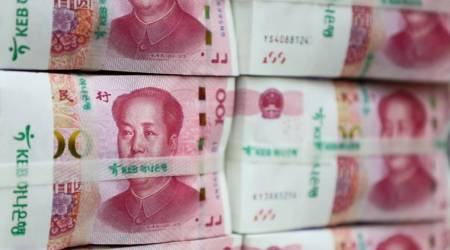
China's gross domestic product (GDP) expanded 3.2 per cent year on year in the second quarter of 2020, the country's National Bureau of Statistics (NBS) said on Thursday.
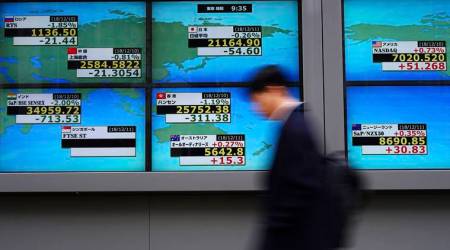
MSCI's broadest index of Asia-Pacific shares outside Japan slid by 0.83%, while Tokyo's Nikkei fell 0.49%. US S&P 500 e-mini stock futures declined by 0.33%.
MSCI's broadest index of Asia-Pacific shares outside Japan was last up 0.14%, after rising over 1% earlier in the session. Chinese shares were deep in red, with the blue-chip CSI300 index off 1% and Hong Kong's Hang Seng index down 0.6%.
Exports rose 0.5% from a year ago, while imports expanded 2.7%. Both had been forecast by economists to fall.
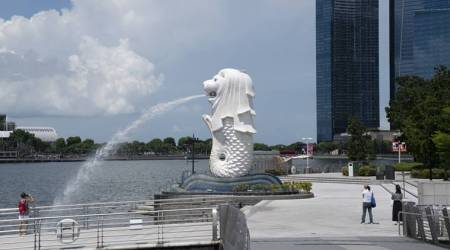
Gross domestic product declined an annualized 41.2 per cent from the previous three months, the Ministry of Trade and Industry said in a statement Tuesday, the biggest quarterly contraction on record
MSCI's broadest index of Asia-Pacific shares outside Japan fell 1.2%. Japan's Nikkei retreated from a one-month high touched on Monday, dropping 0.8%. A firm dollar put pressure on the Aussie and kiwi.
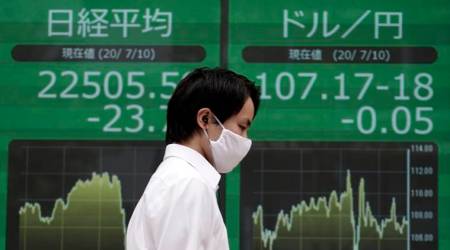
MSCI's broadest index of Asia-Pacific shares outside Japan added 0.15%, having climbed sharply last week on the back of surging Chinese stocks, which added another 1% on Monday.
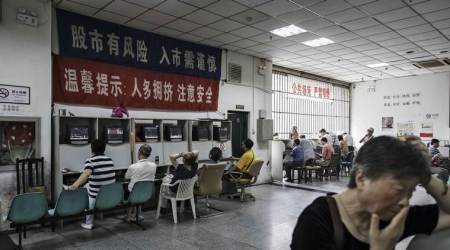
At the close, the Shanghai Composite index was down 1.95% at 3,383.32, while the blue-chip CSI300 index was down 1.81%. The start-up board ChiNext Composite index was higher by 0.754%.
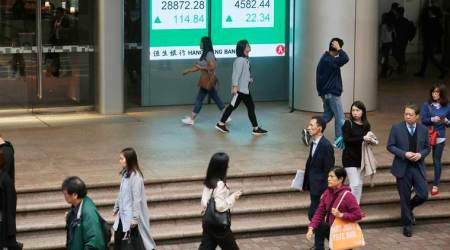
Chinese shares flickered between green and red. Australian shares were down 0.4% as were indexes for New Zealand and South Korea. Japan's Nikkei was off 0.1% and Hong Kong's Hang Seng index was slightly firmer.
MSCI's broadest index of Asia-Pacific shares outside Japan was last down 0.25%, a seemingly inevitable correction after sharp gains of 7% in just five days that took it to a 4-1/2-month high.
MSCI's broadest index of Asia-Pacific shares outside Japan climbed 1% to its highest since February.

“We express our deepest gratitude for the cooperation the US authorities have shown to our request,” the Tokyo District Prosecutors Office said in a statement.
MSCI's broadest index of Asia-Pacific shares outside Japan rose 0.66%, reaching the highest level since late February, while Japan's Nikkei rose 0.40%.
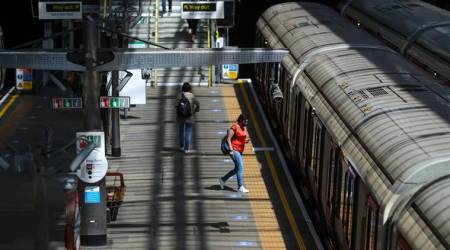
The owner of sandwich and coffee shop chain Upper Crust was the latest business that caters to travelers to announce cuts Wednesday.
MSCI's broadest index of Asia Pacific shares outside of Japan rose 0.9% with all major indexes trading higher on hopes of a vaccine for COVID-19, which has killed more than half a million people globally and shut down the world economy.

Wirecard's implosion came just seven days after EY, its auditor for more than a decade, refused to sign off on the 2019 accounts, forcing out Chief Executive Markus Braun and leading it to admit that $2.1 billion of its cash probably didn't exist.
Chinese blue chips slipped 0.4% and E-Mini futures for the S&P 500 0.2%. EUROSTOXX 50 futures and FTSE futures both dithered either side of flat.

Global leaders are closely watching China to see how long it takes to get back on its feet as they begin to relax their own stringent anti-virus measures and reboot their economies.
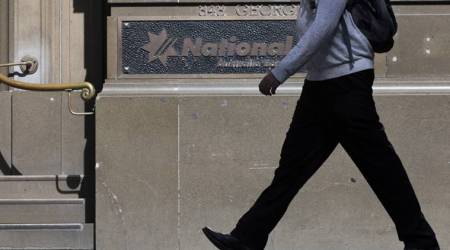
Australian banks, including NAB, have since March provided holiday periods of up to six months to customers on over 772,000 business and home loans, worth over A$234 billion ($159.73 billion), according to industry statistics.
MSCI's broadest index of Asia-Pacific shares outside Japan slid 1.3%. Australian stocks dropped 1.74%, while shares in China fell 0.67%.

The Dow Jones Industrial Average sank more than 1,800 points and the S&P 500 dropped 5.9%, its worst day since mid-March, when stocks had a number of harrowing falls as the virus lockdowns began.
After a slow start, MSCI's broadest index of Asia-Pacific shares outside Japan slipped 1.1%, potentially putting an end to a 10-session winning streak. Japan's Nikkei slid 2.1% as the yen firmed, though Chinese blue chips managed to hold steady.

A related statement from the New York Fed specified that the pace of the increase would be about $80 billion a month for purchases of Treasuries and about $40 billion of mortgage-backed securities.
MSCI's broadest index of Asia-Pacific shares outside Japan, which has galloped 9% higher in June and is 35% above March lows, rose 0.5%. Japan's Nikkei rose 0.3%.
The Department for Work and Pensions said the number of individuals making declarations for Universal Credit benefit claims fell to 96,510 in the week starting May 25, the first time below 100,000 since March. In normal times there are around 55,000 applications a week.


Age, as they say, should never stand in the way of new beginnings. A 70-year-old man from Uttar Pradesh has turned that belief into a living example, and his story has struck a chord online, with the internet cheering him on. At a stage of life when many choose to slow down, Vinod Kumar Sharma chose to pick up a smartphone and press record.