Journalism of Courage
 5 min read



It has been reported that Dhoni offered Harbhajan the last over. Harbhajan averred. He was not confident of the pitch of his offspin yorkers. Sharma bowled and the rest is now embedded in the annals of cricketing lore.
This cameo interpreted to suit my purpose contains messages for our political leadership. It shows what sound leadership can achieve. Here8217;s a youthful captain on the horns of a dilemma. He approaches arguably his most experienced bowler. The bowler admits his shortcoming and by doing so foregoes the opportunity for individual glory. He does so, I will presume, in the interest of the team. The buck passes to the captain. He has to take the ultimate decision. Should he persist with experience or should he risk the unexpected? He knows that the latter if unsuccessful would trigger endless commentary and 8220;what ifs8221;. He accepts the risk but then shares in the burden placed on Sharma.
The cameo is a metaphor for risk-taking and innovation. It is a metaphor for what collective spirit and conviction can achieve. It is a metaphor that is worth stretching to communicate a point to our politicians.
I have been writing a column on mainly energy related issues for several years. I was recently going through some of my older pieces and I was struck by how little has changed over the past decade or so. The issues that I wrote about then are more or less the issues of importance today. Security of energy supply was a priority a decade back. It remains on the agenda today. The decline in the production of oil/gas from our aging fields like Bombay High was a concern then; it continues to be a concern today. The debate on market pricing versus administered pricing for petroleum products like diesel and petrol was much written about. It is today an unresolved issue. Everyone talked about the inefficiencies inherent in the subsidy structure for LPG and kerosene. They continue to talk about it today. The relationship between the government and the public sector petroleum companies was the reason for operational inefficiency and was slated for review. The public sector remains shackled to the bureaucracy and operational excellence is still no more than a byword for conferences.
Much has in fact been initiated over the past decade. But the rhetoric of change has been much louder than the reality of change. The energy sector is not exceptional. The same can probably be said for almost every area of activity in which the government has a dominant say.
Our economy has moved onto a higher trajectory; our business elite are the toast of Davos and New York, and the Sensex is hitting record levels. These are not insubstantive developments. However, they do not disguise the continuing reality of endemic poverty, Naxalism, social injustice, slipshod governance and abysmal infrastructure.
Conventional wisdom tells us that the price of democracy is incrementalism. We must not expect radical change. The gap between the rhetoric of ten years back and the reality of today in the energy sector exists not because the decision-makers do not know what to do. They know it better than any one else. The gap exists because they believe it cannot be bridged without committing political harakiri. They believe that the electorate would punish them if they raised the price of diesel and gasoline even though by not doing so they know they will bankrupt their Navratna companies. They believe that there would be a dharna if the subsidies on LPG were reduced even though they know that the underprivileged do not benefit from these subsidies. In short, conventional wisdom has it that the voter is a gullible hedonist who cannot see beyond his immediate needs.
The metaphor of Dhoni8217;s last over suggests that this might no longer be the case. It suggests that the voter in the shape of the youthful, vernacular citizen is not so gullible. He sees the consequences of populism. He challenges the notion of incrementalism and wants a leader prepared to innovate and take risks.
I am stretching a point. But I do so deliberately. For while India is the destination of choice today, it will not remain so if our leaders continue to be limited by orthodoxy and cliche. I suspect Dravid would not have taken the risk of allowing a rookie to send down the last 6 balls. He is a seasoned practitioner and all too familiar with the consequences of failure. He would have followed convention and by doing so he would no doubt have minimised the risks. But I suspect he would also have reduced the probability of a dramatic victory.
A few days hence Dhoni may find himself at the receiving end of a reinvigorated Australian Eleven. But, the essential message of our South African triumph must not be lost. The youth are impatient of underperformance. And of explanations that justify such underperformance. The leaders must break out of their conventional straightjacket and countenance 8220;radical8221; next steps.
The writer is chairman of the Shell group of companies in India. Views are personal.

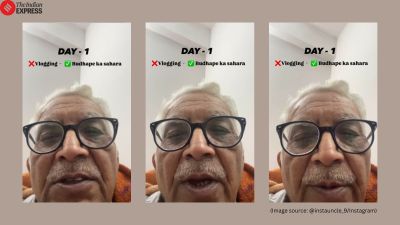
Age, as they say, should never stand in the way of new beginnings. A 70-year-old man from Uttar Pradesh has turned that belief into a living example, and his story has struck a chord online, with the internet cheering him on. At a stage of life when many choose to slow down, Vinod Kumar Sharma chose to pick up a smartphone and press record.