Journalism of Courage
 7 min read



Death on duty
Indian Oil Corporation sales manager Manjunath Shanmugam was murdered on November 19, 2005, for exposing an adulterated fuel racket in Lakhimpur Kheri in Uttar Pradesh.
The sheer unfairness of the act got different people coming together in the months that followed to ensure the intrepid executive got justice.
Last year the IIM alumni8212;Manjunath was a graduate of IIM-Lucknow8212;founded the Manjunath Shanmugam Trust. It initiated the Justice for Manjunath campaign and monitored the case closely. Manjunath8217;s batchmates as well as other alumni of IIT-Kanpur and IIM-Lucknow attended the hearing regularly. The investigating officer and the lawyers too worked conscientiously to nail the accused.
The result: On March 23, 2007, the court convicted all eight accused and three days later judge S M A Abidi read out the punishment: death for the son of the petrol pump owner and main accused Monu Mittal and life terms for his seven associates.
Text: Sanjay Singh
The Initiators
Manjunath Shanmugam Trust
WHEN H Jaishankar started monitoring the Manjunath case, he and his fellow supporters had little knowledge of legal matters. 8220;Without really knowing the difference between an FIR and a chargesheet, we embarked on our mission to ensure justice for Manjunath,8221; says Jaishankar.
But what they did know was that this was dangerous territory. 8220;We visited Lakhimpur Kheri in the third week of April 2006. It was a shock to see the large number of gun shops there,8221; remembers Jaishankar, a 1991 graduate of IIM-Bangalore. Jaishankar who has worked with ANZ Grindlays, Citibank and most recently with Deutsche Bank, now heads the treasury training and consulting division at Catalyst Consulting.
He was not the only one incensed at Manjunath8217;s murder. 8220;All the e-group members of IIM were angry over the murder. We thought we had to do something for justice and we decided to pursue it. Our strength was that we could together do something. Then a discussion took place among the e-group members of IIM. All agreed and the Manjunath Shanmugam Trust came into being,8221; he adds.
Once the Trust was formed, Jaishankar, along with his other team members, met Supreme Court lawyer Kamini Jaiswal in Delhi and requested her to recommend a lawyer. 8220;Kamini spoke to many people in Lucknow and introduced us to lawyer I B Singh,8221; he says. Singh agreed to take up the case. Then they met Sharat Mesram, the GM of IOC in Lucknow.
Finally, the Trust members came to Lakhimpur and talked to the district government counsel Chandra Mohan Singh. 8220;We told him about our meeting with I B Singh. He accepted our proposal to take the help of Singh for the speedy trial of the case,8221; says Jaishankar.
Over the past 16 months, Jaishanker and his team colleagues, made frequent trips to Lakhimpur to oversee the progress in the case. He tried to attend every hearing. 8220;We are outsiders but we got total support in Lucknow and Lakhimpur. Our task was simple8212;ensure speedy trial in the case and we had faith in our judicial system,8221; he says.Last week, the Trust8217;s faith stood vindicated.
The Legal Eye
IB SINGH, lawyer
IB SINGH virtually led the legal team that fought Manjunath8217;s case during the trial. Having spent sleepless nights poring over legal points, Singh visited Lakhimpur Kheri to assist the prosecution for almost every hearing and also argued the case in court. 8220;It was not easy for us to handle the Manjunath case,8221; says 55-year-old Singh, who has 31 years of legal practice behind him. 8220;After thoroughly studying the case, I realised the need for documents from the IOC that could substantiate the motive of the crime. My colleagues, District Government Counsel Chandra Mohan Singh and ADGC Kaushal, were very cooperative. We worked like a team to get justice,8221; he says.
Singh has worked on several high-profile litigation previously. He represented the SSP, DIG and DM of Faizabad in the Ayodhya demolition case before the Liberhans Commission and also was counsel for Sanjay Singh and Amita Modi in the Syed Modi murder case.
However, for Singh, the Manjunath trial meant much more than any other case. 8220;I derive professional satisfaction whenever I handle such cases,8221; he says.
The last he felt similarly satisfied was in 1994 when he got 40 women prisoners, all between 16 and 26, released from jails across Uttar Pradesh.
The Investigator
P K SHUKLA, investigating officer
FOR investigating officer P K Shukla, the case was particularly challenging because it hinged on circumstantial evidence8212;the body was discovered at a location other than the place of crime. But Shukla, the station house officer of Gola Gokarn police station, was determined to piece together the evidence.
8220;It involved multi-tasking8212;to arrest the accused, search for field evidence and then to sit and write the case diary. You are supposed to maintain your record properly,8221; says Shukla. An MSc Maths from Lucknow University, Shukla joined the police in 1998 as a sub-inspector. In 2001 he became inspector after being given an out-of turn promotion.
Working on the Manjunath case, Shukla gave it his best. He formed a team of four officers of SI rank and got cracking. 8220;Our top priority was to arrest the accused at the earliest and collect evidence,8221; he adds.
The next challenge was to link the evidence at the spot where the crime took place and the site where the body was found. The body was recovered from an area under the Maholi police station and the police thus became the complainant in the case.
8220;We did not have any eyewitness and evidence was difficult to find,8221; he says. 8220;We could submit the chargesheet in time only because we were able to arrest all the accused within a week.8221;
The next task was to select the prosecution witnesses. Fortunately, unlike in numerous other cases, the witnesses didn8217;t turn hostile. But such a quick and uninterrupted investigation, Shukla says, would not have been possible without the support of senior officials like then SP Zaki Ahmed.
8220;Manjunath was not a resident of Lakhimpur. So, I thought it had to be the police and the law that got him justice,8221; he says.They did.
The counsel
Chandra Mohan Singh, district government counsel
FOR District Government Counsel Chandra Mohan Singh, arguing this case at a district court was not easy. 8220;The Manjunath case was not based on direct evidence and I was supposed to present the evidence in an effective manner before the court. The most difficult task was to select the prosecution witness. So I examined every aspect of the case and worked out a strategy with the help of I B Singh,8221; says Singh.
During the trial, the government counsel had to ask for adjournment only twice and that too because of external factors. 8220;Due to local body elections in the state on those two occasions, we were unable to present policemen as our prosecution witnesses,8221; he says.
He feels he has done meticulous work that should stand the prosecution in good stead should the verdict be appealed in a higher court.
8220;We did our best to strengthen the very foundation of the case at the district-court level. I don8217;t think there will be any problem in higher courts,8221; he says. 8220;I am happy with my role. The result is now before you,8221; he adds.
His happiest moment after the verdict: A call from Manjunath8217;s father.

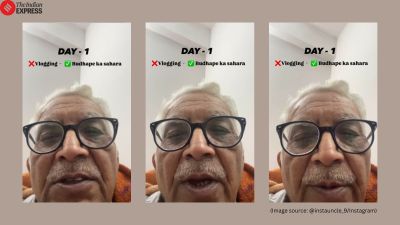
Age, as they say, should never stand in the way of new beginnings. A 70-year-old man from Uttar Pradesh has turned that belief into a living example, and his story has struck a chord online, with the internet cheering him on. At a stage of life when many choose to slow down, Vinod Kumar Sharma chose to pick up a smartphone and press record.