Journalism of Courage
 6 min read



Once again the concept of Indianness is in danger. Raj Thackeray, small fry in Maharashtra politics, has threatened Biharis living in Maharashtra. This is exactly what Balasaheb Thackeray has been doing for the last 40 years to promote his brand of politics: 8220;Maharashtra for Maharashtrians8221;. Once upon a time the target of this hatred were the South Indians, later the focus was on UP-ites, and the latest target are Biharis. During the formation of the state of Maharashtra, a similar divide was created between Maharashtrians and Gujaratis. Earlier it was the senior Thackeray, now it8217;s his nephew who is positioning himself as the new face of Marathi chauvinism.
The fact of the matter is that in the last four decades South Indians have not left Mumbai nor have UP-ites gone back to Jaunpur. Similarly, nobody can force Biharis to go back to their place of origin because there is a constitutional guarantee in our country, whereby every citizen is allowed to stay and earn his livelihood in any part of India. It is the law of the land that allows Biharis to live in Mumbai; Marwaris have nursed Calcutta for decades, Bengalis are living as local inhabitants in Bihar, Maharashtrians in Madhya Pradesh and South Indians in Delhi. This trend has been going on for centuries.
Economic compulsions have created a new class of 8216;migrants8217;. They are found all over the country with no common language or birthplace, with different customs and traditions and in different professions. These migrants are uprooted from their place of origin and are regarded as 8216;outsiders8217; in the cities they have chosen to earn their livelihood. Is the political class in our country ready to address the fact that in this federal structure, Indians are being branded as outsiders in their own country? The government has been busy for the last several years wooing 20 million NRIs by celebrating the 8216;Pravasi Divas8217; every year and providing them innumerable facilities. Yet, nobody listens to the woes of the migrant class in the country. This class cuts across different communities 8212; Gujaratis, Marwaris, Punjabis, South Indians, North Indians and of course Maharashtrians 8212; but all of them have a common plight: Animosity directed at them by the local populace.
There are 45 lakh North Indian migrants in Mumbai and 3 crore Bihari migrants living outside Bihar globally. I am one of them. I am despised as a 8220;bhaiyya8221; in Mumbai and 8220;harry8221; in Delhi. Bengalis are called 8220;bongs8221; in Delhi and Tamilians are 8220;tambrahm8221; in Delhi. Marathis are called 8220;kadhibhaat8221; in the Malwa region of Madhya Pradesh. South Indians are dubbed 8220;annas8221; in Mumbai and Keralites are called 8220;mallus8221; with the same contempt. Is this not chauvinism? ULFA in Assam gave an ultimatum to Bihari migrants to leave 8216;their8217; homeland. In the name of Son of Soil politics, Thackeray8217;s nephew threatens all Biharis living in Mumbai. Is this not a chauvinist remark against a linguistic community? In this TRP-driven TV market era, one actress from our country was subjected to racist taunts by a small-time British actress in a British TV show; the whole world was up in arms and the government of India activated the diplomatic mission in UK to register its official protest. It was a commendable effort in the interest of the nation. My anguish is, why was the anti-Bihari statement of Thackeray8217;s nephew condemned only by Lalu Prasad Yadav, Nitish Kumar and myself and few other Bihari leaders despite the fact that such statements are a threat to our national integration? Is it an issue pertaining only to Biharis?
People accuse me of politicking on this issue. But the fact is that I am deeply concerned about the national perspective and especially so, as a migrant. The victims of this sense of insecurity are spread all over the country. If this scenario continues, what will happen to the federal structure of the country? Don8217;t we need to open our eyes and have a national debate on the plight of migrants in our country?
I don8217;t know if we should leave the migrant issue to the respective state governments or enact a new federal law. There are 60 Lok Sabha constituencies where migrants are a deciding factor. There are over a hundred cities besides the main metropolitan centres where migrants are settled on a large scale. For example, Pune, Nasik, Nagpur, Ahmedabad, Surat, Baroda, Raipur, Bhopal, Gwalior, Mathura, Banaras, Coimbatore, Hyderabad, Ludhiana, Jallandhar, Chandigarh and many more. Interestingly, thousands of Kashmiri migrants are settled in Goa.
These migrants are not a burden. On the contrary, they contribute to the economic growth of the place they settle in. In Mumbai, 48 daily essential services are provided by the North Indian migrants. Ninety per cent of the restaurants in Mumbai are run by South Indians. The diamond market and the stock exchange is dominated by Gujaratis. Punjab has been the flag bearer of the green revolution and today most of the workers in the farmlands are from Bihar. Recently I visited Mundra, a huge private port in Kutch where all the daily wage labourers are from Bihar and Eastern UP. Centuries ago people from the Kutch region migrated to places all over the world in search of livelihood and today the Biharis and Eastern UP-ites are filling up the lack of labourers in the Kutch region. Do the Kutchis hate the migrants? They don8217;t. The nursing profession all over the country is dominated by Keralites. In Bihar the trading sector is controlled by Marwaris. In Calcutta all the rickshaw pullers are from Bihar or Eastern UP.
Migration is need based and that is on account of mutual compulsions. Let us recognise this new migrant class as a part of our social system and national structure. Else, it will fracture the social fabric in the times ahead.
The writer is spokesperson for Maharashtra Pradesh Congress Committee

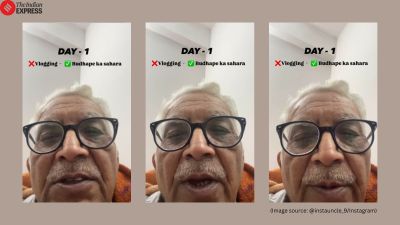
Age, as they say, should never stand in the way of new beginnings. A 70-year-old man from Uttar Pradesh has turned that belief into a living example, and his story has struck a chord online, with the internet cheering him on. At a stage of life when many choose to slow down, Vinod Kumar Sharma chose to pick up a smartphone and press record.