Journalism of Courage
 4 min read



Although Pakistan8217;s President Pervez Musharraf refused to read the writing on the wall, the vice around him had been tightening for days.
Musharraf might have survived the collapse of the consequential deal with the PPP that had set the stage for a return to civilian rule last year, or fought back in the style of a commando he had been, if he had secured the support of at least one of the three A8217;s holding up Pakistan8217;s power structure.
The first of the proverbial three A8217;s is of course the Pak Army.
Once Musharraf shed his uniform and became a civilian president, the real source of power drained away to his successor. It was Ashfaq Kiyani who now represented the corporate interests of the army. Like so many of his predecessors who threw out their benefactors, Kiyani was not going to put Musharraf8217;s interests above those of the army.
America, which has shaped Pakistan8217;s destiny over the last six decades, has been Musharraf8217;s strongest external supporter since September 11, 2001. Having facilitated the deal between the late Benazir Bhutto and Musharraf, encouraged him to step down as army chief, and pressed him to hold free and fair elections, Bush felt he had an obligation to back Musharraf8217;s attempts to stay in power.
In the last few days, however, the White House would not take Musharraf8217;s desperate phone calls.
If there were any doubts about a definitive change in the US policy, they were cleared by the US Secretary of State, Condoleezza Rice, who stated over the weekend that Washington had no plans to offer political asylum to Musharraf. For Washington, Musharraf8217;s 8216;use-by date8217; had expired.
Since 9/11, Washington8217;s priority has always been the war on terror in the borderlands between Pakistan and Afghanistan. In recent weeks, the Bush Administration had come to the conclusion that Musharraf was a distraction in the effort to get Pakistan8217;s government to focus on the war on terror.
We might take the third 8216;A8217; in Pakistan8217;s political life as 8216;Arabia8217; 8212; a shorthand for the growing political clout of Saudi Arabia in resolving Pakistan8217;s internal political disputes.
Whether it was in managing the end-game in Kargil in July 1999, getting Musharraf to release Nawaz Sharif from prison and giving him shelter in Jeddah, whisking away Sharif when he tried to land in Islamabad last September, or helping him get back into Pakistan, the Saudis had played a key role.
Last Friday, the Saudi intelligence chief, Prince Muqrin bin Abdul Aziz dashed to Islamabad to make sure there was an amicable settlement and that 8220;no one becomes a laughing stock8221;.
Like most of his predecessors, Musharraf rode in as Pakistan8217;s saviour and left it in greater troubles than he found it. As multiple crises haunt Pakistan, none is more important than squaring American pressures for a purposeful campaign against the Taliban and the al Qaeda with the declining support for the war on terror inside Pakistan.
New Delhi8217;s problems with Pakistan, including the resurgence of separatism in J038;K, are likely to remain a side show in comparison to the unprecedented challenges that Islamabad faces on its western frontiers.
8220;Extremism bahut extreme ho gaya hai 8230; Hum se koi darta hi nahin .8221;
8226;On announcing the state of emergency, November 3, 2007
8220;This army is my life. This army is my passion. I have given this army my love8230;8221;
8226;On resigning from the army after 46 years on November 28, 2007
8220;For standing up outside the car, I think it was she to blame alone. Nobody else. Responsibility is hers.8221;
8226;On Benazir Bhutto8217;s assassination, January 6, 2008
8220;What do the Indians want?8230; It is very important that while the entire world is talking about this horrible terrorist attack, our neighbouring country instead of talking peace and cooperation, was trying hard to harm Pakistan and defame Islam8230; I would like to tell India 8216;Lay Off8217;8221;.
8226;In his 9/11 speech on TV, September 19, 2001
The writer is professor at S. Rajaratnam School of International Studies, Nanyang Technological University, Singapore

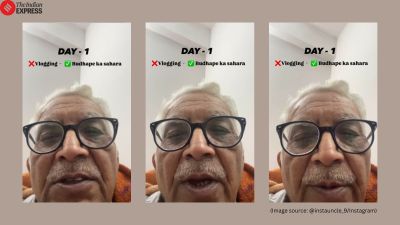
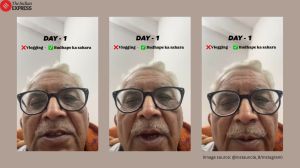
Age, as they say, should never stand in the way of new beginnings. A 70-year-old man from Uttar Pradesh has turned that belief into a living example, and his story has struck a chord online, with the internet cheering him on. At a stage of life when many choose to slow down, Vinod Kumar Sharma chose to pick up a smartphone and press record.