Journalism of Courage
 6 min read



The most corrosive crisis a society faces is often not manifested as a dramatic political episode. It rather reveals itself in periodic outbreaks of senseless violence or grim reminders of a society losing its moral compass. Just the random perusal of news for a couple of days, rioting in Agra, violence in Dohna, inhumane torture of a petty offender in Bhagalpur, road rage, a child dead because of petty street clashes, increasing crime, the sordid goings-on in a Delhi school, were all reminders of just how fragile social order can be. Given the dramatic character of political violence in India 8212; terrorism, Naxalism, communalism 8212; should we really worry about outbursts of violence that traffic accidents occasion? And in each instance don8217;t we have a ready structural explanation for violence, a master narrative that explains it all? When the state has no outlet for legitimate grievances, violence will erupt. The surprise is not that we often have senseless violence without an object; the surprise is that we don8217;t have more of it.
After the now already forgotten Nithari, can any news of an insidious sickness creeping on Indian society really surprise us? But we focus on side issues: the morality of sting operations, the failures of the state, but side-step the fundamental question: why is India becoming a society with a reputation of preying on its own children in the most appalling ways one can imagine? There is an unspoken dread enveloping urban India: a new freedom producing new vulnerability, a new sophistication accompanied by a loss of innocence, a new sense of aspiration accompanied by a greater sense of danger.
Different types of violence have their own psychology and sociology. But there is a thread that connects seemingly disparate forms of violence that lurk under the surface of our existence. The first is our attitudes to them. The minute we encounter such violence a kind of containment strategy sets in. We control the meaning of these events, by explaining them in terms of some master narrative: the omissions of the state, the inherited inequalities of society or the depravations of tradition. There is some truth to these attributions. But the ease and frequency with which these are invoked suggests not so much a diagnosis but an avoidance strategy. We oscillate between thinking that this is a violence that always happens elsewhere on the one hand, and it is over-determined and inevitable on the other. Either way this violence becomes something that does not demand our intervention.
The second thing this violence draws our attention to is just how attenuated our conceptions of social order have become. Societies are complex entities, held together not so much by a state but by an amalgam of attributes: mores, traditions, sensibilities, sympathies, taboos, reciprocities, even an aesthetic. In a society that is rapidly changing, these are all coming under immense stress. Violent crime is a topic of great discussion. But the sum total of public discourse on this focuses on three lines of inquiry: lament for an age when the lower classes were supposedly more obedient than violent, poor law enforcement by the state, or a generalised explosion of greed. Indian cities have had, by comparative standards, relatively lower rates of crime. The reasons for this are not entirely clear. Was it the spatial layout of Indian cities? Was it the relatively intact authority of the family? Was it the relative lack of conspicuous consumption? Was it a certain civic culture that gave cities a distinctive hue? Or was it a form of living that made our outlook on life less edgy?
In libidinal matters we are, across small towns, becoming a society moving from a society premised on secrecy, repression and control to a society where knowledge, publicity and individual experimentation are going to increase. But will this new age of freedom and access, of knowledge and individuality simply produce a culture of selfishness, crudeness and fatuity or a culture of integrity, sophistication and discrimination? The pathologies of social convention cannot be a defence of the pathologies of freedom. If the traditional moral anchors for relationships are not tenable, what will be the new foundations for those relationships? Will these changes combine with a cult of instrumentalism to always make Eros a dangerous and poisoned chalice?
It is fatuous to assume that the state can be rationalised and made powerful enough to protect us from the depredations that large-scale social transformation might bring. The reason these acts of violence are significant is that they are early warnings of many things: of the increasing alienation of urban existence, of the fact that without stronger moral barriers the line between pathology and liberation can be very thin, of unchanelled rage that does not quite know how to articulate itself, and that creates the possibility of violence waiting to be mobilised. A little bit more pressure, an economic downturn or even greater increases in inequality, could snap the fragile sense of self that makes cities hold on. We rightly take solace in the fact that India has been resilient, in the face of terrorist violence, material deprivation. But this faith in resilience is also a form of avoidance: it prevents us from asking what the great transformation of our times means for social relationships and a sense of the self.
The focus on the state and economy is crucial. But they seldom on their own determine what the security or character of life and self is going to be like in any society. Despite the explosion of aspirations, and feverish activity, will we escape the charge that Muktibodh levelled against urbanising India decades ago: that it was a font of meaninglessness, disguised by divertissements? It would be premature to engage in pessimism. But the striking absence of self-reflection on emerging pathologies in society should worry us. Broken states can be fixed through collective action, economies can be energised through policy, but sick societies are harder to cure.
The writer is president, Centre for Policy Research, New Delhi

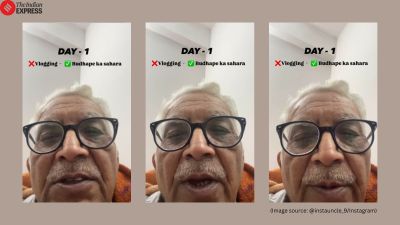
Age, as they say, should never stand in the way of new beginnings. A 70-year-old man from Uttar Pradesh has turned that belief into a living example, and his story has struck a chord online, with the internet cheering him on. At a stage of life when many choose to slow down, Vinod Kumar Sharma chose to pick up a smartphone and press record.