Journalism of Courage
 2 min read



Abroad he has a reputation as a tireless peacemaker; at home in Israel he is a byword for political failure. When Yossi Beilin announced his decision to step down as head of the left-liberal Meretz party at its next leadership election in the spring, there were palpable sighs of relief not just from his rivals but also from his friends, who hope that he still has a chance to be remembered for his bold statesmanship instead of his defective leadership.
Mr Beilin was one of the first mainstream Israeli politicians to push for what most Israelis now accept: the need to give the Palestinians an independent state. And it was largely thanks to him that serious peace talks first got going. In the early 1990s, when Israel was talking to local Palestinian leaders in an attempt to circumvent the exiled Yasser Arafat and his Palestine Liberation Organisation in Tunis, Mr Beilin argued as a youthful deputy foreign minister that without Arafat, whom most Israelis dismissed as an incorrigible terrorist, peace talks would be worthless. With the backing of Shimon Peres, he encouraged the secret meetings in Oslo between an Arafat aide and two Israeli peace activists that led eventually to the famous handshake between Arafat and Yitzhak Rabin on the White House lawn8230;
Lately Mr Beilin has courted unpopularity by speaking reluctantly of the need for Israel to do business, through a third party, with the rejectionists of Hamas now that they have deposed Arafat8217;s old Fatah movement and control the Gaza Strip. His daring has long hurt his political career. When Palestinian suicide-bombings disheartened Israel8217;s peace camp he lost his relevance to Labour, left to head Meretz, and ran it into the ground. His own defence, that other parties had appropriated Meretz8217;s peace agenda, is only partly true; he neglected its other core issues such as social justice and civil rights. An allegedly dictatorial management style did not help8230;
Mr Beilin has been perhaps Israel8217;s boldest peacenik. He will be missed, if his departure from the arena is permanent.
Excerpted from the December 22 issue of 8216;The Economist8217;

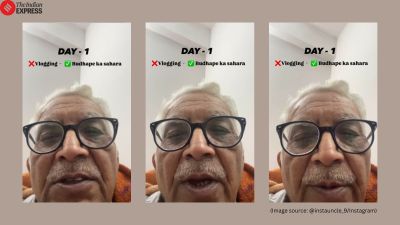
Age, as they say, should never stand in the way of new beginnings. A 70-year-old man from Uttar Pradesh has turned that belief into a living example, and his story has struck a chord online, with the internet cheering him on. At a stage of life when many choose to slow down, Vinod Kumar Sharma chose to pick up a smartphone and press record.