Journalism of Courage
 5 min read



Bombay, like any great city, is all things to all people. It is a city of timeless beauty coexisting with modern ugliness, of unshakeable decency amidst unflinching cruelty, of genteel charm jostling with crass wealth; a cultural Petri dish that begat an economic powerhouse.
Of its many avatars one received most attention following last week8217;s unforgiveable attacks 8212; its status as the financial hub of India8217;s economic miracle. This raised questions about the attack8217;s effect on business and investment. Might foreign businesses shy away for fear of being attacked? Would investors avoid new ventures in an insecure and violent environment?
Globally, political violence raises political risk: it deters transnational investment, owing largely to the increased riskiness of a business environment in which the destruction of physical and human capital is a constant concern. A 2006 Harvard study covering 186 countries found that, on average, a single standard deviation increase in a country8217;s terrorist risk rating can lead to as much as a 5 per cent drop in that country8217;s foreign direct investment. For the average developing country, that amounts to millions of unrealised dollars that might have been used to alleviate poverty and induce economic growth.
Yet, I would argue, investors did not stay away after the 1993 Bombay bomb blasts; they did not stay away after 20068217;s train bombings; and they will not stay away now 8212; at least, not yet. The potential rewards from investing in India remain too great to ignore. Consider as parallel examples the experiences of Israel, where FDI is high and continues to increase, even as that democratic state battles a threatening security environment; and of Indonesia, to which destination investment continues to flow in spite of well-publicised challenges by domestic militants.
Does this mean that there is no reason to worry about the economic effects of terrorism in India? Hardly. India faces critical choices today that will determine whether it continues to foster investment rather than descend into a pit of persistent violence that deters productive economic activity, and makes it an unattractive destination for investment. Answers to four questions hold the key to avoiding such a poverty-conflict trap, from which it is difficult to emerge.
First, how do we respond to Pakistan? In the past week, tensions have risen again. Desiring revenge is only human, but we ignore the dangers of such sabre-rattling at our own peril. Far, far more damaging to India8217;s economy than an isolated terrorist attack, however painful, would be another confrontation with Pakistan. Its consequence would be to plunge India into an extended period of increased insecurity, forcing potential investors to reconsider the best setting for their business.
Second, how do we create a sense of security about future attacks? Without taking anything away from the armed forces that bravely battled the terrorists last week, these attacks made clear the state8217;s lack of preparedness to tackle modern terrorism. The shoddy state of our transportation and utility infrastructure makes the Indian economy extremely vulnerable to an attack on its roads, railways, harbours, airports, electricity grids, dams and so on. A terrorism policy for the 21st century must take seriously the immense task of securing these vital assets on which hundreds of millions of Indians depend daily. Yet, success in such an endeavour can only be achieved if we are willing to take drastic steps to reform an antiquated bureaucracy that is woefully ill-equipped to handle the reins of an aspiring superpower.
Third, how do we reform a society in which human life is cheap? November 26 attacks are just the tip of the iceberg of an extremely violent society. Across India, insurgent groups brazenly challenge the state8217;s legitimate monopoly on violence. Citizen kills citizen because of caste, religion, language, and region; women and children are violated by those who should be their protectors; farmers are destroyed by crushing debt; and millions of untold others live out their lives in quiet desperation with little hope that they might ever lead lives they have reason to value. Such societies can easily foster further violence: in such a Hobbesian state of nature, economic expansion is difficult to envision for outsiders. A fundamental challenge therefore is to re-establish the basis of our community, a monumental task in a society as diverse as ours but one that is vital to our future.
Finally, how do we fight those who would do us harm while remaining open to new ideas, investment, and people from around the world? Simple! We do so by remaining open to new ideas and new people, resisting the twin temptations of putting up fortress-like walls and expelling from within those we deem to be different. For generations, people have flocked to Bombay because of its willingness to adopt anyone who wishes to make a new life there. This constant influx of talent fuels Bombay8217;s entrepreneurial spirit and provides the energy that makes it India8217;s economic engine. But when outsiders no longer feel welcome, when a first-time visitor can no longer arrive at the Gateway of India and instantly feel at home, then Bombay will be lost and, with it, investment in India and its dreams for its future.
The writer is professor of political science at Ohio State University and the author of the forthcoming 8216;The Political Economy of Development8217;
expressexpressindia.com

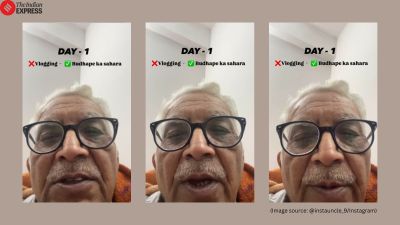
Age, as they say, should never stand in the way of new beginnings. A 70-year-old man from Uttar Pradesh has turned that belief into a living example, and his story has struck a chord online, with the internet cheering him on. At a stage of life when many choose to slow down, Vinod Kumar Sharma chose to pick up a smartphone and press record.