Journalism of Courage
 7 min read



It is worth reminding ourselves, on this day particularly, that we come no closer to understanding the significance of 9/11, at home and abroad, if we use the memory of what happened that morning falsely and vainly. It seemed as if two great tides emanated in response to the tragedy of that Tuesday. One was a sense of generosity, a deep compassion that expressed itself in immediate acts of cooperation and support. The other was a sense of patriotism, a strong consciousness of our American identity. When those two tides overlapped, as they often did in the months after 9/11, the result was impressive and profoundly moving. But we have also seen, in the past two years, a regrettable narrowing of our idea of patriotism. It has become, for some people in some ways, a more brittle expression of national sentiment 8212; a blind statement of faith that does more to divide Americans from one another than to join them together.
We need to fear and temper that kind of rigidity. It is not the least bit unpatriotic to question some of the arguments that led to war in Iraq. No national purpose is served by losing our sense of political and historical discrimination in an upwelling of patriotic fervor. Much as it may seem logical that the horror of the morning of Sept. 11, 2001, is inextricably linked to the other terrorist horrors around the world, the fact is that the connections are not all clear. The final answers must be as the evidence 8212; not political will 8212; determines8230; Those buildings did not fall or their occupants die to become symbols in an incoherent argument.
The New York Times
Two years of lost opportunities
The goodwill of many of America8217;s allies has been squandered. The threat represented by the terrible attacks of two years ago remains. The response they called for was not confined to firm action against the perpetrators. As well, and even more important, it required the much more difficult diplomatic effort to remove the cause of terrorism by persuading the nations of the Muslim world 8212; where terrorism is spawned 8212; that their interests lie in co-operation, not conflict, with the West. That, in the end, is what the war on terrorism means.
The Sydney Morning Herald
A bad situation made worse
On September 11 2001, the Bush administration was confronted by the greatest, existential challenge to its power and authority that any US government has faced since Pearl Harbor or, perhaps, in the entire post-civil war history of the republic. The nature and manner of its response, as we said at the time, would be critical. Two years on, it must be judged, regrettably, to have failed that test. There have been successes. But overall, George Bush has made a bad situation worse. How is such a verdict reached? Opinion polls are one guide. Surveys suggest that two-thirds of New Yorkers, for example, feel less secure today than a year ago. All polls agree that Americans8217; confidence in Mr Bush8217;s 8216;8216;war on terror8217;8217; is falling steadily. In western Europe, it is all but non-existent. Mr Bush told the nation last Sunday that 8216;8216;great progress8217;8217; has been made, with over half of al-Qaida8217;s 8216;8216;known leaders8217;8217; captured or killed. But he could not disguise the fact that in Afghanistan, where the US fightback began, the Taliban and the terrorists are now resurgent.
The Guardian, London
How the West is winning
September 11 acted as a wake-up call for a country where security was far too lax, despite a previous attack on the World Trade Centre and the carnage wrought by the Oklahoma City bombing in 1995. It galvanised America and its allies into strengthening anti-terrorist laws, and using them to arrest suspects, ban radical groups and curb their ability to raise money. The fact that no Western country has suffered a major terrorist attack for the past two years points to the effectiveness of this campaign. The effete enemy has not been engulfed in a sea of righteous fire. Instead, it has forced Islamic radicals on to the defensive.
The Daily Telegraph, London
Will the real terrorist please stand up?
We are of the opinion that those responsible for the bloodbath should be brought to justice. Indonesia has also suffered from acts of terrorism8230; However, we are also of the opinion that in fighting terrorism, the roots 8212; not just the symptoms 8212; must first be identified if we want to find an effective medicine for the disease8230;
Those who do not like the US now jeer, 8216;8216;Who is the real terrorist?8217;8217; The US alone will not be able to eradicate terrorism. It must work hand in hand with other nations around the globe to combat this global scourge. But how can the US persuade other nations to join its antiterrorism drive when they can so easily put a finger on US arbitrary actions? It seems that, for the present at least, the Bush administration has its hands so full with fighting its own battles against its enemies that it has no time to reflect on the fact that other nations also have a right to exist on this planet.
The Jakarta Post
A just-do-it war
Two years hence the world is not a safer place and America8217;s war on terror has not been a resounding success. Osama bin Laden remains free, Saddam Hussain, not in any way implicated in the attacks on America, has been toppled, without any evidence of weapons of mass destruction being found. Violence and death stalk Iraq, America is struggling to come up with a coherent Middle East policy, divisions, deep, stark, divisions remain in the United Nations as to how this war should be conducted. The world may be united in tackling terror but just how to tackle it remains contentious8230; The conduct of any war requires certain goals, certain criteria and benchmarks to gauge its success. Washington8217;s war seems too partisan in its conduct and targets to measure up successfully against such criteria.
Gulf News, Dubai
A world in jitters
Some are calling George Bush8217;s war on terrorism the fourth world war, and are anticipating that it will last longer than World Wars 1 and 2. They may as well also contemplate the ugly prospect of it enduring longer than the Cold War World War 3.
Bush must also ponder this today as America mourns the atrocity of two years ago, when terrorists perverted airliners into missiles on civilian targets. American shock soon turned to rage and a lust for revenge, and Bush led the charge against global terrorism. A nation8217;s character changed overnight 8230; an isolationist who rated foreign policy low among his priorities in the Oval Office transformed into an internationalist bearing menace for foes or, on the basis of pre-emption, those who might be hostile8230; Judging by the jitters and security measures in many countries today, Bush is far from convincing the world that his war on terrorism has, after two years, made the planet safer. The question is whether it has worsened it.
The Star, Johannesburg

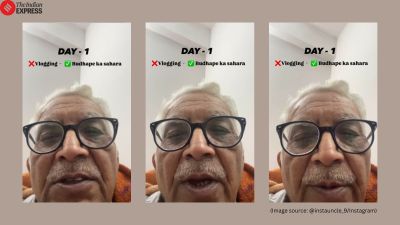
Age, as they say, should never stand in the way of new beginnings. A 70-year-old man from Uttar Pradesh has turned that belief into a living example, and his story has struck a chord online, with the internet cheering him on. At a stage of life when many choose to slow down, Vinod Kumar Sharma chose to pick up a smartphone and press record.