Journalism of Courage
 6 min read



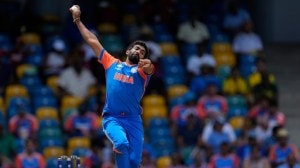
It has become the new slogan of India. Cutting across boundaries of language, location and context, it has the force of a new national imperative. Actor Shah Rukh Khan in an interview to this paper in July had expressed the hope that it would become 8220;like a sporting line8221;, an exuberant call to be used, in his words: 8220;Whenever Sachin is playing. Or perhaps when Dhanraj Pillai is going with the ball8230; or get Sania Mirza to win the Wimbledon.8221; Khan appears to have got his wish. A high point of the Indian Idol8217;s season finale on Sunday night was the singer Sukhwinder belting it out on stage. The song played intermittently throughout the India-Pakistan Twenty20 final on Monday night and seemed to blare from every car stereo in the euphoric hours that followed that decisive last catch by Sreesanth.
Chak De India! Part exhortation, part exultation 8212; it has just the right amount of zing and energy to work in a stadium, on the street or in a national singing contest. But it is more than a popular song, a motto or a rallying cry. In its form, its content, its multiple uses and its spreading appeal it captures the zeitgeist and holds up a mirror to change, allowing one to compare the past, in terms of concepts, attitudes and states of mind with the present.
We Indians are an emotional people. We are also a musical people, and it is easy to see why film songs, particularly the Hindi film song, the country8217;s unique contribution to the world, has such a special place in our social life. We use films songs for lullabies and picnic games, to mark festivals and weddings in the year 2020 there will still probably be a nankhatai band playing 8216;Meri pyaari beheniya banegi dulhania8217;. But above all we use them to express our patriotism, our love and our feelings for the country. From the anti-colonial fervour of the pre-Independence era, to the panegyric lyrics of the war years, to the celebratory songs about India8217;s natural riches and its spiritual superiority, Bollywood songs have conveyed an idea of the relationship Indians have with India.
8216;Chak De India8217; pleads for a complete recasting of this relationship. Gone are the melodrama of the past and the brooding Manoj Kumar style of patriotism. There is no anger in this new call, no fear. There is no glorification, nor is there any assertion of greatness. The country is not a goddess or a parent 8216;dharti maa8217;; she is not an ancient land of epic proportions 8216;Bharat8217;/ 8216;Hindustan8217;, a soldier dying in the snow-capped Himalayas, a great heritage to be defended or, if one wants to bring in political slogans, a space for impossible expectations 8216;Garibi Hatao8217;, or for gloating 8216;India Shining8217;. No, the country is more like a buddy, a friend. Someone to urge and encourage, to smile with, to cheer. And it is this stripped-down quality of quiet assurance that seems to pervade the national consciousness 8212; it was certainly in evidence on the field in Johannesburg on Monday night 8212; at the moment.
But 8216;Chak De India8217; is not just about the things it is not dread, awe, melodrama, hostility; it is also about the thing it is. 8216;Chak de8217;, a phrase used to denote encouragement in Punjabi, is close in sound to words from other languages. To the English 8216;chuck8217; for instance in the hockey fields of suburban Mumbai you can hear the cry, 8220;Chuck it, chuck it, chuck it, men!8221;; it is also close to the Hindi verb chakhna for taste, both resemblances helping to give it a certain onomatopoeic resonance.
In form, its succinctness like the lean frames of today8217;s athletes evokes the world of sports and concepts such as teamwork, integrity and unity so well brought out in the eponymous film and common both to the sports field and to the building of nationhood. But it also evokes the world of advertising with its own associations of consumerism, cosmopolitanism enhanced by the mixing of languages, global-ism and contemporariness. Whether it is the subliminal effect of the film8217;s message or the lyrics of the song 8220;kuch kariye/ kuch kariye/ nuss nuss meri khaule8230;8221; there is nothing so much the slogan 8216;Chak De8217; brings to mind as Nike8217;s 8216;just do it8217;.
A call to action. A farewell to the burdens of the past. Haven8217;t we been here before? The World Cup victory of 1983 was a prelude to Rajiv Gandhi8217;s election as prime minister and to the promised dawn of a modern, 21st century India. Rahul Gandhi8217;s formal elevation within the ranks of the Congress on the day of India8217;s exciting T20 win against the backdrop of India8217;s technological and economic advancement seems to be another such moment.
As we have seen before the country8217;s problems are too intractable for easy optimism. And the glamorous ferment of dance contests, cricketing events and soaring Sensex figures cannot obscure the deprivations of a large number of our people. Yet the fact that a youthful exuberance is muscling through the cobwebs of our tangled past and that the middle-class Indian youth is, according to a much reported study by the Swedish research and consulting firm Kairos Future, the happiest in the world is surely a cause for celebration. The challenge is to both boost and harness this new energy and focus it in a purposeful direction. For opportunities are known to dissipate as quickly as champagne bubbles.
Mumbai-based Shah is the author of 8216;Hype, Hypocrisy and Television in Urban India8217;