10 min read
Stay updated with the latest - Click here to follow us on Instagram

Journalism of Courage



Dancing Glory
Ranee Ramaswamy<\b>
A year ago,US-based Bharatanatyam dancer Ranee Ramaswamy received an important phone call. I was told that I was being considered for the National Council on the Arts,a prestigious body that assesses policies,funds and grants related to the arts in the country. Here I was,a dancer in a studio and my name was being associated with the Obama administration. It was a good feeling,as well as a little unnerving, she says. Ramaswamy was sworn in on December 16.
Her nomination to this position is a pointer to the status of Indian arts in the US. At another level,it is a tribute to Ramaswamy,61,one of the strong forces behind taking Bharata-natyam out there to the American people and placing it firmly in their cultural consciousness.
A firm believer in tradition,Ramaswamy is dancing today and scooping up accolades and honours simply because,35 years ago,she took a chance. I grew up in Tamil Nadu of the 70s. Like a good girl,I learnt dance till I was 15,got engaged at 17 and married at 20. Of course,I did not continue dance, she says. When she arrived in Minneapolis in 1978 at the age of 26 with her husband and young daughter,Ramaswamy hadnt danced for 10 years. A local Tamil association asked me to perform for an event,and I fearlessly agreed. Most people would not have taken this chance but my decision that day was made. People loved it and my eyes opened. I never left dance again. Today I advise people who want to do something to just take that first step,fearlessly, she says.
Though she takes risks,Ramaswamy never breaks the Bharatanatyam style or grammar. Our aim is to introduce the audience in the US to the art form and make them enjoy it even if they dont know the history or context of Bharata-natyam, she says.
Ramaswamys first doorway to take Bharata-natyam to non-Indians was a piece titled Mirabai Versions,based on poems by Robert Bly,in 1991. The Mirabai in his poems was dynamic and powerful. I called Bly and asked if he could read his poems while I performed. He agreed, she says. Mirabai Versions was a confluence of several art forms Bly read,two American musicians played the tabla and the sitar and Ramaswamy danced. The
familiar and the novel were wrapped in a fine spiral. The people related to this piece very internally, recalls the dancer.
Since 1983,Ramaswamy and her daughter Aparna had been travelling to India for four months every year to learn from famous dancer Alarmel Valli. The knowledge that she has given us is a dictionary from which we derive the foundations of our creativity, says Ramaswamy. In 1992,armed with finer technique and the success of Mirabai Versions,Ramaswamy set up her dance company,Ragamala. Together with Aparna,she created a series of choreographies,some of which are still touring.
Sacred Earth,which travelled to 30 cities in the US,celebrates the kolam (a pattern made on the floor from rice flour),Sangam poetry from Southern India and Warli art of Western India. In the West,people are talking about caring for the planet and Sacred Earth showed that Indian culture has worshipped the bhoomi for centuries, she says. Ramaswamy has collaborated with art forms such as flamenco,Balinese chants,contemporary poetry and photography,the last for a piece titled Where the Hands go,the Eyes Follow. In this,six poets created pieces inspired by black-and-white images of Ramaswamy. She interpreted these poems through the expressions
and gestures of Bharata-natyam,wearing a simple black costume.
Ranee and Aparna have been commissioned a new work by the Walker Art Centre in Minneapolis and Lincoln Center in New York. Titled Song of Jasmine,it is a wordless piece,based on the writings of Tamil women poets as well as jazz and Carnatic music and evokes the twin powers of spirituality and sensuality. Women poets looked upon god as their lover so this piece will express their words through dance alone, she says.
Just Singing,Not Sorry
Bishi Bhattacharya<\b>
The widows of Varanasi are hunched by age and tradition,presenting a homogenous image of sunken cheeks,hollow eyes and saris that have long lost their colour. The City of Salvation doesnt allow then to participate in any festivities,least of all a carnival called Holi. But things are changing even in the town that locals call the oldest in the world. This year,when a group of widows got together to celebrate Holi,among the audience was a London-based musician called Bishi Bhattacharya. As she strode among the widows dressed in a golden headgear and a shocking pink dress,Bhattacharya was complementing their radical action with a statement of her own. Designer Manish Arora and photographer Bharat Sikka captured the event in their award-winning film,Holy Holi. We see Bhattacharya riding through the streets in a chariot-like tonga as different shades of powdered colour drench the widows whites into chaotic hues. Too many women are walking about apologising and walking into stereotypes to attain love and acceptance. This is not how people should be. This is not how I am, says Bhattacharya.
Like her striking appearance in the film,Bhattacharya is a hard-to-miss,harder-to-forget face in Englands pop arena. In Holy Holi,I represent a goddess-like figure among the ancient and the new,the sacred and the profane. What I portray here is much like how I explore my music, she says.
Born to a musical Bengali family now based in London,Bhattacharya started out in the music circuit quite young. By 18,she had co-founded an experimental underground club called Kash Point,where she deejayed and hosted prominent musicians,artists and designers. With influences of electronic,dance,progressive and glam rock,she went on to release three EPs and five singles and is currently working on a third album. My work explores the shifting paradigms of culture and technology. I also look at contemporary visual culture,digital streams of consciousness and collaborative contexts, she says about her anarchist musical approach. Her collaborators include The London Symphony Orchestra,composer Philip Glass and performance artiste Yoko Ono.
Bhattacharyas sound is a curious but enchanting mix of British pop and Indian folk. From her latest album Albion Voice,comes the track of the same name that goes,Im Indian in skin but English in heart. The cliched East meets West question is,thus,inevitable. Racially,its a difficult time. When I came here,it was a new country with people who didnt understand us. It takes time to settle down. My music comes out of that isolation and confusion, she says.
Bhattacharya can often be seen with her rock sitar propped over the shoulder,her trademark upturned mohawk,and dressed in futuristic burlesque styles. Her fashion inspirations are unusual suspects Hollywood costume designer of the yore,Adrian Greenberg,and Academy Award-winning designer Edith Head,famous for her creations in Alfred Hitchcock films. When not making music,Bhattacharya designs suits for women based on the styles of the 40s and is on her way to opening a couture store in London.
Plucky Musician
Soumik Datta<\b>
The lightness and delicacy of notes in the deeply masculine sound of sarod being played at Londons Rich Mix,a performing arts centre located on citys Bethnal Road,stirs up memories of an older generation of Indian classical musicians,who would pride themselves in playing deep and introspective glides. The notes are lucid,and a few seconds into this YouTube video,the gatkari (trills) and the powerful madhyam fall in place in the late night melody of Charukeshi. Soumik Datta,28,plays the sarod but he is not sitting down like most sarod players do. Instead,he has the sarod strapped to himself and looks like a cross between an Indian classical musician and a steel guitarist,strumming away with a compelling whim,improvising,thinking and travelling along with the melody. The sarod sings,hollers in joy,wails,even laughs. The London-based Datta plays the first-ever electro acoustic sarod,which he has created by adding a combination of mics and pic-up mics to an electric sarod. These help him create a combination of traditional and processed sound.
I played solo as well as collaborated with many musicians,but the hard part was to figure out what I wanted my music to be. What was it that would satisfy my appetite for newer sounds? Composition seemed to be an apt answer, says Datta,in a telephone conversation from Kolkata,where he is spending his holiday writing a piece that the Scottish Chamber Orchestra will play live during forthcoming screenings of Satyajit Rays Goopy Gyne Bagha Byne in Europe.
Dattas recent collaboration with Raghu Dixit on Rain Song,a track in the singers recent album Jag Changa has also begun to garner much attention. A contemplative melody based on the meditative raag Tilang with touches of Jog,it is punctuated by Dattas poignant interludes,as he creates note combinations reminiscent of the human voice. This was an interesting project and,one jam session later,Raghu and I decided to collaborate, he says.
Growing up in a Bengali household in London,music for Datta did not happen by default. A chance discovery of his grandmothers sarod which twanged the moment a cricket ball hit it in the corner had Datta hooked. My parents had wanted me to learn music,but I was not interested. But there is something about the sound of sarod that is unlike any other instruments. Immediately,I wanted to learn how to play it, says Datta,who learned from Buddhadev Das Gupta,a Kolkata-based sarod player.
Datta,who has collaborated with musicians such as Beyonce,Nitin Sawhney and Talvin Singh,is keen to create new idioms with the sarod.
As for the difference between audience in India and abroad,Datta believes that there is actually none. I would divide this on the basis of music. When Im on stage,I play with their energy,imbibe it and tweak the set list or create a new one accordingly on stage, says Datta.
He also believes that best pieces come from improvisation,but wonders if such a concept really exists. All of what we refer to as improvisation comes from an aesthetic that you have already built. There is that partial finger memory in some shape or form. So it may be a passage that I played five years ago but makes an appearance when I feel deeply for it, says Datta.
Stay updated with the latest - Click here to follow us on Instagram

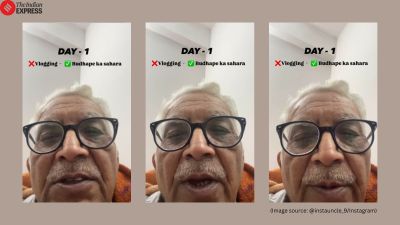
Age, as they say, should never stand in the way of new beginnings. A 70-year-old man from Uttar Pradesh has turned that belief into a living example, and his story has struck a chord online, with the internet cheering him on. At a stage of life when many choose to slow down, Vinod Kumar Sharma chose to pick up a smartphone and press record.