5 min read
© The Indian Express Pvt Ltd



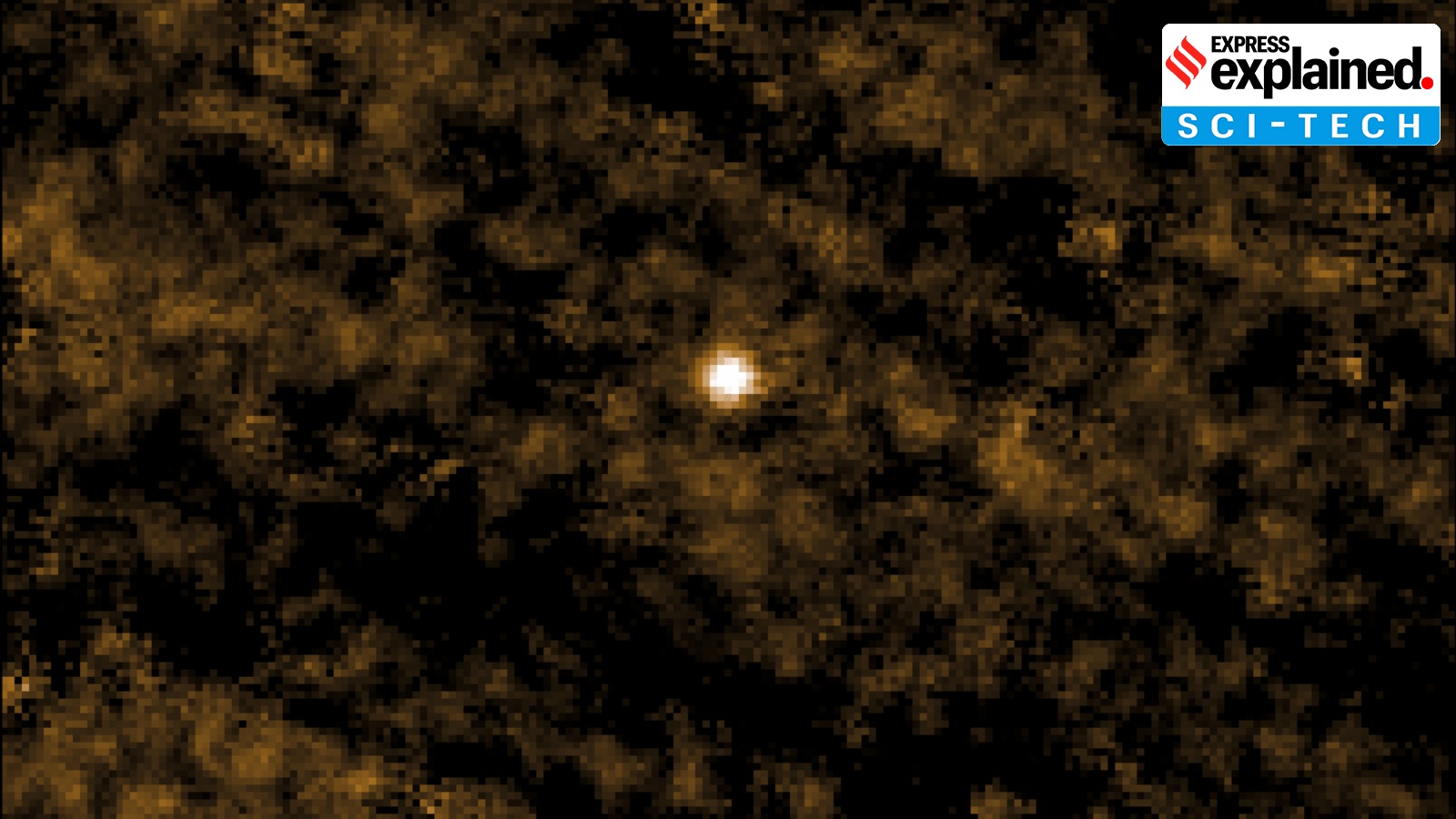 This image shows Polarimeter to Unify the Corona and Heliosphere (PUNCH) observations of Comet 3I/ATLAS from September 28 to October 10, 2025, when the comet was between 231 million to 235 million miles from Earth. Each frame is a daily stacked image, made up of multiple observations taken of the comet on each day. Stars create streaks of light in the background as the comet moves across the sky. (Photo: NASA/Southwest Research Institute)
The National Aeronautics and Space Administration (NASA) on Wednesday (November 19) released new images of Comet 3I/Atlas, an interstellar object that astronomers have determined is billions of years old.
The new images come from a wide range of NASA missions, including planetary science missions such as the Perseverance Mars rover and the Mars Atmosphere and Volatile Evolution (MAVEN) orbiter, the asteroid missions Psyche and Lucy and the sun-studying spacecraft Polarimeter to Unify the Corona and Heliosphere (PUNCH).
Comet 3I/Atlas was first spotted on July 1 by the Asteroid Terrestrial-impact Last Alert System (ATLAS) survey telescope in Río Hurtado, Chile. At the time, it was about 670 million km from the Sun. On December 19, the object will fly closest to Earth at 170 million miles, which is almost twice the distance between the Earth and the Sun.
The comet is just the third interstellar object that scientists have discovered so far. The first two were 1I/ʻOumuamua and 2I/Borisov, which were found in 2017 and 2019, respectively.
Interstellar objects are celestial bodies that originate outside the solar system, and travel through it. These objects are not gravitationally bound to a star. They can come from other solar systems and be thrown into interstellar space — the area between the stars — due to collisions or be slingshotted by a planet’s or star’s gravity.
Scientists have long suspected that interstellar objects frequently pass through our solar system. However, these objects were not discovered until recently, as they were too small and faint to be detected. With recent advancements in technology and the development of more powerful telescopes, scientists have now begun to observe them.
To determine if a celestial body is interstellar, scientists compute its trajectory. All planets, asteroids, and comets within the Solar System move in closed elliptical orbits. When they come closest to the Sun (a point called perihelion), they travel the fastest, trying to move away from the Sun, but are slowed down by solar gravitational pull. When these celestial bodies are farthest from the Sun (a point called aphelion), they are brought back close to the Sun by solar gravitational pull.
The trajectory of interstellar objects, however, is quite different. They basically move in an open-ended hyperbolic orbit, where there is a perihelion point but no aphelion. That is because these objects move at such great speeds that the Sun’s gravitational pull is not able to slow them down enough during their outbound leg, allowing them to escape our Solar System.
Scientists determine the trajectory of these objects by observing several factors, including the speed at which they are moving, and how far away they are compared with other stars in the background. If an object is moving fast enough at a faraway distance, it is bound to be following a hyperbolic orbit.
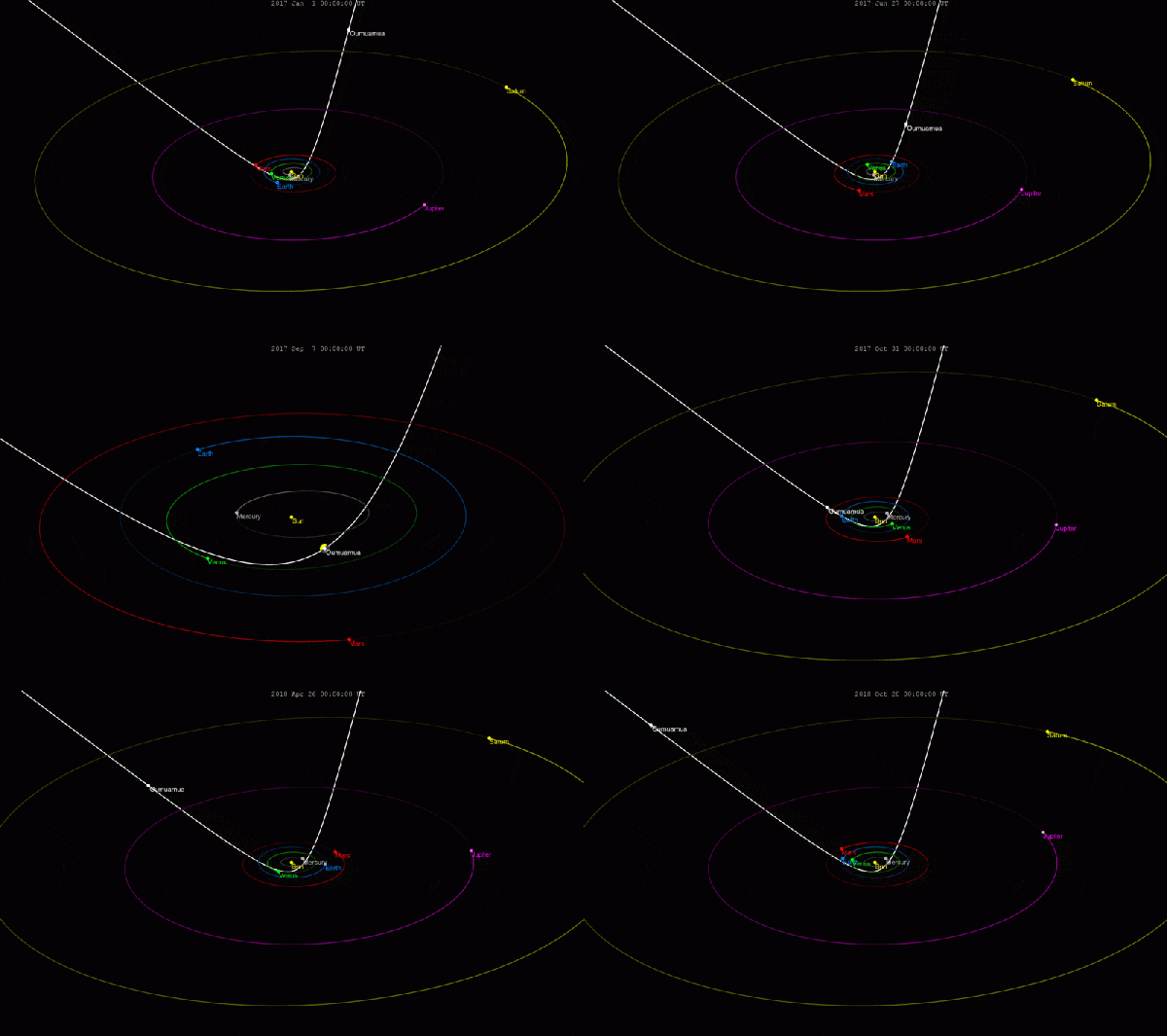 Hyperbolic path of 1I/ʻOumuamua. Credit: Wikimedia Commons
In the case of 3I/Atlas, scientists observed that it was moving at a speed of 60 kmph at a distance of 670 million km from the Sun. This speed is quite fast for such a distance because the further away a celestial body is from the Sun, the slower it moves due to a weaker solar gravitational pull. This means that 3I/Atlas must have approached our Solar System already with considerable initial speed, and thereby is an interstellar object.
Objects such as 3I/Atlas and 1I/ʻOumuamua can help give clues about the formation of worlds far beyond our Solar System. Scientists usually analyse the chemical composition of these objects, which can provide them with information about the conditions of the objects’ solar systems, and how they were formed.
For instance, if an interstellar object is a comet with a lot of ice, it tells scientists that it was formed far away from a star and then got ejected by something massive, such as a planet the size of Jupiter or Neptune. The ice can also reveal where the object came from.
“It may be thousands of years until humans visit a planet in another solar system and interstellar comets offer the tantalising opportunity for us to touch something truly otherworldly. These… wanderers offer a rare, tangible connection to the broader galaxy — to materials formed in environments entirely unlike our own,” the European Space Agency said on its website.