29 min read


© IE Online Media Services Pvt Ltd



 UPSC Key October 2023: Here's what you should be reading from the October 5, 2023 edition of The Indian Express
Important topics and their relevance in UPSC CSE exam for October, 5, 2023. If you missed the October, 4, 2023 UPSC CSE exam key from the Indian Express, read it here
FRONT PAGE
Sanjay Singh, AAP MP, arrested by ED in Delhi excise policy case
Syllabus:
Preliminary Examination: Indian Polity and Governance-Constitution, Political System, Panchayati Raj, Public Policy, Rights Issues, etc.
Mains Examination: General Studies II: Structure, organization and functioning of the Executive and the Judiciary—Ministries and Departments of the Government; pressure groups and formal/informal associations and their role in the Polity.
Key Points to Ponder:
• What’s the ongoing story- A DAY of searches at his official residence on Wednesday ended with the arrest of Aam Aadmi Party Rajya Sabha MP Sanjay Singh, who was picked up by the Enforcement Directorate in connection with the Delhi excise policy case.
• Who is Sanjay Singh?
• Why the Enforcement Directorate arrested Sanjay Singh?
• The new liquor policy was very much in news-why?
• For Your Information-Proposed in 2020, it came into effect in November 2021. Delhi was divided into 32 zones with each zone having 27 liquor vends. It marked the exit of the government from selling liquor — only private liquor shops would run in the city, and each municipal ward would have 2-3 vends. It aimed to end the liquor mafia and black marketing, increase revenue and improve the consumer experience, and ensure equitable distribution of liquor vends. The government also made the rules flexible for licensees, such as allowing them to offer discounts and set their own prices instead of selling on MRP fixed by the government. Following this, discounts were offered by vendors, which attracted crowds. After protests by the opposition, the excise department withdrew the discounts for some time.
• What provision in the new liquor policy was the point of contention?
• What differences exist between the old liquor policy and the new liquor policy?
• What exactly has the ED said about the South Group?
• Why did the South Group pay these kickbacks, according to the ED?
Other Important Articles Covering the same topic:
📍Explained: Meant to boost revenue, Delhi’s new liquor policy ran into trouble from early on
Flash flood in Sikkim: Five dead, 22 soldiers among 42 still missing
Syllabus:
Preliminary Examination: Indian and World Geography-Physical, Social, Economic Geography of India and the World.
Mains Examination:
• General Studies I: Important Geophysical phenomena such as earthquakes, Tsunami, Volcanic activity, cyclone etc., geographical features and their location-changes in critical geographical features (including water-bodies and ice-caps) and in flora and fauna and the effects of such changes.
• General Studies II: Government policies and interventions for development in various sectors and issues arising out of their design and implementation.
• General Studies III: Disaster and disaster management.
Key Points to Ponder:
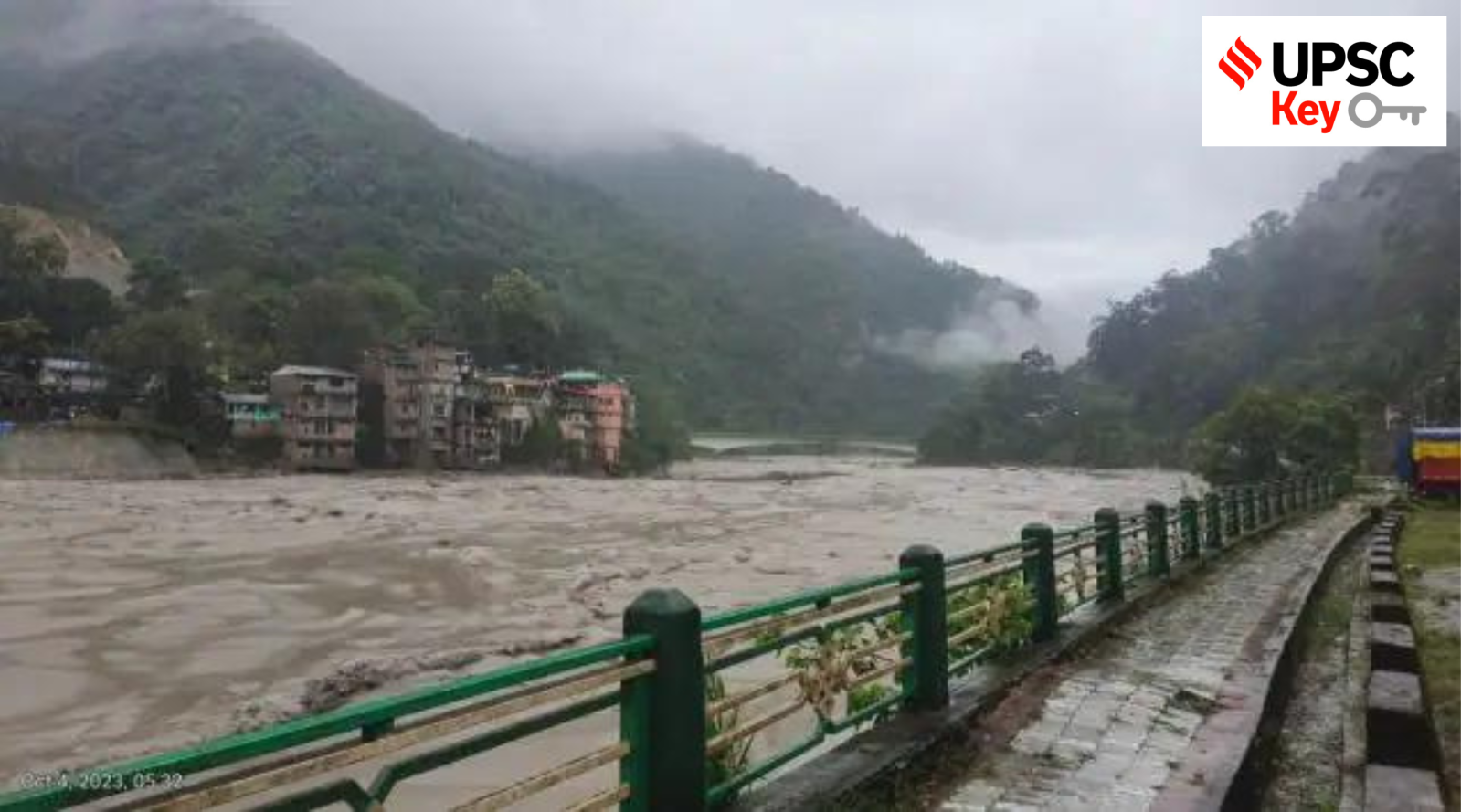
• What’s the ongoing story- At least five persons died and 42 people, including 22 Army personnel, went missing on Wednesday after heavy rainfall triggered a lake outburst in parts of the highly vulnerable Lhonak Lake in north Sikkim and resulted in a flash flood in the Teesta river basin, officials said. They said a search operation was on to trace those missing.
• Know about Sikkim flood in detail
• For Your Information-Sikkim received nearly 41 mm of rainfall between 8 am of Tuesday and Wednesday, which was almost five times the normal rainfall expected around this time, rainfall data from the India Meteorological Department showed. In fact, South Sikkim received rainfall that was 33 times more than normal while East Sikkim got 15 times higher rainfall during the 24 hours. The IMD has predicted more rainfall till October 6.
The state disaster management authority said the lake outburst had resulted in flooding in the Teesta, which flows through Sikkim and West Bengal before entering Bangladesh.
“The Glacial Lake Outburst Flood in portions of Lhonak Lake, Mangan district, which caused the rise of water levels with very high velocities downstream along the Teesta river basin in the early hours of October 4, 2023, has caused severe damage in Mangan, Gangtok, Pakyong, and Namchi districts,” it said in a statement.
Lhonak Lake, located at a height of 5,200 metres above sea-level, is one of the several glacial lakes in Sikkim vulnerable to bursting under stress.
• What is a cloudburst?
• How common are cloudbursts?
• Why do cloudbursts occur in hilly areas?
• Can we predict cloudbursts?
• What is a ‘Highly local cloud’?
• What is the reason of cloudburst?
• What is flash flooding?
• For Your Information-Excessive or continuous rainfall over a period of days, or during particular seasons, can lead to stagnation of water and cause flooding. Flash floods refer to such a situation, but occurring in a much shorter span of time, and are highly localised. For instance, the US’s meteorological agency, the National Weather Service, says flash floods are caused when rainfall creates flooding in less than 6 hours. It adds that flash floods can also be caused by factors apart from rainfall, like when water goes beyond the levels of a dam.
In India, flash floods are often associated with cloudbursts – sudden, intense rainfall in a short period of time. Himalayan states further face the challenge of overflowing glacial lakes, formed due to the melting of glaciers, and their numbers have been increasing in the last few years.
Frequently, flash floods are accompanied by landslides, which are sudden movements of rock, boulders, earth or debris down a slope. It is common in mountainous terrains, where there are conditions created for it in terms of the soil, rock, geology and slope. Natural causes that trigger landslides include heavy rainfall, earthquakes, snowmelting and undercutting of slopes due to flooding. Landslides can also be caused by human activities, such as excavation, cutting of hills and trees, excessive infrastructure development, and overgrazing by cattle.
Flash flooding commonly happens more where rivers are narrow and steep, so they flow more quickly. They can occur in urban areas located near small rivers, since hard surfaces such as roads and concrete do not allow the water to absorb into the ground.
According to government data from a project by the Assam State Disaster Management Authority, India is the worst flood-affected country in the world, after Bangladesh, and accounts for one-fifth of the global death count due to floods. Flash floods have been commonly witnessed in cities like Chennai and Mumbai. Depression and cyclonic storms in the coastal areas of Orissa, West Bengal, Andhra Pradesh, and others also cause flash floods.
Further, data from the National Disaster Management Authority (NDMA) states that one of the reasons for flood situations occurring so frequently is that nearly 75 per cent of the total Indian rainfall is concentrated over a short monsoon season of four months (June to September). As a result, the rivers witness a heavy discharge during these months. About 40 million hectares of land in the country are liable to floods according to the National Flood Commission, and an average of 18.6 million hectares of land are affected annually.
Flash floods may in the future, begin to take place after wildfires that have been taking place more frequently. This is because wildfires destroy forests and other vegetation, which in turn weakens the soil and makes it less permeable for water to seep through.
• What is the reason for flash floods?
• Are cloudburst incidents increasing?
• What is glacial lake outburst flood (GLOF)?
• How did South Lhonak Lake become susceptible to GLOF?
• Map Work-Sikkim and Lhonak Lake
• Did the Sikkim government take any action to tackle the expanding South Lhonak Lake?
• Do You Know-Glacial lakes, like the South Lhonak Lake, are large bodies of water that sit in front of, on top of, or beneath a melting glacier. As they grow larger, they become more dangerous because glacial lakes are mostly dammed by unstable ice or sediment composed of loose rock and debris. In case the boundary around them breaks, huge amounts of water rush down the side of the mountains, which could cause flooding in the downstream areas. This is called glacial lake outburst floods or GLOF.
GLOF can be triggered by several reasons, including earthquakes, extremely heavy rains and ice avalanches, Tom Robinson, lecturer in Disaster Risk & Resilience at the University of Canterbury (New Zealand), told The Indian Express in February.
“These lakes are also often found in steep, mountainous regions, which means landslides or ice avalanches can sometimes fall directly into the lakes and displace the water, causing it to over-top the natural dam and flood downstream,” he added.
In 2013, one such event took place in Uttarakhand’s Kedarnath when the region witnessed flash floods along with a GLOF caused by the Chorabari Tal glacial lake, killing thousands of people.
• Why is Himalayan ecosystem fragile?
• What are the ecological problems faced by the Himalayan States?
• How disaster management is done in the landslide and subsidence-hit zone?
• How do the Centre and state government ensure the safety and rehabilitation of residents?
• Run-of-the-river (RoR) hydropower projects in the Himalayan states-what are the issues and challenges?
• What Ravi Chopra committee which was constituted by the Supreme Court says about the developmental project in Himalayan States?
• What are the major steps to be undertaken for safeguarding the fragile ecosystem of the Himalayan States?
• For Your Information-Floods and landslides are not uncommon in the Himalayan region. The young mountains are geologically active and the region has a long history of downslope movement of rocks and boulders. According to the ISRO’s Landslide Atlas of India, all 12 districts of Himachal are susceptible to landslips. But the slopes seem to have become more unstable in recent years.
According to the state’s disaster management data, the number of landslides increased nearly six times between 2020 and 2022. Himachal’s Disaster Management Plan ascribes this to climate change and the increase in extreme rainfall events. It’s correct that the average temperature in the Himalayas is rising faster than the rest of the country. There is also no doubt that short but intense bursts of rainfall have become frequent in the state, like in several other parts of the country. But ecologically-insensitive development has compromised Himachal’s capacity to withstand inclement weather. In the past 10 years, the state has gone on a road-widening spree. Sixty-nine national highway projects have been approved, of which five are four-lane highways. Roads and highways are important to the region’s economic development. But such projects must be mindful of the area’s ecological vulnerabilities. For instance, road expansion drives rarely factor in slope stability. There is very little planning on what to do with construction debris. Last year, the Himachal Pradesh High Court expressed serious concerns on the “unplanned excavation” of the hills and “poorly executed construction” of roads in the state.
Other Important Articles Covering the same topic:
📍Cloudbursts & heavy localised rainfall — why hills are at risk
📍What are cloudburst incidents and are they rising across India?
📍The 360° UPSC Debate| Himalayan States: Environmental concerns vs development
Previous year UPSC Mains Question Covering similar theme:
📍Describe the various causes and the effects of landslides. Mention the important components of the National Landslide Risk Management Strategy. (2021, GS3)
📍Discuss the recent measures initiated in disaster management by the Government of India departing from the earlier reactive approach. (2020, GS3)
📍Vulnerability is an essential element for defining disaster impacts and its threat to people. How and in what ways can vulnerability to disasters be characterized? Discuss different types of vulnerability with reference to disasters. (2019, GS3)
📍Disaster preparedness is the first step in any disaster management process. Explain how hazard zonation mapping will help disaster mitigation in the case of landslides. (2019, GS3)
📍How important is vulnerability and risk assessment for pre-disaster management? As an administrator, what are key areas that you would focus on in a Disaster Management System? (2013, GS3)
EXPRESS NETWORK
Curbs on new medical colleges draw TN ire
Syllabus:
Preliminary Examination: Economic and Social Development-Sustainable Development, Poverty, Inclusion, Demographics, Social Sector Initiatives, etc.
Main Examination:
• General Studies II: Functions and responsibilities of the Union and the States, issues and challenges pertaining to the federal structure, devolution of powers and finances up to local levels and challenges therein.
• General Studies II: Issues relating to development and management of Social Sector/Services relating to Health, Education, Human Resources.
Key Points to Ponder:
• What’s the ongoing story- A notification by the National Medical Commission (NMC) on restricting the opening of new medical colleges has created a “regressive scenario” and should be kept in abeyance, the Tamil Nadu government said on Wednesday.
• Why National Medical Commission (NMC) is restricting the opening of new medical colleges in Tamil Nadu?
• How Chief Minister M K Stalin responded?
• For Your Information-“I wish to draw your kind attention to the regressive scenario created by the recent notification issued by the NMC to restrict the opening of new medical colleges. It has been notified by the NMC that after the academic year 2023-2024, the Letter of Permission for starting new medical colleges shall be issued only for an annual intake capacity of 50/100/150 seats, provided that the medical college shall follow the ratio of 100 MBBS seats for 10 lakh population in that State/ UT.” This is a “direct encroachment” on the rights of all State governments and penalisation of those who have invested more in their public health infrastructure over the years, the CM said.
He said progressive states like Tamil Nadu have been strengthening their tertiary healthcare network for many decades, leading to ample availability of doctors and nurses, which he said has manifested in their better performance in terms of various health indicators.
“Chennai has emerged as the healthcare capital of India. In both public and private sectors, our skilled medical professionals have been able to successfully serve not only the people of Tamil Nadu but also of other states as well as other nations. This has generated a huge demand for quality health services and new institutions are absolutely necessary for us to cater to it in the future,” Stalin added.
• What is ratio of 100 MBBS seats for 10 lakh population?
• What are the new guidelines by National Medical Commission (NMC)?
• Do You Know-The National Medical Commission, through its ‘Undergraduate Medical Education Board’ notification has stipulated that “medical colleges shall follow the ratio of 100 MBBS seats for 10 lakh population in that State and Union Territory.”
• Recently, Telangana government also inaugurated nine government medical colleges, pushing the State’s total count to 28-Does this breach new guidelines by National Medical Commission?
• What is the doctor to population ratio in India
• Why National Medical Commission guidelines is another serious encroachment on the powers of the state government and the state legislature?
• “In a recent judgement, the Supreme Court also held that executive instructions could not impose reasonable restrictions on the fundamental right to establish educational institutions under Article 19(1)(g) of the Constitution of India”-Analyse
• What are key issues faced by the healthcare sector of India?
• India’s Health Budget-Know the Statistics
• How does the pandemic affected health services?
• How does the impact of the pandemic on health services put the spotlight on the benefits of digital innovation and technology-enabled solutions?
• How implementation of Ayushman Bharat Digital Mission (ABDM) united all stakeholders in the digital healthcare ecosystem?
• Public Health Systems in India-Know the Background
• Current state of India’s health infrastructure- What World Bank data says?
• COVID-19 Pandemic and India’s Healthcare System-Connect the dots
• Steps required to strengthen the existing state of Health infrastructure in India
• What do you understand by Universal Health Coverage (UHC)?
• PM Atma Nirbhar Swasth Bharat Yojana and Ayushman Bharat Scheme-Key Highlights
• Is there any explicit/implicit recognition of the right to health or healthcare under the Constitution? (Hint: Directive Principles of State Policy in Part IV of the India Constitution provide a basis for the right to health)
• What is Supreme Court of India stand on Right to Health?
• What is National Medical Commission?
• What is the role of National Medical Commission?
Other Important Articles Covering the same topic:
📍India has a doctor for every 10,189 people, finds WHO survey
SC pulls up Punjab for not constructing its part of SYL canal
Syllabus:
Preliminary Examination: Indian Polity and Governance-Constitution, Political System, Panchayati Raj, Public Policy, Rights Issues, etc.
Mains Examination: General Studies II: Functions and responsibilities of the Union and the States, issues and challenges pertaining to the federal structure, devolution of powers and finances up to local levels and challenges therein.
Key Points to Ponder:
• What’s the ongoing story-Noting that Haryana had already constructed its portion of the Sutlej-Yamuna Link (SYL) canal, the Supreme Court on Wednesday pulled up the Punjab government for not completing construction of its part of the canal and asked the Centre to survey the land allocated for the project in Punjab so as to assess the work progress.
• What exactly the Supreme Court said?
• For Your Information-A bench presided by Justice S K Kaul recalled that it had earlier stayed Punjab’s attempt to release the land to farmers and appointed a receiver. The bench, also comprising Justices C T Ravikumar and Sudhanshu Dhulia, told Additional Solicitor General Aishwarya Bhati who appeared for the Centre that “we would like the Union of India to survey the portion of the land allocated for the project in Punjab to ensure that the land is protected…” and to know “how much has been made and what has been made”.
The court said “we are concerned with the decree for the construction of the SYL canal in the Punjab portion, as Haryana has already constructed” and asked the Punjab government to extend full cooperation to the survey.
• Sutlej-Yamuna Link Canal Project-Know the background of this issue
• Why has the Sutlej-Yamuna Link Canal (SYL) come up again now?
• Map Work-Sutlej, Yamuna and Sutlej-Yamuna Link Canal
• What is Punjab’s argument in this issue?
• What is Haryana’s argument in this issue?
• Sutlej-Yamuna Link Canal (SYL) and Central Government’s Stand-know in detail
• What are the Constitutional Provisions for interstate water disputes?
• What Article 262 of the Constitution says about interstate water disputes?
• Do You Know-The canal, once completed, will enable sharing of the waters of the rivers Ravi and Beas between the two states. The issue dates back to 1966 at the time of reorganisation of Punjab and formation of Haryana was formed. Punjab was opposed to sharing the waters of the two rivers with Haryana, citing riparian principles.
A decade before the formation of Haryana, the water flowing down Ravi and Beas was assessed at 15.85 million acre feet (MAF) per year. The Union government had organised a meeting in 1955 between the three stake-holders — Rajasthan, undivided Punjab and Jammu and Kashmir — and allotted 8 MAF per year to Rajasthan, 7.20 MAF to undivided Punjab and 0.65 MAF to J&K.
A decade after reorganisation, the Centre issued a notification allocating 3.5 MAF to Haryana out of the 7.2 MAF allotted to Punjab before reorganisation. In a reassessment in 1981, the water flowing down Beas and Ravi was estimated at 17.17 MAF, of which 4.22 MAF was allocated to Punjab, 3.5 MAF to Haryana, and 8.6 MAF to Rajasthan.
On April 8, 1982, then Prime Minister Indira Gandhi launched the construction of the SYL Canal with a groundbreaking ceremony in Kapoori village in Patiala district. A stretch of 214 km was to be constructed, out of which 122 km was to cross Punjab and 92 km in Haryana. But the Akalis launched an agitation in the form of Kapoori Morcha against the construction of the canal. Then in July 1985, Prime Minister Rajiv Gandhi and then Akali Dal chief Sant Harchand Singh Longowal signed an accord agreeing for a new tribunal to assess the water.
The Eradi Tribunal headed by Supreme Court Judge V Balakrishna Eradi was set up to reassess availability and sharing of water. In 1987, the tribunal recommended an increase in the shares of Punjab and Haryana to 5 MAF and 3.83 MAF, respectively.
On August 20, 1985, Longowal was killed by militants, less than a month for signing the accord. In 1990, a chief engineer M L Sekhri and a Superintending Engineer Avtar Singh Aulakh were killed by militants.
In other violence, labourers were shot dead in Majat village near Chunni and Bharatgarh near Ropar. The construction came to a halt. In the backdrop of these incidents, Punjab leaders has been cautioning the Centre not to rake up the issue again.
As per Punjab’s argument, many areas in Punjab may go dry after 2029. The state has already over-exploited its groundwater for irrigation purposes as it fills granaries of the Centre by growing wheat and paddy worth Rs 70,000 crore every year. As per reports, water in about 79% of the state’s area is over-exploited. Out of 138 blocks, 109 blocks are “over-exploited”, two blocks are “critical” five blocks are “semi-critical” and only 22 blocks are in “safe” category. In such a situation, the government says sharing water with any other state is impossible.
As per Haryana’s argument, Haryana has been staking claim to the Ravi-Beas waters through the SYL Canal on the plea that providing water for irrigation was a tough task for the state. In southern parts, where underground water had depleted up to 1700 feet, there was a problem of drinking water. Haryana has been citing its contribution to the central food pool and arguing that it is being denied its rightful share in the water as assessed by a tribunal.
Other Important Articles Covering the same topic:
📍Explained: Canal to nowhere — Why the SYL is a stalemate with no winners
EXPLAINED
Syllabus:
Preliminary Examination: Indian Polity and Governance-Constitution, Political System, Panchayati Raj, Public Policy, Rights Issues, etc.
Mains Examination: General Studies II: Welfare schemes for vulnerable sections of the population by the Centre and States and the performance of these schemes; mechanisms, laws, institutions and Bodies constituted for the protection and betterment of these vulnerable sections.
Key Points to Ponder:
• What’s the ongoing story- The Bihar government released the results of its survey of castes in the state on Monday (October 2), which put the share of Extremely Backward Classes (EBCs) and Other Backward Classes (OBCs) cumulatively at more than 63%. The “unreserved” category of so-called “forward” castes is about 15.5%.
The survey, which has shed light into the exact caste breakup of Bihar has far-reaching implications. Economist MR Sharan spoke to The Indian Express about caste in Bihar, the historical context of caste politics in the state, what the survey tells us, and its potential impact on policy-making and politics.
• What was the caste landscape in Bihar like historically?
• What changed in the late 1970s?
• What role did Lalu have in the story of caste in Bihar?
• How did the implementation of the Mandal Commission report impact caste consciousness?
• How did things change with Nitish?
• How do EBCs differ from other OBCs?
• If the layers within the OBCs have been known since the 1970s, how does just having numbers help?
• How does having data translate to better-designed policies on the ground?
• So the data are known, what happens now?
• Critics have said the survey results will lead to intensified jockeying for reservations and potentially social turmoil.
• What was the need to have this survey — and in Bihar specifically?
• Could this be a Mandal 2.0 moment as some JD(U) and RJD leaders have claimed?
• For Your Information-The EBCs are the biggest social group comprising 4,70,80,514 individuals, or 36.01% of the state’s population. The OBCs number 3,54,63,936 (27.12%), and the Scheduled Castes (SCs) 2,56,89,820 (19.65%).’
Scheduled Tribes (STs) number only 21,99,361 (1.68%), the bulk of the tribal population having become part of Jharkhand after the bifurcation of the state in 2000. The “unreserved” category comprises 2,02,91,679 individuals (15.52%).
Bihar’s population, according to the survey, is 13,07,25,310, compared to the 10.41 crore recorded in the 2011 census. Hindus comprise 81.99% of the population, and Muslims 17.72%. The populations of Buddhists, Christians, Sikhs, Jains, and other religious denominations are minuscule.
According to data released by Development Commissioner Vivek Singh, Bihar’s total population now stands at a little over 13.07 crore, up from 10-odd crore in the 2011 Census. The EBCs make up 36.01% of this, and OBCs an additional 27.13%. The survey also found that Yadavs, the main vote base of the RJD, are the largest group, accounting for 14.27% of the total population.
The Dalits, or Scheduled Castes, account for 19.65%, higher than expected, while STs comprise 1.68%.
Those belonging to the “unreserved” category, or the “upper castes”, who dominated politics till the Mandal wave of 1990s, comprise 15.52% of the total population. These groups, who are believed to be BJP voters, are 2-3% more in number than the general opinion regarding their numbers.
The Muslims, the second leg of the RJD’s M-Y plank, comprise 17.70% of the population. The other religious minorities have a minuscule presence.
Other Important Articles Covering the same topic:
📍Pending in SC: Question on survey or census, issues relating to privacy
📍Counting the gains: How the survey puts Nitish back in focus
📍Bihar data can reopen debate on SC’s 50% quota ceiling in 1992
📍4 takeaways from Bihar survey
How size of particles changes their behaviour, and why that is important
Syllabus:
Preliminary Examination: General Science
Mains Examination: General Studies III: Science and Technology- developments and their applications and effects in everyday life.
Key Points to Ponder:
• What’s the ongoing story- Every element exhibits specific properties, usually determined by the number of electrons in its atoms and the distribution of these electrons around the nucleus. Also, every piece of a pure element exhibits exactly the same properties, regardless of its size.
• Forty years ago, scientists started discovering something very remarkable-what was that?
• “A nanoparticle (sizes in the range of 1 to 100 billionth of a metre) of gold, for example, displayed properties different in some respects from larger particles of gold. Such deviant behaviour had been predicted in theory a few decades earlier, but never observed”-So what happened now?
• For Your Information-Alexei Ekimov was the first to notice this deviant behaviour in Copper Chloride nanoparticles around 1980. He was also able to manufacture these nanoparticles to show this change in behaviour. However, as he was working in the erstwhile USSR then, his finding was largely unknown in the rest of the world.
A few years later, Louis Brus, an American scientist working independently, discovered similar behaviour in Cadmium Sulphide nanoparticles. He too was able to create these nanoparticles with changed properties. Moungi Bawendi, who worked with Brus in the initial part of the career, later developed easier methods to efficiently produce nanoparticles that showed some desired deviant behaviour.
For their path-breaking research, done three to four decades ago, Ekimov (78), Brus (80), and Bawendi (62) were awarded the 2023 Nobel Prize in Chemistry. Thanks to their work, nanoparticles with desired deviant behaviour have become an integral part of a variety of modern appliances, including television, computer screens, and LED lamps. There are a wide range of applications in biochemistry and medicine as well.
• So exactly, why these scientists namely Ekimov (78), Brus (80), and Bawendi (62) were awarded the 2023 Nobel Prize in Chemistry?
• “The deviant behaviour of small nanoparticles arises because of the emergence of quantum effects”-What is quantum effects?
• What Ekimov and Brus noticed?
• Do You Know-One of the most noticeable special properties of the nanoparticles becomes evident when they interact with light. The colour of any material depends on the wavelengths of the light spectrum absorbed or reflected by the material.
Ekimov was working with coloured glass tinted with Copper Chloride when he noticed something special. He heated molten glass to very high temperatures and then allowed it to cool and harden. Crystals of Copper Chloride, of different sizes, had formed on the glass. He observed that the part of the glass where smaller crystals of Copper Chloride were present had a slightly different colour than the area where there were larger crystals. What this showed was that the same material, Copper Chloride, was absorbing different wavelengths of light depending on its size.
Brus also observed a similar phenomenon, while working on something completely different. He too realised that particles of different sizes, all in the nanometer range, were interacting with light in different ways. This meant that apart from the number of electrons, the properties of the material were also being dictated by its size.
Both Ekimov and Brus could fabricate these nanoparticles, but their methods required extreme conditions and produced particles of unpredictable quality. It was later Bawendi who developed efficient methods to produce nanoparticles with precise desired properties.
Other Important Articles Covering the same topic:
📍Nobel Prize in Chemistry for 2023: What exactly have the three scientists been honoured for?
ECONOMY
Centre hikes LPG subsidy for Ujjwala beneficiaries by 50%
Syllabus:
Preliminary Examination: Economic and Social Development-Sustainable Development, Poverty, Inclusion, Demographics, Social Sector Initiatives, etc.
Mains Examination: General Studies III: Indian Economy and issues relating to planning, mobilization, of resources, growth, development and employment.
Key Points to Ponder:
• What’s the ongoing story-In the run-up to Assembly polls in five states later this year and Lok Sabha elections in 2024, the government on Wednesday increased the cooking gas subsidy for poor households under the Pradhan Mantri Ujjwala Yojana (PMUY) by Rs 100 per 14.2-kg cylinder to Rs 300. The decision is expected to benefit 9.6 crore households that are currently covered under the targetted subsidy scheme.
• What is Pradhan Mantri Ujjwala Yojana (PMUY)?
• How is gas price decided in India?
• What is the Current Gas Pricing in India?
• For Your Information-As per official data, there are currently around 9.6 crore households covered under the PMUY and the average LPG refill rate under the scheme was 3.71 cylinders for 2022-23 in terms of 14.2-kg cylinders. Assuming the beneficiary base and the cylinder refill rate remains constant, the decision to raise cooking gas subsidy could cost the government around Rs 3,600 crore on an annualised basis. This translates to around Rs 1,800 crore for the remainder of the current fiscal ending March.
In the Union Budget for 2023-24, the government provisioned Rs 7,680 crore as cooking gas subsidy for the fiscal, assuming a per-cylinder subsidy of Rs 200. With Wednesday’s decision, the final subsidy burden for the fiscal is likely to be higher than the budget estimate.
The PMUY, which was launched in 2016, was seen as one the key welfare schemes that helped the Bharatiya Janata Party return to power at the Centre in 2019. The scheme has played a key role in taking LPG coverage to near saturation in India. The key objective of the PMUY is to discourage poor households from using conventional cooking fuels like firewood, which are a cause of household pollution and have an adverse impact on health.
According to the latest National Sample Survey Office (NSSO) report, LPG is the primary source of energy for nearly 50 per cent of households in rural areas and about 90 per cent of urban households across India.
Other Important Articles Covering the same topic:
For any queries and feedback, contact priya.shukla@indianexpress.com
The Indian Express UPSC Hub is now on Telegram. Click here to join our channel and stay updated with the latest Updates.
Subscribe to our UPSC newsletter and stay updated with the news cues from the past week.

Read UPSC Magazine