5 min read
Stay updated with the latest - Click here to follow us on Instagram

Journalism of Courage



Medieval India historian and Amin Saab to several generations of Stephanians,Mohammed Amin,turns up his nose when younger students talk about wanting to visit Old Delhi. For heavens sake,you are very welcome to call yourself New or even Newest Delhi,but we are just Delhi,not Old Delhi, he says.
Kashmere Gate (built in 1638),one of the only four of the gates of Shahjahanabad still in existence,defies the break-up of Delhi into the Old and the New. Though at first glance,it seems just a chaotic car parts bazar and a monumentally busy thoroughfare,this has been and is a very significant gateway between the Delhis of varying vintages.
Still boasting of a GPO,perhaps the first big post office,built by the British,Kashmere Gate bears witness to much that went into the making of Delhi down the ages. The Mughal Magazine,just near the GPO,used as an armoury by the British later,saw one of the most fierce battles during the 1857 war of independence. Two cemeteries Nicholson and Lothian served as resting places for many of the British killed in battle then. The British,when they started to wrest back control of Delhi in September 1857,started right through Kashmere Gate.
The remains of the library of Dara Shikoh (the author of Majma ul Bahrain,son of Shah Jahan,who translated the Upanishads into Persian) are here. St James Church,commissioned by James Skinner,the son of a Scotsman and a Rajput lady,is an imposing structure to date.
St Stephens College was housed right across from the Church,before moving to its present location. The rivalry between St Stephens and Hindu College was nursed at the crossing here as the two colleges faced off exactly as they do today on north campus.
Delhiphile and CEC,SY Qureshi,who grew up close by,wistfully recalls shopping for shoes here.
Kashmere Gate to Civil Lines was where the British chose to locate their homes and markets,even before the Crown took over. In 1804,the British chose a military engineer,Robert Smith,to fortify the gate whose strategic value they recognised. The area acquired a distinct cosmopolitan air about it. Says Kashmere Gate-born Sohail Hashmi,who organises historical walks: the market here is still so typically English in design that it stands out from the rest of the city. Look at the wrought iron work in the balconies,some of it,surprisingly,survives,the cast iron pillars,the
sloping roofs topped with wooden tiles or corrugated sheets.
It was not without reason that Nirad Choudhri made Nicholson Road his home and An Autobiography of an Unknown Indian was mostly written here. Or that Congress President,Dr MA Ansari,had his house here,and hosted people like EM Forster. Malik Ram,an eminent expert on poet Ghalib,did most of his research at his Transport Company here.
The Shia Jama Masjid is here,and another open ground where women have offered the namaz alongside men for years. Books at the 102-year-old Atma Ram and Sons are still sold and there is a fourth generation son,Sudhir Puri,holding the fort. But others,like leather at Verma Leather Stores,movies at Ritz or Minerva,drycleaning at Band Box,scones at Carlton Cafe,or Khameeri roti at Khyber,dahi vadas at Mithan Halwai,or sightings of the various test cricket teams that stayed at the Oberoi Hotel,then located here,are history now. Kashmere Gate grew as Delhi did sometimes planned but,at most other times,despite the neglect and indifference.
With the Metro now and the bus adda,it remains a transport hub as ever,but the historicity of the area has been not overtly recognised. Large monuments like Jama Masjid or Red Fort have been easier to push as chapters of the Delhi story.
But,says Prof Sanjay Sharma of Ambedkar University,which is located here: The Delhi government wants the proposed Museum of Delhi to be here and we are to help with the project and resurrect the sense of the city that this place embodies. So,Mughal cannons,British engineering,mithai,the special rotis,the Chinese shoe-maker,wrought iron balconies,the new metro and car parts shops could just find a context and help explain as Dara Shikoh may have put it the confluence or Majma ul Bahrain that Delhi and India are.
Stay updated with the latest - Click here to follow us on Instagram

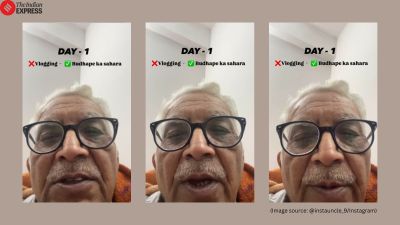
Age, as they say, should never stand in the way of new beginnings. A 70-year-old man from Uttar Pradesh has turned that belief into a living example, and his story has struck a chord online, with the internet cheering him on. At a stage of life when many choose to slow down, Vinod Kumar Sharma chose to pick up a smartphone and press record.