© IE Online Media Services Pvt Ltd
 6 min read


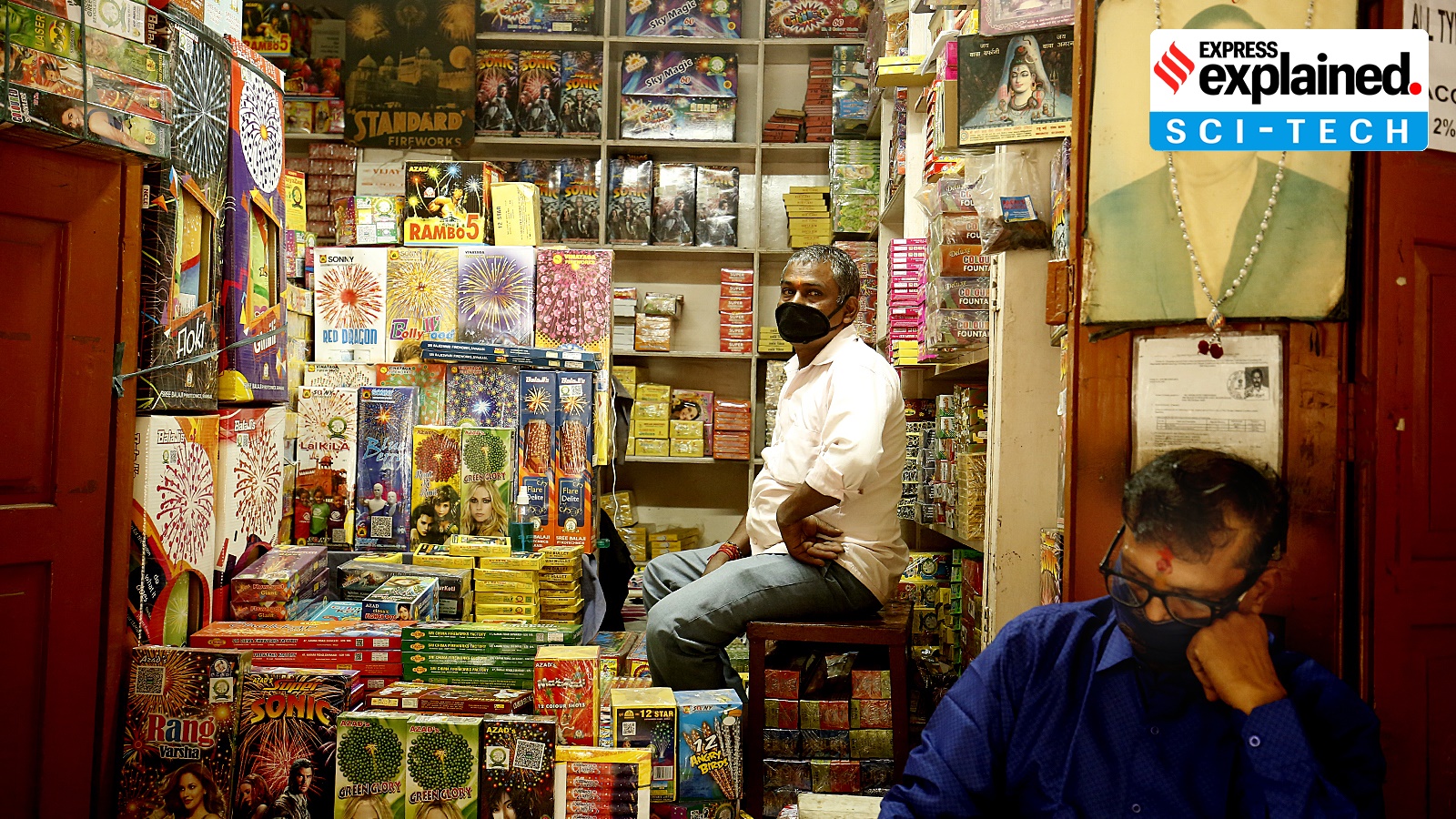 Green crackers 2025: Sale of Green Crackers at Old Delhi market in 2020. (EXPRESS PHOTO: Praveen Khanna)
Written by Dr. Wazeem Nishad
Green crackers 2025: When scientists at the Council of Scientific and Industrial Research–National Environmental Engineering Research Institute (CSIR-NEERI) developed green crackers, it marked an important step towards cleaner celebrations. Born out of a necessity to combat the thick, hazardous smog that chokes major cities during festivals, their efforts aimed to reduce smoke, noise, and harmful emissions through improved formulations and safer chemistry.
Seven years after their launch, it’s worth looking back to understand how far this innovation has come — and how green it truly is.
Traditional firecrackers rely on chemical mixtures of potassium nitrate, barium nitrate, aluminium powder, sulphur, and charcoal. These compounds produce brilliant colours and loud bangs but also emit fine particulate matter (PM₂.₅ and PM₁₀), sulphur dioxide (SO₂), and nitrogen oxides (NOₓ) — all major contributors to smog.
Scientists sought to reformulate these mixtures by reducing toxic metals and introducing additives that suppress dust. Green crackers, branded as SWAS (Safe Water Releaser), STAR (Safe Thermite Cracker) and SAFAL (Safe Minimal Aluminium), typically replace barium nitrate with potassium nitrate or strontium salts, limit aluminium content, and add compounds like zeolite and iron oxide to capture soot.
In NEERI’s emission tests, such formulations achieved 30-40 per cent lower PM and gas emissions compared with conventional fireworks (Wankhede et al., Environmental Pollution 2023).
Cleaner, but not pollution-free
Replacing barium nitrate has clear benefits. Barium compounds, responsible for the green flame, are highly soluble and can cause lung and heart toxicity. By cutting their content, scientists reduced the barium load in airborne PM₂.₅ and PM₁₀ by 30–60 per cent in laboratory tests (Wankhede et al., Environmental Pollution 2023). Yet, the same study found trace aluminium, copper and strontium particles still present in the emissions.
Soil analysis after firecracker burning confirmed that residual metals do not vanish. A 2024 experiment using laser-induced breakdown spectroscopy detected Al, Ba, Sr, and Mg in the ash and in surrounding soil samples, with concentrations of micronutrients like Fe, Cu, Mn, Zn and P rising above normal background levels (Dubey & Rai, Journal of Laser Applications 2024).
The researchers concluded that even “green” residues contaminate soil, although to a lesser degree than traditional fireworks.
In simple terms, green crackers release fewer toxic particles into the air, but the chemistry behind the sparkle is still not entirely clean.
The ultrafine particle puzzle
With green crackers, while the emission mass falls, some studies report a rise in ultrafine particles (UFPs) — those smaller than 100 nanometres, invisible but highly penetrative.
During a study in Delhi in 2019, after the use of green crackers, scientists recorded a 138 per cent jump in particle number concentration, with an average particle size of about 44 nm (Yadav et al., Journal of Environmental Management 2022). These nanoparticles, though tiny in mass, can travel deep into the lungs and bloodstream, posing serious health risks.
Health effects still a concern
Medical research links fireworks emissions to respiratory, cardiovascular, and neurological problems. Even short-term exposure to metal-rich PM can trigger asthma, bronchitis, and cardiac arrhythmia (Mehra et al., Pollution Research 2022).
The soluble barium oxides and aluminium particles produced on combustion are particularly harmful because they dissolve easily in body fluids, aggravating lung and muscle disorders (Wankhede et al., Environmental Pollution 2023).
During major festivals, emergency rooms in Indian cities report a marked increase in breathing difficulties. Though green crackers reduce pollutants somewhat, doctors caution that any form of smoke inhalation remains unsafe — especially for children, the elderly and those with chronic respiratory diseases.
Implementation challenges
Each approved batch of green crackers carries a logo and QR code, which can be scanned to verify authenticity — an effort to distinguish genuine low-emission products from ordinary ones. However, the system’s real-world effectiveness has been challenged by the proliferation of counterfeit products, making it difficult for consumers to guarantee they are purchasing a certified low-emission cracker.
Global scenario
The pursuit of cleaner fireworks globally is still in its early stages. While countries like China, the United States, and Japan have explored low-smoke or perchlorate-free formulations, these remain industry-led efforts, distinct from certified “green cracker” programmes.
Simultaneously, many nations, including China, the United Kingdom, and parts of the European Union, have restricted or banned fireworks in urban areas due to air quality and safety concerns.
India, through its government-backed initiative via CSIR-NEERI, remains the only country with a formal programme for developing and certifying low-emission fireworks, setting a distinct global precedent.
A step, not a solution
Evidence from multiple studies shows that green crackers are less polluting but not pollution-free. They lower overall emissions, remove some of the most hazardous metals, and make manufacturing marginally safer. But they still release ultrafine particles and residual toxins that harm air and soil quality. For cities like Delhi, where baseline air pollution is already severe, a 30 per cent emission cut does not make the air safe to breathe.
Experts suggest that green crackers should be treated as a transitional measure — better than the old ones, yet far from clean. Cleaner cracker formulations are in progress and appreciations, but the solution lies in striking a delicate balance between honouring traditions and addressing the urgent realities of climate change and the pursuit of net-zero goals.
Net zero, aimed at mitigating climate change, is not merely a technical milestone — it represents a societal transformation. The journey may be long, but every small step toward cleaner choices marks an essential beginning.
While it is true that firecrackers are used for only a few days a year, their short-term impact is severe, because large volumes of smoke and fine particles are released in a matter of hours, causing sharp pollution spikes.
Yet, when viewed over the entire year, emissions from vehicles, industries, waste burning, and other activities remain the dominant contributors to poor air quality.
Therefore it is important to recognise the impact of our daily choices and consumption — how we travel, consume energy, manage waste, what we purchase — and to embrace broader behavioural changes that can make a lasting difference in addressing air pollution and climate change.
Dr Wazeem Nishad is COO, IIT Bombay’s Research Hub for Green Energy and Sustainability (GESH IITB)