4 min read
© The Indian Express Pvt Ltd



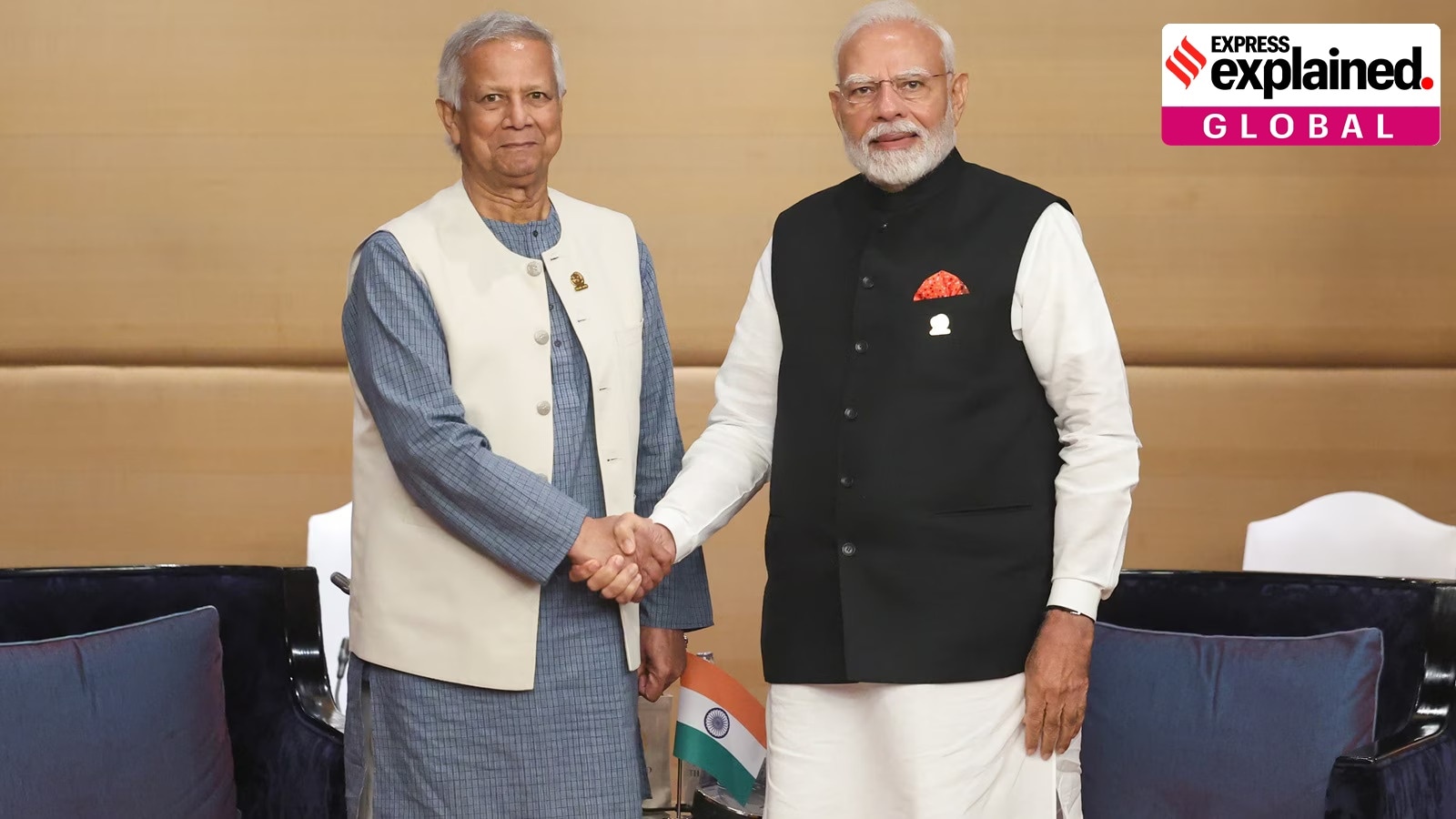 India-Bangladesh tensions: Prime Minister Narendra Modi with Bangladesh’s Chief Adviser Muhammad Yunus in Bangkok in April 2025. (Photo: MEA)
India-Bangladesh tensions news: The Ministry of External Affairs has summoned Bangladesh High Commissioner M Riaz Hamidullah over security concerns of the Indian High Commission in Dhaka.
The development has come after Bangladesh’s National Citizen Party (NCP) leader Hasnat Abdullah, on Monday (December 15), warned of isolating the Northeast’s Seven Sisters and offering shelter to separatist groups if India tried to destabilise Bangladesh.
Here is a look at who Hasnat Abdullah is, his warning, and how India has responded to his statement.
Abdullah, 27, came under the spotlight during the student-led protests against certain quotas in Bangladesh’s public jobs, which later snowballed into widespread demonstrations over Prime Minister Sheikh Hasina’s regime in 2024. Hasina was eventually ousted from power.
At the time of the protests, Abdullah was one of the coordinators of the Students Against Discrimination, a platform of student activists which was formed in 2024 during the protests.
However, after Hasina resigned, Abdullah became part of the NCP, which emerged in February 2025. The party appointed him as its chief organiser for the southern region of Bangladesh.
Abdullah is no stranger to controversies. For instance, in April 2025, he accused Bangladesh’s Army of interfering in political affairs. The remark led to an uproar, and the Army responded by calling Abdullah’s statement “ridiculous and immature”.
What is the latest statement by Abdullah about India?
Addressing a gathering at Dhaka’s Central Shaheed Minar, the young political leader said, “If Bangladesh is destabilised, the fire of resistance will spread beyond borders. Since you are housing those who destabilise us, we will give refuge to the separatists of the Seven Sisters too.”
He also said, “I want to say clearly to India that if you shelter forces who do not respect Bangladesh’s sovereignty, potential, voting rights and human rights, Bangladesh will respond.”
The Seven Sisters refer to India’s seven Northeast states. Currently, the rest of India’s only access to the seven Northeastern states is through the narrow Siliguri Corridor, which goes by the apt moniker of “Chicken’s Neck”. Straddled between Nepal and Bangladesh, and only 20 km at its narrowest, this corridor has long posed an economic and a strategic challenge to New Delhi — one that has prompted some experts to call it “an Achilles heel for India”.
Over the last decade-and-a-half, an important element of New Delhi’s engagement with the Hasina government in Dhaka was to open pathways to the Northeast via Bangladesh — as would have been the case pre-Partition. (Note that Agartala, the capital of Tripura, lies less than 200 km from the port of Chattogram in Bangladesh.)
However, after Hasina’s ouster and the installation of a seemingly “anti-India” interim government led by Nobel Peace Prize laureate Muhammad Yunus, these plans have fallen by the wayside.
How has India responded to Abdullah’s statement?
In a statement, the MEA has said, “The Bangladesh High Commissioner to India, Riaz Hamidullah, was today summoned by the Ministry of External Affairs and apprised of India’s strong concerns at the deteriorating security environment in Bangladesh. His attention was drawn, in particular, to the activities of some extremist elements who have announced plans to create a security situation around the Indian Mission in Dhaka.”
It further said: “India completely rejects the false narrative sought to be created by extremist elements regarding certain recent events in Bangladesh. It is unfortunate that the interim government has neither conducted a thorough investigation nor shared meaningful evidence with India regarding the incidents.”