Premium
This is an archive article published on September 3, 2019

Explained: How to read GDP data

Q1 growth data show that the two biggest job-providing sectors, Agriculture and Industry, are witnessing feeble income growth. That explains why private consumption demand has collapsed in the economy

India gdp, national statistical commission, gdp growth during upa regime, India GDP modi govt, Niti Aayog, indian economy, gdp report, India GDP explained, Indian express The GDP is arrived at from the demand side. It is calculated by mapping the expenditure made by different categories of spenders.
The Central Statistics Office (CSO) on Friday released the economic growth data for the first quarter (Q1, or April to June) of the current financial year (2019-20, or FY20). A disappointing number was widely expected, especially after the 5.8% growth in Q4 of FY19, and the wave of bad news such as falling sales of automobiles and everyday consumables — even so, the official GDP data of just 5% came as a shock to many.

Real vs Nominal Growth

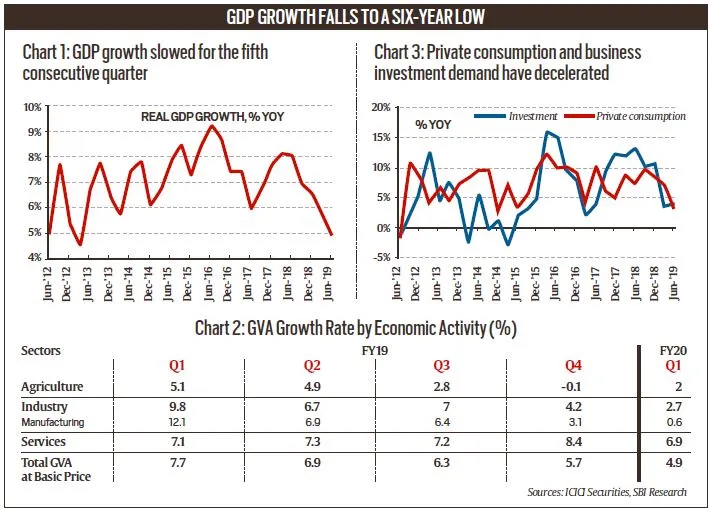
At 5%, the real GDP growth rate has hit a six-year low (see Chart 1). Real GDP growth rate is a derived figure — it is arrived at by subtracting the inflation rate from the nominal GDP growth rate, that is growth rate calculated at current prices. What is more worrying is the deceleration in the nominal GDP growth, which has been pegged at 8% for Q1. For perspective, it should be noted that the Union Budget, presented on July 5, had expected a nominal growth of 12%. The idea was that with a 12% nominal growth and 4% inflation rate, real GDP would be 8%.

At 8% nominal growth, all calculations — real GDP and tax revenues etc. — go haywire. An 8% nominal growth is unusually low; just once has nominal growth fallen to this level in both the current GDP series (with a base year of 2011-12) and the past GDP series (with the base year of 2004-05). And that was in the wake of the global financial crisis in 2009.

GVA vs GDP

There are two main ways in which the CSO estimates economic growth. One is from the supply side — that is, by mapping the value-added (in rupee terms) by the various sectors in the economy. The sectors are broadly divided into Agriculture, Industry and Services, and all workers in the economy fall into one or the other category.
There are sub-categories too — Industry, for example, has Manufacturing, Construction, Mining & Quarrying, etc. When all the value-added is totalled, we get the Gross Value Added (GVA) in the economy. In other words, GVA tracks the income generated for all the workers in the economy.

how to read GDP data, India gdp, gdp growth during upa regime,India GDP modi govt, Niti Aayog, indian economy, gdp report, India GDP explained, Indian express Real GDP growth rate is a derived figure — it is arrived at by subtracting the inflation rate from the nominal GDP growth rate, that is growth rate calculated at current prices.

The GDP is arrived at from the demand side. It is calculated by mapping the expenditure made by different categories of spenders. Broadly speaking, there are four sources of expenditure in an economy — namely, private consumption, government consumption, business investments, and net exports (exports minus imports). Because the GDP maps final expenditure, it includes both taxes and subsidies that the government receives and gives. This component, net taxes, is the difference between GVA and GDP.

Typically, GDP is a good measure when you want to compare India with another economy, while GVA is better to compare different sectors within the economy. GVA is more important when looking at quarterly growth data, because quarterly GDP is arrived at by apportioning the observed GVA data into different spender categories.

The supply-side story

The GVA in Q1 is pegged at 4.9%. Such a low level of GVA suggests that producers are not adding enough value — in other words, their income growth is low.

Story continues below this ad

As Chart 2 shows, growth in all three sectors has declined, but most of the decline is in Agriculture and Industry. Within Industry, Manufacturing has seen a spectacular collapse. Other sub-sectors of Industry such as Mining & Quarrying and Construction too, have slumped over the past five quarters.

These two sectors — Agriculture and Industry — not only employ the largest number of people, but also have the maximum potential to create new jobs. Stagnant Agriculture and Industry imply that a bulk India’s poorest and less educated workforce is either not getting jobs, or not seeing their incomes grow. And they can’t shift to the better-paying Services sector because of the deficiency in skills.

The demand-side story

The GVA weakness shows up on the demand side (Chart 3). Private consumption, which accounts for over 55% of GDP, has grown by just 3.14%. The reason why private demand has collapsed is that the bulk of India’s labour force is not earning enough to spend more.

The other big GDP component — business investments (which accounts for 32% of GDP) — has grown by just 4.04%. Businesses are not investing because they are either in the process of deleveraging (getting rid of excess loans) or stuck with unsold inventories. The only spender that has grown better than expected is the government.

Story continues below this ad

What the numbers imply

Firstly, the growth trajectory suggests there is more pain ahead. According to an analysis by State Bank of India, when GDP grew by 8% in Q1 of FY19, 70% of the leading indicators such as car sales showed acceleration. In this quarter, only 35% of these indicators showed acceleration, and GDP grew by 5%. For Q2 (July to September), only 24% indicators show acceleration.

Secondly, since the release, GDP growth rate forecasts for the current year have been dialled down yet again. Most observers expected a real GDP growth rate of somewhere between 5.4% and 6.4% for Q1. Now, SBI pegs the full-year growth at 6.1%, ICICI Securities at 6.3%, and Pronab Sen, former Chief Statistician, pegs it at 5.5%. Roughly six months ago, most estimates for FY20 were around 7.5%.

Thirdly, such weak growth implies that the government’s fiscal deficit figures are likely to be breached.
Lastly, since weak growth will lead to lower tax revenues, the government is likely to struggle if it wants to push up growth by spending on its own.

Udit Misra is Senior Associate Editor at The Indian Express. Misra has reported on the Indian economy and policy landscape for the past two decades. He holds a Master’s degree in Economics from the Delhi School of Economics and is a Chevening South Asia Journalism Fellow from the University of Westminster. Misra is known for explanatory journalism and is a trusted voice among readers not just for simplifying complex economic concepts but also making sense of economic news both in India and abroad. Professional Focus He writes three regular columns for the publication. ExplainSpeaking: A weekly explanatory column that answers the most important questions surrounding the economic and policy developments. GDP (Graphs, Data, Perspectives): Another weekly column that uses interesting charts and data to provide perspective on an issue dominating the news during the week. Book, Line & Thinker: A fortnightly column that for reviewing books, both new and old. Recent Notable Articles (Late 2025) His recent work focuses heavily on the weakening Indian Rupee, the global impact of U.S. economic policy under Donald Trump, and long-term domestic growth projections: Currency and Macroeconomics: "GDP: Anatomy of rupee weakness against the dollar" (Dec 19, 2025) — Investigating why the Rupee remains weak despite India's status as a fast-growing economy. "GDP: Amid the rupee's fall, how investors are shunning the Indian economy" (Dec 5, 2025). "Nobel Prize in Economic Sciences 2025: How the winners explained economic growth" (Oct 13, 2025). Global Geopolitics and Trade: "Has the US already lost to China? Trump's policies and the shifting global order" (Dec 8, 2025). "The Great Sanctions Hack: Why economic sanctions don't work the way we expect" (Nov 23, 2025) — Based on former RBI Governor Urjit Patel's new book. "ExplainSpeaking: How Trump's tariffs have run into an affordability crisis" (Nov 20, 2025). Domestic Policy and Data: "GDP: New labour codes and opportunity for India's weakest states" (Nov 28, 2025). "ExplainSpeaking | Piyush Goyal says India will be a $30 trillion economy in 25 years: Decoding the projections" (Oct 30, 2025) — A critical look at the feasibility of high-growth targets. "GDP: Examining latest GST collections, and where different states stand" (Nov 7, 2025). International Economic Comparisons: "GDP: What ails Germany, world's third-largest economy, and how it could grow" (Nov 14, 2025). "On the loss of Europe's competitive edge" (Oct 17, 2025). Signature Style Udit Misra is known his calm, data-driven, explanation-first economics journalism. He avoids ideological posturing, and writes with the aim of raising the standard of public discourse by providing readers with clarity and understanding of the ground realities. You can follow him on X (formerly Twitter) at @ieuditmisra           ... Read More


Latest Comment
Post Comment
Read Comments
Advertisement
Loading Taboola...
Advertisement
Advertisement
Advertisement