© The Indian Express Pvt Ltd
 7 min read


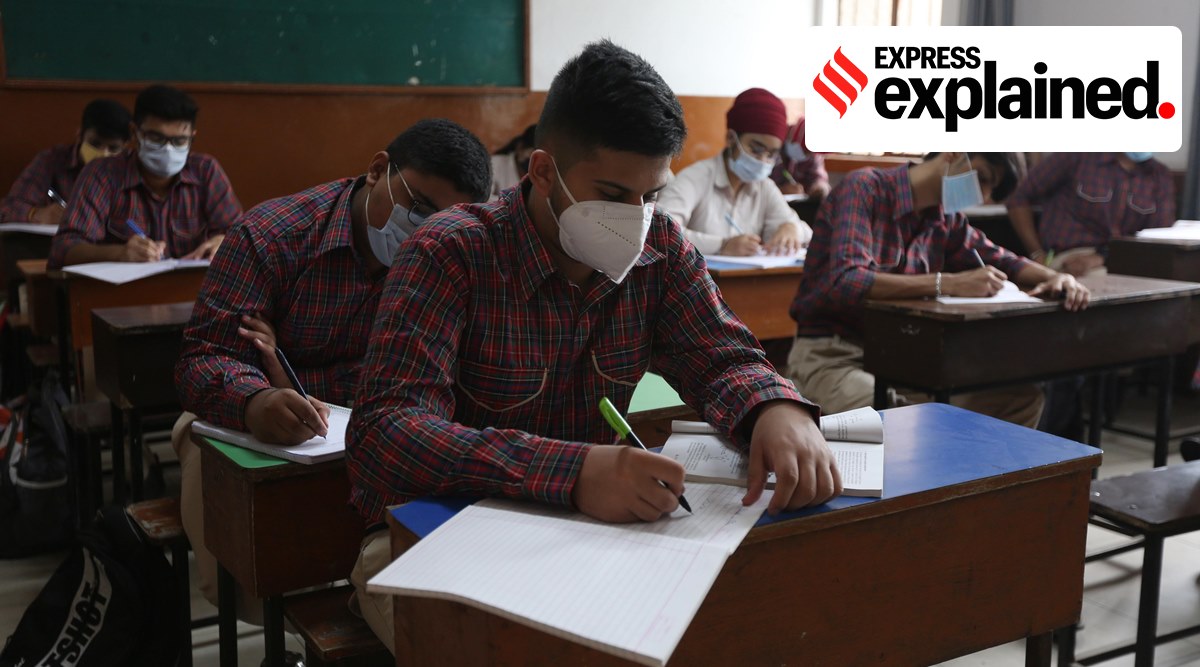 Schools in Punjab reopened for Classes 10 to 12 at DAV Public School at BRS Nagar in Ludhiana in July. (Express Photo: Gurmeet Singh)
The examination schedule released by the Central Board of Secondary Education (CBSE) this week is at the centre of a political controversy, with Punjab Chief Minister Charanjit Singh Channi criticising the school board for keeping Punjabi out of the “main” subjects.
The decision, he tweeted on Thursday, was against the federal spirit of the Constitution, and violates the right of Punjabi youth to learn their native language.
I firmly oppose the CBSE’s authoritarian decision to keep Punjabi out of the main subjects. This is against the federal spirit of Constitution, violating the right of Punjabi youth to learn their native language. I condemn this biased exclusion of Punjabi.
— Charanjit S Channi (@CHARANJITCHANNI) October 21, 2021
The Indian Express explains how an examination date sheet has acquired political overtones in Punjab:
First, why has CBSE released the Board examination date sheet so early this year?
In view of the Covid-19 pandemic disrupting the Board examination for two consecutive years, the CBSE, in July, announced a new assessment scheme for the Class 10 and 12 board exams in 2022. Instead of a single Board exam at the end of the year, CBSE has split the academic year 2021-22 into two terms, and it will conduct exams at the end of each.
The first-term exam will be conducted in November-December and the second term in March-April. This week, the Board released the date sheet for the first-term exam.
To conduct the examination, CBSE has categorised subjects under two heads — minor and major — and released separate date sheets for each category. For instance, in the case of Class 10 schedule, subjects such as Social Science, Science, Mathematics, Hindi, Computer Application and English are classified as ‘major’ subjects. On the other hand, regional languages such as Urdu, Punjabi, Bengali, Tamil, Telugu, Gujarati, Marathi, Sanskrit and foreign languages such as French, German and Tibetan fall in the ‘minor’ category.
But why has the Board issued separate schedules for ‘major’ and ‘minor’ subjects this year?
CBSE offers 114 subjects to Class 12 students and 75 subjects in Class 10. Meaning the Board has to conduct examinations for 189 subjects. Preparing a single schedule for 189 subjects would mean the entire duration of the exams would last around 40-45 days. So, CBSE decided to divide subjects into two categories and release a separate date sheets for each to shorten the duration.
Major subjects are those that all affiliated schools offer. Since all schools do not offer ‘minor’ subjects, the Board can conduct more than one paper a day for subjects under this category and save time.
Why is the Punjab government upset over the CBSE exam schedule for the first term?
Politicians in Punjab, including education minister Pargat Singh and the chief minister have objected to the inclusion of Punjabi language in the list of ‘minor’ subjects. Singh was the first to react to the examination date sheet calling it a “conspiracy to wean children away from their mother tongue.” He has said that “at least in their respective states, regional languages should be included in the list of main subjects.” Asking the CBSE to reconsider its decision, he further said that he would urge the union education minister to roll back the move.
What impact will CBSE’s classification of subjects have on the teaching-learning of Punjabi in schools?
Classification of subjects for (the ease of) preparing the examination date sheet has no implications for the teaching of Punjabi (or any other minor subject) in schools. There’s been no change in either the syllabus or marking scheme for any subject. CBSE has even clarified that the decision to issue two separate schedules is purely “administrative” and has been made based on the number of candidates that will appear for a paper. The major-minor classification is in no way a reflection of the academic importance of a subject, CBSE spokesperson Rama Sharma told The Indian Express. Moreover, Punjabi is not the only language on the ‘minor’ list. All regional languages, including Gujarati, Telugu, Bengali, Sindhi, Marathi, and other subjects such as agriculture, food production, and retailing, are listed as ‘minor’ subjects.
“Every subject is equally important from the academic point of view. Punjabi is one of the regional languages being offered. All the regional languages have been put under a minor category for the purpose of administrative convenience in relation to the logistics required for the conduct of examinations,” Sharma told this newspaper.
What does CBSE’s scheme of studies say about the selection of languages by students?
As per the Board’s “scheme of studies” for secondary education (Class 9 and 10), there are five compulsory subjects — two languages, mathematics, science and social science. One compulsory language has to be either English or Hindi. The second compulsory language can be chosen from the list of 40 languages provided by the Board, including regional languages such as Punjabi. Students can also opt for a third language and appear for an additional exam.
Similarly, for Class 11 and 12, students must opt for either Hindi or English as one of the two languages. The second language and an additional language can be chosen from the Board’s list, which also includes Punjabi.
However, students of all CBSE-affiliated schools in Punjab have to study Punjabi as one of the two languages up to Class 10 by default. This is because the Punjab Learning of Punjabi and Other Languages Act, 2008, makes it mandatory for all schools to teach Punjabi as a compulsory subject in Classes 1 to 10. Moreover, the law empowers the government to act against erring schools.
Newsletter | Click to get the day’s best explainers in your inbox
How have principals of CBSE schools in Punjab reacted to the controversy?
Schools principals, who spoke to The Indian Express on the condition of anonymity, said that a “non-issue” is being given a political colour. The state government, they said, has misunderstood the classification of Punjabi as a ‘minor’ subject as a decision that affects the compulsory teaching of the language in schools.
“CBSE exam schedule has nothing to do with Punjabi being offered as a compulsory subject in Punjab schools or not. It is the duty of the state education department to check that the law which makes it compulsory for Punjabi to be taught from Classes 1 to 10 was followed across all schools, not of the Board,” said a principal.
“The CBSE scheme is very clear for Classes 9 to 12. It does not give preference to any one language. Students have to study either English or Hindi as one language in Class 10 and the second one can be chosen from the list, which also includes Punjabi. There is also a provision of taking an exam for a third language. The classification of regional languages as ‘minor subjects’ for examination purposes doesnt mean Punjabi is less important. Not just Punjabi but other languages such as Urdu, Sanskrit, Gujarati, Telugu have also been classified as ‘minor subjects’ because it is obvious that fewer students will sit for an exam in these subjects as they are state specific,” said another principal.