12 min read
© IE Online Media Services Pvt Ltd
Latest Comment
Post Comment
Read Comments



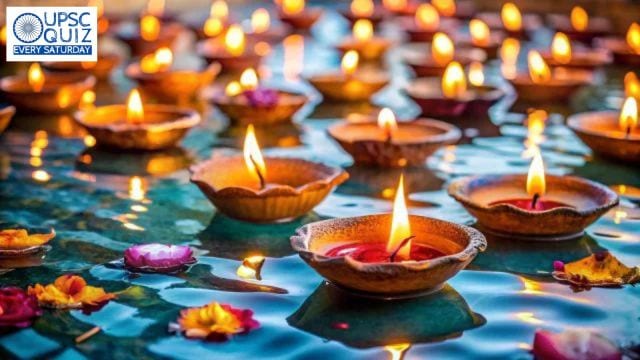 Brush up your current affairs knowledge with this week's top 10 questions. Find a question on the UNESCO Representative List of the Intangible Cultural Heritage of Humanity in today's quiz. (Pixabay)
UPSC Weekly Quiz is a current affairs-based quiz on relevant topics from the past week, curated for the aspirants of competitive examinations. Attempt the weekly quiz every Saturday and find answers to the MCQs with explanations.
🚨 Click Here to read the UPSC Essentials magazine for November 2025. Share your views and suggestions in the comment box or at manas.srivastava@indianexpress.com🚨
Which of the following has been inscribed on UNESCO’s Representative List of the Intangible Cultural Heritage of Humanity?
1. Kumbh Mela
2. Durga Puja of Kolkata
3. Garba dance of Gujarat
4. Ramlila – the traditional performance of the epic ‘Ramayana’
5. Deepavali
Select the correct answer using the codes given below:
(a) 2, 3 and 5
(b) 2, 3 and 4
(c) 1, 3 and 4
(d) 1, 2, 3, 4 and 5
Explanation
— The decision was taken during a key meeting of the United Nations Educational, Scientific and Cultural Organisation (Unesco) being hosted at the Red Fort in Delhi. For the next year’s cycle, India has sent a nomination dossier for Bihar’s Chhat Puja for the consideration of the Unesco committee.
— India currently has 15 elements inscribed on Unesco’s Representative List of the Intangible Cultural Heritage of Humanity, and these include the Kumbh Mela, Durga Puja of Kolkata, Garba dance of Gujarat, yoga, the tradition of Vedic chanting, and Ramlila – the traditional performance of the epic ‘Ramayana’.
— The Intergovernmental Committee advances the objectives of the 2003 Convention and ensures their effective implementation across member states. It offers guidance on best practices, recommends safeguarding measures, and mobilises resources for the Intangible Cultural Heritage Fund.
Therefore, option (d) is the correct answer.
The Jackson Gate, a royal-era landmark demolished during the Left Front regime in 1981, was recently in the news. It is located in:
(a) Assam
(b) Tripura
(c) Odisha
(d) West Bengal
Explanation
— In November this year, Tripura Chief Minister Dr Manik Saha announced a decision that revived memories of a vanished landmark. The state government, he said, would rebuild the Jackson Gate in Agartala, a royal-era landmark demolished during the Left Front regime in 1981.
— Ninety-six years ago, a custom-made concrete gate modelled on Hyderabad’s Charminar was erected on Central Road, the main thoroughfare leading to the Ujjayanta Palace — the seat of the Manikya dynasty that ruled the erstwhile princely state of Tripura.
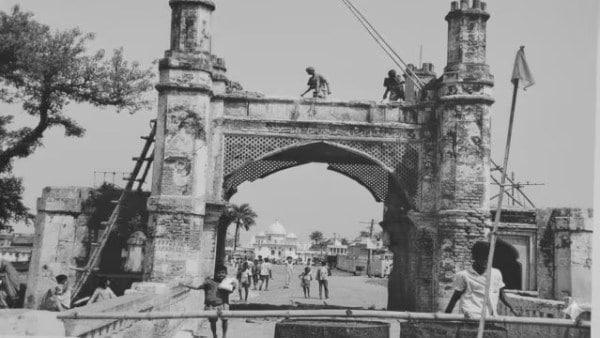 (Image enhanced using AI)
— The last reigning king, Maharaja Bir Bikram Kishore Manikya Bahadur, was coronated in 1927. A year and a half later, in August 1929, he held his first Raj Darbar. Sir Francis Stanley Jackson, then Governor of the Bengal province, attended as the special guest.
— Although Tripura was autonomously ruled by the Manikya kings, it remained a British protectorate. The Governor’s presence. Therefore, it had diplomatic significance, and the royal court was eager to present Tripura in its best light.
Therefore, option (b) is the correct answer.
The Shyok tunnel is of key strategic significance as it would provide all-weather connectivity to:
(a) Southern Jammu and Kashmir
(b) Western Ladakh
(c) Northern Himachal Pradesh
(d) Eastern Ladakh
Explanation
— Defence Minister Rajnath Singh inaugurated 125 infrastructure projects of the Border Roads Organisation (BRO), including the Shyok Tunnel on the Durbuk-Shyok-Daulat Beg Oldie Road that runs along the Line of Actual Control (LAC) in eastern Ladakh.
— The Shyok Tunnel is of key strategic significance as it would provide all-weather connectivity to areas close to the LAC; it would particularly help in the quick mobilisation and redeployment of troops when needed. Sources said the tunnel will also likely reduce dependence on air maintenance and resolve logistical challenges in the difficult terrains.
— The Shyok tunnel is of key strategic significance as it would provide all-weather connectivity to areas close to the LAC in eastern Ladakh, where India and China were locked in a military standoff between 2020-2024 before both sides decided to disengage from all friction points along the border.
Therefore, option (d) is the correct answer.
With reference to the Pax Silica Initiative, consider the following statements:
1. It is a Russia-led strategic initiative.
2. India is a member of this initiative.
3. It aims to build a secure supply chain ranging from critical minerals and energy inputs to advanced manufacturing and semiconductors.
How many of the statements given above are correct?
(a) Only one
(b) Only two
(c) All three
(d) None
Explanation
— A new US-led strategic initiative, Pax Silica, which aims to build a secure supply chain ranging from critical minerals and energy inputs to advanced manufacturing and semiconductors, does not include India. Hence, statements 1 and 2 are not correct and statement 3 is correct.
— Pax Silica, founded on close collaboration with trusted partners, seeks to decrease coercive reliance, preserve the materials and capabilities that underpin artificial intelligence, and ensure allied nations may develop and deploy breakthrough technologies on a large scale.
— The inaugural Pax Silica Summit brings together peers from Japan, the Republic of Korea, Singapore, the Netherlands, the United Kingdom, Israel, the United Arab Emirates, and Australia.
Therefore, option (a) is the correct answer.
(Other Source: http://www.state.gov)
Which of the following are the measures taken under GRAP Stage III?
1. Complete shutdown of all schools and colleges.
2. Ban on construction activities
3. Odd–even scheme for all private vehicles
Select the correct answer using the codes given below:
(a) 1 and 2 only
(b) 2 only
(c) 1, 2 and 3
(d) 2 and 3 only
Explanation
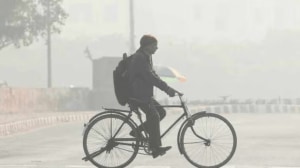
— The Delhi government has reinstated GRAP Stage III after previously lifting it, following a sharp rise in the city’s Air Quality Index (AQI). The worsening air quality is attributed to slow wind speed, a stable atmosphere, unfavourable weather conditions, and poor dispersal of pollutants.
Measures taken under GRAP Stage III
– Hybrid learning for students up to Class V.
– Ban on construction activities. Hence, statement 2 is correct.
– NCR governments can take a decision on allowing public, municipal and private offices to work on 50 percent strength and the rest to work from home.
– The Centre may similarly implement work-from-home arrangements for central government employees..
— A complete shutdown of all schools and colleges is considered under Stage IV (Severe+) and the odd–even vehicle scheme is under Stage IV. Hence, statements 1 and 3 are not correct.
Therefore, option (b) is the correct answer.
Which countries were flagged for climate-related corruption concerns as per the 2024 Corruption Perceptions Index (CPI)?
1. Bangladesh
2. India
3. Vanuatu
4. Mauritius
5. Maldives
6. Canada
Select the correct answer using the codes given below:
(a) 1, 2, 3, and 5
(b) 1, 3, 4, 5 and 6
(c) 2 and 6 only
(d) 1, 2, 3 and 6
Explanation
— Governments across the Asia-Pacific are failing to keep pace with their own anti-corruption pledges, Transparency International warned in its 2024 Corruption Perceptions Index (CPI). The region’s score has slipped after years of stagnation, with the watchdog linking the decline directly to vulnerabilities in climate finance and governance.
— The watchdog said governments across the Asia Pacific region are falling short in their commitment to curb corruption. The region’s average CPI score slipped by one point to 44, ending years of stagnation.
— The report stated that Asia Pacific — home to a third of the global population and one of the most disaster-exposed regions — faces severe risks if governance systems fail to protect climate funds.
Countries flagged for climate-related corruption concerns
— Bangladesh: Research indicates climate finance is vulnerable and being misused.
— Pakistan: Governance gaps have delayed key provisions of the Climate Change Act; financing remains far below the estimated US$348 billion needed by 2030.
— India: A US indictment alleges over US$250 million in bribes to secure solar energy contracts, indicating the need for stronger safeguards.
Small island states:
— Papua New Guinea: Corruption allegations at its Climate Change and Development Authority.
— Vanuatu: Political instability and integrity concerns.
— Maldives: Civil society raised warnings about weakening democratic checks.
— Mauritius and Canada were not flagged for climate-related corruption concerns as per the 2024 Corruption Perceptions Index
Therefore, option (a) is the correct answer.
The Extended Fund Facility (EFF) is a part of:
(a) World Bank
(b) World Trade Organisation
(c) International Monetary Fund
(d) New Development Bank
Explanation
— The IMF, however, imposed 11 new structural benchmarks for Pakistan to avail its loan, out of which three conditions related to tax reforms, asset declarations of government officials, and private sector participation in the energy sector have to be met by the country by end-December.
— The IMF released the country report for Pakistan on Thursday (December 11) after agreeing in October to process the second $1-billion tranche for the country as part of its $7-billion Extended Fund Facility (EFF) lending program, and conducting the first review of the arrangement under the Resilience and Sustainability Facility (RSF), allowing Islamabad to draw $200 million.
Therefore, option (c) is the correct answer.
Shia Alawites, the Druze, and Kurds are the communities in:
(a) Iran
(b) Greece
(c) Oman
(d) Syria
Explanation
— Since the fall of the Assad regime, there has been widespread ethnic violence, with Sunni groups aligned to the new regime targeting minority communities, notably, Shia Alawites (Assad’s community), the Druze, and Kurds. Al-Sharaa has been criticised for not doing enough to control this violence.
Therefore, option (d) is the correct answer.
With reference to Thomas Macaulay, consider the following statements:
1. He pushed for English-medium, Western-style education.
2. He was the first ever law member of the Governor-General’s Council of India.
Which of the statements given above is/are correct?
(a) 1 only
(b) 2 only
(c) Both 1 and 2
(d) Neither 1 nor 2
Explanation
— The first ever medical college anywhere in the country, focused exclusively on allopathy or the Western medical system, was set up on January 28, 1835. It was quaintly called “Medical College, Bengal”, which has since gained currency as Calcutta Medical College.
— It was this breakthrough in modernity that served as the immediate impetus for Thomas Macaulay’s much-maligned Minute on Education that pushed for English-medium, Western-style education. Macaulay wrote his Minute just five days after the commencement of the medical college, as the first ever law member of the Governor-General’s Council of India. Hence, statements 1 and 2 are correct.
Therefore, option (c) is the correct answer.
Read more: How Macaulay’s education agenda was shaped by India’s first allopathy medical college
With reference to the Atomic Energy Bill, 2025, consider the following statements:
1. It is also known as the Sustainable Harnessing and Advancement of Nuclear Energy for Transforming India (SHANTI) Bill.
2. It will enable private companies to enter nuclear power plant operations in India.
3. It aims to progressively add 1000 gigawatt electric (GWe) of nuclear capacity by 2047.
How many of the statements given above are correct?
(a) Only one
(b) Only two
(c) All three
(d) None
Explanation
— It is aimed at tweaking the Atomic Energy Act 1962 to enable private companies to enter nuclear power plant operations in India. Hence, statement 2 is correct.
— Consequently, private players could take a minority equity exposure of up to 49 per cent in upcoming nuclear power projects, with the move also potentially setting the stage for foreign companies, in collaboration with global sovereign wealth funds, to infuse equity into these projects. Hitherto, atomic energy has been one of India’s most closed sectors.
— The approved Atomic Energy Bill, 2025, or the Sustainable Harnessing and Advancement of Nuclear Energy for Transforming India (SHANTI) Bill as the rebadged legislation has been named, comes amid the country’s plan to progressively add 100 gigawatt electric (GWe) of nuclear capacity by 2047, up from the current installed nuclear capacity of under 8 GWe. Hence, statement 1 is correct and statement 3 is not correct.
— The US has the highest operational nuclear capacity of 100 GWe, followed by France (65 GWe) and China (58 GWe).
Therefore, option (b) is the correct answer.
UPSC Weekly Current Affairs Quiz | November 30 to December 06, 2025
UPSC Weekly Current Affairs Quiz | November 23 to November 29, 2025
UPSC Weekly Current Affairs Quiz | November 16 to November 22, 2025
UPSC Weekly Current Affairs Quiz | November 09 to November 15, 2025
UPSC Weekly Current Affairs Quiz | November 02 to November 08, 2025
Subscribe to our UPSC newsletter and stay updated with the news cues from the past week.
Stay updated with the latest UPSC articles by joining our Telegram channel – IndianExpress UPSC Hub, and follow us on Instagram and X.

Read UPSC Magazine