30 min read


© IE Online Media Services Pvt Ltd



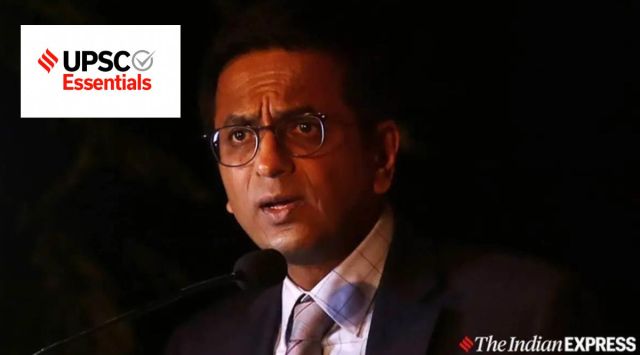 A CJI Chandrachud-led bench of the Supreme Court decided to examine a petition challenging the constitutional validity of Section 376 DB of the Indian Penal Code. (File)
(The UPSC Essentials Indian Express is now on Telegram. Click here to join our channel and stay updated with the latest updates.
Subscribe to The Indian Express UPSC Key and prepare for the Civil Services and other competitive examinations with cues on how to read and understand content from the most authoritative news source in India.
Note: Catch the UPSC Weekly Quiz every Saturday evening and brush up on your current affairs knowledge.)
Essential key terms from the last week’s news headlines or between the lines categorised as per the relevance to the UPSC-CSE syllabus along with the MCQs followed.
Why in news?
— New Delhi has issued a notice to Islamabad seeking modification of the more than six-decade-old Indus Waters Treaty (IWT) that governs the sharing of waters of six rivers in the Indus system between the two countries. New Delhi said the notice follows Pakistan’s continued “intransigence” in implementing the treaty, by raising repeated objections to the construction of hydel projects on the Indian side.
— The notice, sent on January 25 through the Commissioner for Indus Waters, gives Pakistan 90 days to consider entering into intergovernmental negotiations to rectify the material breach of the treaty.
— The notice has invoked Article XII (3) of the treaty which says: The provisions of this Treaty may from time to time be modified by a duly ratified treaty concluded for that purpose between the two Governments.
KEY TAKEAWAYS
What is the Indus Water Treaty (IWT)?
— The six rivers of the Indus basin originate in Tibet and flow across the Himalayan ranges to end in the Arabian sea south of Karachi. Preceding partition, it was one common network for both India and Pakistan. However, while partition managed to draw terrestrial borders, the question of how to divide the Indus waters was something that needed to be worked out. Since the rivers flowed from India to Pakistan, the latter was unsurprisingly threatened by the prospect of being fed by the former.
— Initially, the issue of water sharing was sorted out by the Inter-Dominion accord of May 4, 1948 that laid out that India would release enough waters to Pakistan in return for annual payments from the latter. The problems of this arrangement was soon realised and it was considered necessary to find an alternative solution.
— Eventually, in 1960, the two countries reached a decisive step with the intervention of the World Bank wherein precise details were laid out regarding the way in which the waters would be distributed. The components of the treaty were fairly simple. The three western rivers (Jhelum, Chenab and Indus) were allocated to Pakistan while India was given control over the three eastern rivers (Ravi, Beas and Sutlej). While India could use the western rivers for consumption purpose, restrictions were placed on building of storage systems. The treaty states that aside of certain specific cases, no storage and irrigation systems can be built by India on the western rivers.
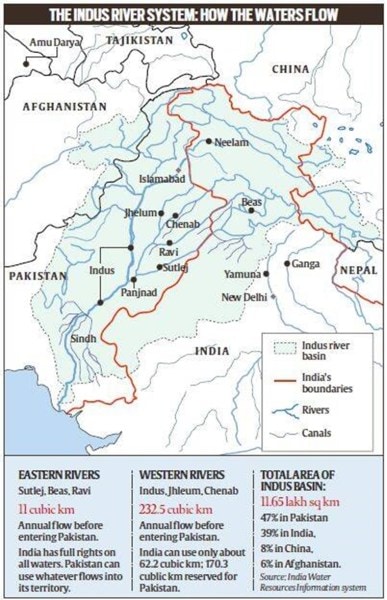
Map showing the Indus water system that is crucial for both Pakistan and Northern India. (Express Graphic)
Harikishan Sharma and Amitabh Sinha Explain:
What is the history of the dispute over the hydel projects?
— The notice appears to be a fallout of a longstanding dispute over two hydroelectric power projects that India is constructing – one on the Kishanganga river, a tributary of Jhelum, and the other on the Chenab.
— Pakistan has raised objections to these projects, and dispute resolution mechanisms under the Treaty have been invoked multiple times. But a full resolution has not been reached.
— In 2015, Pakistan asked that a Neutral Expert should be appointed to examine its technical objections to the Kishanganga and Ratle HEPs. But the following year, Pakistan unilaterally retracted this request, and proposed that a Court of Arbitration should adjudicate on its objections.
— In August 2016, Pakistan had approached the World Bank, which had brokered the 1960 Treaty, seeking the constitution of a Court of Arbitration under the relevant dispute redressal provisions of the Treaty.
— Instead of responding to Pakistan’s request for a Court of Arbitration, India moved a separate application asking for the appointment of a Neutral Expert, which is a lower level of dispute resolution provided in the Treaty. India had argued that Pakistan’s request for a Court of Arbitration violated the graded mechanism of dispute resolution in the Treaty.
— In between, a significant event had happened which had consequences for the Treaty. A Pakistan-backed terror attack on Uri in September 2016 had prompted calls within India to walk out of the Indus Waters Treaty, which allots a significantly bigger share of the six river waters to Pakistan. The Prime Minister had famously said that blood and water could not flow together, and India had suspended routine bi-annual talks between the Indus Commissioners of the two countries.
What happened with the two applications moved by Pakistan and India?
— The World Bank, the third party to the Treaty and the acknowledged arbiter of disputes was, meanwhile, faced with a unique situation of having received two separate requests for the same dispute. New Delhi feels that the World Bank is just a facilitator and has a limited role.
— On December 12, 2016, the World Bank had announced a “pause” in the separate processes initiated by India and Pakistan under the Indus Waters Treaty to allow the two countries to consider alternative ways to resolve their disagreements.
— The regular meetings of Indus Waters Commissioners resumed in 2017, and India tried to use these to find mutually agreeable solutions between 2017 and 2022. Pakistan, however, refused to discuss these issues at these meetings, sources said.
— At Pakistan’s continued insistence, the World Bank, in March last year, initiated actions on the requests of both India and Pakistan. On March 31, 2022, the World Bank decided to resume the process of appointing a Neutral Expert and a Chairman for the Court of Arbitration. In October last year, the Bank named Michel Lino as the Neutral Expert and Prof. Sean Murphy as Chairman of the Court of Arbitration.
“They will carry out their duties in their individual capacity as subject matter experts and independently of any other appointments they may currently hold,” the Bank said in a statement on October 17, 2022.
— On October 19, 2022, the Ministry of External Affairs said, “We have noted the World Bank’s announcement to concurrently appoint a Neutral Expert and a Chair of the Court of Arbitration in the ongoing matter related to the Kishanganga and Ratle projects.” Recognising the World Bank’s admission in its announcement that “carrying out two processes concurrently poses practical and legal challenges”, India would assess the matter, the MEA said. “India believes that the implementation of the Indus Water Treaty must be in the letter and spirit of the Treaty,” the MEA statement added.
— Such parallel consideration of same issues is not provided for in any provisions of the Treaty, and India has been repeatedly citing the possibility of the two processes delivering contradictory rulings, which could lead to an unprecedented and legally untenable situation, which is unforeseen in Treaty provisions.
What exactly is the dispute redressal mechanism laid down under the Treaty?
— The dispute redressal mechanism provided under Article IX of the IWT is a graded mechanism. It’s a 3-level mechanism. So, whenever India plans to start a project, under the Indus Water Treaty, it has to inform Pakistan that it is planning to build a project.
— Pakistan might oppose it and ask for more details. That would mean there is a question — and in case there is a question, that question has to be clarified between the two sides at the level of the Indus Commissioners.
— If that difference is not resolved by them, then the level is raised. The question then becomes a difference. That difference is to be resolved by another set mechanism, which is the Neutral Expert. It is at this stage that the World Bank comes into picture.
— In case the Neutral Expert says that they are not able to resolve the difference, or that the issue needs an interpretation of the Treaty, then that difference becomes a dispute. It then goes to the third stage — the Court of Arbitration.
— To sum up, it’s a very graded and sequential mechanism — first Commissioner, then Neutral Expert, and only then the Court of Arbitration.
What is India’s notice about, and what are its implications here onward?
— While the immediate provocation for the modification is to address the issue of two parallel mechanisms, at this point, the implications of India’s notice for modifying the treaty are not very clear.
— Article XII (3) of the Treaty that India has invoked is not a dispute redressal mechanism. It is in effect, a provision to amend the Treaty.
— However, an amendment or modification can happen only through a “duly ratified Treaty concluded for that purpose between the two governments”. Pakistan is under no obligation to agree to India’s proposal.
— As of now, it is not clear what happens if Pakistan does not respond to India’s notice within the 90-day period.
— The next provision in the Treaty, Article XII (4), provides for the termination of the Treaty through a similar process — “a duly ratified Treaty concluded for that purpose between the two governments”.
— India has not spelled out exactly what it wants modified in the Treaty. But over the last few years, especially since the Uri attack, there has been a growing demand in India to use the Indus Waters Treaty as a strategic tool, considering that India has a natural advantage being the upper riparian state.
— India has not fully utilized its rights over the waters of the three east-flowing rivers — Ravi, Beas and Sutlej — over which India has full control under the Treaty. It has also not adequately utilized the limited rights over the three west flowing rivers — Indus, Chenab and Jhelum — which are meant for Pakistan.
— Following the Uri attack, India had established a high-level task force to exploit the full potential of the Indus Waters Treaty. Accordingly, India has been working to start several big and small hydroelectric projects that had either been stalled or were in the planning stages.
(Source: The Indus Waters Treaty, and why India has issued notice to Pakistan seeking changesby Harikishan Sharma and Amitabh Sinha )
Point to ponder: Using water as a weapon is never a good idea. It would be so much better for both countries to treat the IWT as an instrument for collaboration on climate action in the fragile Himalayan region. Do you agree?
1. MCQ:
The Indus Waters Treaty does not give India absolute control over the river:
(a) Chenab
(b) Sutlej
(c) Beas
(d) Ravi
Why in news?
— A five-judge Bench of the Supreme Court headed by Justice K M Joseph agreed to significantly ease the procedure for passive euthanasia in the country by altering the existing guidelines for ‘living wills’, as laid down in its 2018 judgment in Common Cause vs. Union of India & Anr, which allowed passive euthanasia.
KEY TAKEAWAYS
Khadija Khan Explains:
What is euthanasia, and what is a living will?
— Euthanasia refers to the practice of an individual deliberately ending their life, oftentimes to get relief from an incurable condition, or intolerable pain and suffering. Euthanasia, which can be administered only by a physician, can be either ‘active’ or ‘passive’.
— Active euthanasia involves an active intervention to end a person’s life with substances or external force, such as administering a lethal injection. Passive euthanasia refers to withdrawing life support or treatment that is essential to keep a terminally ill person alive.
— Passive euthanasia was legalised in India by the Supreme Court in 2018, contingent upon the person having a ‘living will’ or a written document that specifies what actions should be taken if the person is unable to make their own medical decisions in the future.
— In case a person does not have a living will, members of their family can make a plea before the High Court to seek permission for passive euthanasia.
What did the SC rule in 2018?
— The Supreme Court allowed passive euthanasia while recognising the living wills of terminally-ill patients who could go into a permanent vegetative state, and issued guidelines regulating this procedure.
— A five-judge Constitution Bench headed by then Chief Justice of India (CJI) Dipak Misra said that the guidelines would be in force until Parliament passed legislation on this. However, this has not happened, and the absence of a law on this subject has rendered the 2018 judgment the last conclusive set of directions on euthanasia.
— The guidelines pertained to questions such as who would execute the living will, and the process by which approval could be granted by the medical board. “We declare that an adult human being having mental capacity to take an informed decision has right to refuse medical treatment including withdrawal from life-saving devices,” the court said in the 2018 ruling.
What was the situation before 2018?
— In 1994, in a case challenging the constitutional validity of Section 309 of the IPC — which mandates up to one year in prison for attempt to suicide — the Supreme Court deemed the section to be a “cruel and irrational provision” that deserved to be removed from the statute book to “humanise our penal laws”. An act of suicide “cannot be said to be against religion, morality, or public policy, and an act of attempted suicide has no baneful effect on society”, the court said. (P Rathinam vs Union Of India)
— However, two years later, a five-judge Bench of the court overturned the decision in P Rathinam, saying that the right to life under Article 21 did not include the right to die, and only legislation could permit euthanasia. (Smt. Gian Kaur vs The State Of Punjab, 1996)
— In 2011, the SC allowed passive euthanasia for Aruna Shanbaug, a nurse who had been sexually assaulted in Mumbai in 1973, and had been in a vegetative state since then. The court made a distinction between ‘active’ and ‘passive’, and allowed the latter in “certain situations”. (Aruna Ramchandra Shanbaug vs Union Of India & Ors)
— Earlier, in 2006, the Law Commission of India in its 196th Report titled ‘Medical Treatment to Terminally Ill Patients (Protection of Patients and Medical Practitioners)’ had said that “a doctor who obeys the instructions of a competent patient to withhold or withdraw medical treatment does not commit a breach of professional duty and the omission to treat will not be an offence.” It had also recognised the patient’s decision to not receive medical treatment, and said it did not constitute an attempt to commit suicide under Section 309 IPC.
— Again, in 2008, the Law Commission’s ‘241st Report On Passive Euthanasia: A Relook’ proposed legislation on ‘passive euthanasia’, and also prepared a draft Bill.
What changes after the SC’s order this week?
— The petition was filed by a nonprofit association that submitted that the 2018 guidelines on living wills were “unworkable”. Though the detailed judgement is yet to be released, the Court dictated a part of their order in open court.
— As per 2018 guidelines, a living will was required to be signed by an executor (the individual seeking euthanasia) in the presence of two attesting witnesses, preferably independent, and to be further countersigned by a Judicial Magistrate of First Class (JMFC).
— Also, the treating physician was required to constitute a board comprising three expert medical practitioners from specific but varied fields of medicine, with at least 20 years of experience, who would decide whether to carry out the living will or not. If the medical board granted permission, the will had to be forwarded to the District Collector for his approval.
— The Collector was to then form another medical board of three expert doctors, including the Chief District Medical Officer. Only if this second board agreed with the hospital board’s findings would the decision be forwarded to the JMFC, who would then visit the patient and examine whether to accord approval. This cumbersome process will now become easier.
— Instead of the hospital and Collector forming the two medical boards, both boards will now be formed by the hospital. The requirement of 20 years of experience for the doctors has been relaxed to five years. The requirement for the Magistrate’s approval has been replaced by an intimation to the Magistrate. The medical board must communicate its decision within 48 hours; the earlier guidelines specified no time limit.
— The 2018 guidelines required two witnesses and a signature by the Magistrate; now a notary or gazetted officer can sign the living will in the presence of two witnesses instead of the Magistrate’s countersign. In case the medical boards set up by the hospital refuses permission, it will now be open to the kin to approach the High Court which will form a fresh medical team.
(Source: What is a living will, and the new Supreme Court order for simplifying passive euthanasia procedure? by Khadija Khan)
Point to ponder: The argument on euthanasia is always on moral grounds. Discuss.
2. MCQ:
Recently seen in news, 2018 judgment in Common Cause vs. Union of India & Anr is related to:
(a) Agricultural issues
(b) Women rights
(c) Environment issues
(d) None of the above
Why in news?
— Since last September, countries like the UK and the US have rolled out variant-specific or bivalent boosters, in the hope that they would provide better protection against the coronavirus infection in comparison to the original vaccine. However, a slew of recent studies has shown that a phenomenon in our bodies, called immune imprinting, might be making these new boosters far less effective than expected.
— Two papers, published earlier in January in the New England Journal of Medicine (NEJM), pointed out that bivalent boosters — made to counter both the Omicron strains and the original Covid-19 strain — don’t generate significantly greater antibody responses than an additional dose of the original mRNA vaccines.
— The observed ineffectiveness of the bivalent or variant-specific boosters might be due to immune imprinting, scientists of both studies concluded.
KEY TAKEAWAYS
— Immune imprinting is a tendency of the body to repeat its immune response based on the first variant it encountered — through infection or vaccination — when it comes across a newer or slightly different variant of the same pathogen.
— The phenomenon was first observed in 1947, when scientists noted that “people who had previously had flu, and were then vaccinated against the current circulating strain, produced antibodies against the first strain they had encountered”, according to a report published in the journal Nature. At the time, it was termed the ‘original antigenic sin’ but today, it’s commonly known as imprinting.
— Over the years, scientists have realised that imprinting acts as a database for the immune system, helping it put up a better response to repeat infections. After our body is exposed to a virus for the first time, it produces memory B cells that circulate in the bloodstream and quickly produce antibodies whenever the same strain of the virus infects again.
— The problem occurs when a similar, not identical, variant of the virus is encountered by the body. In such cases, the immune system, rather than generating new B cells, activates memory B cells, which in turn produce “antibodies that bind to features found in both the old and new strains, known as cross-reactive antibodies”, the Nature report said.
— Although these cross-reactive antibodies do offer some protection against the new strain, they aren’t as effective as the ones produced by the B cells when the body first came across the original virus.
What are the findings of the recent study?
— In the first study, done by the researchers of the Columbia University Vagelos College of Physicians and Surgeons in New York, participants were 40 individuals, who had already received three shots of the original or monovalent vaccine. To carry out the experiment, 19 of them were given a booster (fourth shot) of the original vaccine while 21 received a booster of the new bivalent vaccine.
— It was observed that the bivalent boosters “did not elicit a discernibly superior virus-neutralising peak antibody response as compared with boosting with the original monovalent vaccines” across all coronavirus strains tested. In the second study, researchers of the Beth Israel Deaconess Medical Center in Boston evaluated immune responses in 15 participants, who had received the original monovalent boosters, and in 18 participants, who had received the bivalent boosters.
— It was found that “median BA.5 (Omicron) neutralising antibody titer was similar after monovalent and bivalent mRNA boosting, with a modest trend favouring the bivalent booster by a factor of 1.3.”
— The findings of both studies suggested immune imprinting might be posing a hurdle in the success of the bivalent or variant-specific vaccines.
How to circumvent immune imprinting?
— Currently, several ongoing studies are trying to find a way to deal with imprinting. Some scientists have said nasal vaccines might be better at preventing infections than injected ones. They believe the mucous membranes would create stronger protection, despite carrying some imprint of past exposure.
— Researchers are also trying to find if spacing out coronavirus vaccine shots on an annual basis, could help with the problem of imprinting.
(a) Innate Immunity
(b) Active immunity
(c) Passive immunity
(d) Acquired immunity
Why in news?
— A CJI Chandrachud-led bench of the Supreme Court decided to examine a petition challenging the constitutional validity of Section 376 DB of the Indian Penal Code. This section describes the punishment for gangrape of a minor under 12 years of age, to the extent that it prescribes a ‘minimum mandatory sentence’ of life imprisonment for the remainder of the convict’s life and even death.
KEY TAKEAWAYS
Khadija Khan Explains:
What is mandatory minimum sentencing?
— The concept of mandatory minimum sentencing refers to “a sentence which must be imposed without leaving any discretion to the court. It means a quantum of punishment which cannot be reduced below the period fixed,” the Apex court held in its 2016 ruling in ‘Mohd Hashim vs State Of UP And Others’.
— Essentially, this predetermines the minimum punishment or sentence for certain offenses which are considered to be more serious than others, with a view to ensure justice and not let the perpetrator of such an offense go unpunished.
— No matter what the unique, individual circumstances of the offender or the offense might be, the court must mandatorily award this minimum period of sentencing for the offenses which prescribe it.
What provisions award a mandatory sentence?
— A concept that comes primarily from the Canadian and American legal systems; in India, such sentences are prescribed for all sexual offenses under the Prevention of Children from Sexual Offences (POCSO) Act except the offense of sexual harassment.
— Under Section 8 of the POCSO Act, a punishment of 3-5 years has been prescribed for offenses under Section 7 which deals with offenses of sexual assault against children. However, imposing the minimum punishment in such cases is mandatory.
“..When the legislature has prescribed a minimum sentence without discretion, the same cannot be reduced by the courts. In such cases, imposition of minimum sentence, be it imprisonment or fine, is mandatory and leaves no discretion to the court,” the Supreme Court reiterated in its 2019 ruling in ‘State Of Madhya Pradesh vs Vikram Das’. Similarly, in the State of J&K vs. Vinay Nanda’, the Court said that even if it were to consider the mitigating circumstances, it cannot shy away from giving the minimum sentence as prescribed in the statute.
— However, it was first in the year 1983, following nationwide protests in the wake of the Supreme Court’s 1978 ruling acquitting two policemen for the rape of a 16-year-old Adivasi girl in ‘Tukaram And Ors v. State Of Maharashtra’ that the Criminal Law Amendment Act Of 1983 was passed. The 1983 amendment was the first instance of ‘mandatory minimum punishment’ being prescribed, with seven years for general rapes and ten years for aggravated cases which could include rapes of minors below 12 years, and pregnant women, while the maximum punishment or life imprisonment for both was stipulated as 14 years.
— Years later, in 2012, following the brutal gangrape and death of a medical student in Delhi, the demand for more stringent rape laws with stricter punishments gained widespread momentum. This resulted in the Criminal Law (Amendment) Act, of 2013, which expanded the definition of ‘rape’ beyond penetration to include insertion of objects, anal sex, and oral sex. The 2013 reforms also updated the definition of ‘life imprisonment’ to mean the entire remainder of the convict’s life and introduced a minimum sentence of 20 years for gang rape. Following this, even the death penalty could be meted out to those repeatedly indulging in such offenses.
What are the arguments for and against?
— The proponents of minimum mandatory sentencing say that it limits the scope for judicial discretion and arbitrariness, thereby enhancing the cause of justice. It is also believed that it acts as a deterrent for serious or harsh offenses by ensuring that the perpetrator doesn’t go unpunished. On the other hand, critics say that this leads to overcrowding of prisons and is unfair as the convict’s mitigating circumstances, such as if they are a first-time offender or the sole breadwinner in the family, are often overlooked.
— Moreover, such provisions can often have unintended consequences as judges might feel the prescribed punishment to be excessively stringent in such cases and acquit the accused altogether.
— Such a situation was witnessed in the 2021 ruling of the Nagpur Bench of the Bombay High Court in the case of ‘Satish S/O Bandu Ragde vs State Of Maharashtra, where the court acquitted a man accused of sexually assaulting a 12-year-old girl under the POCSO. Instead, the court convicted him under Section 354 of the Indian Penal Code (Outraging the Modesty of a Woman), for which minimum punishment is one year, on account of the allegations lacking adequate ‘seriousness’.
— According to the official statistics issued by the National Crime Records Bureau of the Ministry of Home Affairs in 2016, there has been no significant increase in convictions despite an increase in reported cases. A possible factor could be that judges still have enormous discretion in such cases and the higher degree of stringency attached to the punishment could tilt the balance in favour of reduction or even, the acquittal of those convicted.
(Source: What are mandatory minimum sentences and what is the rationale behind them? by Khadija Khan)
Point to ponder: What are the arguments for and against mandatory minimum sentences?
4. MCQ:
With reference to mandatory sentences in judicial sysytem, consider the following statements:
1. The concept is originally Indian.
2. In India, such sentences are prescribed for all sexual offenses under the Prevention of Children from Sexual Offences (POCSO) Act including the offense of sexual harassment.
Which of the above statements are incorrect?
(a) Only 1
(b) Only 2
(c) Both 1 and 2
(d) Neither 1 nor 2
Why in news?
— On Saturday, Assam Chief Minister Himanta Biswa Sarma announced that the central government has decided to put forth the name of Assam’s Charaideo moidams burial sites for addition to United Nations Educational, Scientific and Cultural Organization’s (UNESCO) World Heritage Sites list.
KEY TAKEAWAYS
— The Charaideo moidams are royal burial sites of the Ahom dynasty, which ruled over much of Assam and the North East from 1228 to 1826 AD. Located around 30 km from Sivasagar town in eastern Assam, even today, the tumuli in Charaideo are considered sacrosanct by many locals.
What are moidams?
— A moidam is a tumulus – a mound of earth raised over a grave – of Ahom royalty and aristocracy. While Charaideo exclusively contains moidams of Ahom royals, other moidams of aristocrats and chiefs can be found scattered across Eastern Assam, in the region between the towns of Jorhat and Dibrugarh.
— A typical moidam at Charaideo contains one or more chambers in a vault. On top of these is a hemispherical earthen mound, rising high above the ground, covered in grass. On top of this mound, there is a pavilion, known as the chow chali. A low octagonal wall surrounds the mound with one entrance.
— Ahom kings and queens were buried inside these moidams. Unlike Hindus who cremate their dead, the predominant funerary method of the Ahoms, originating from the Tai people, was the burial. The height of a moidam is typically indicative of the power and stature of the person buried inside. However, except for those of Gadhadhar Singha and Rudra Singha, most moidams remain unidentified.
— Inside the chambers of the moidam, the dead king would be buried along with items he needed for the “afterlife”, as well as servants, horses, livestock and even their wives. It is the similarity of the Ahom burial rites with that of the ancient Egyptians that give Charaideo moidams the moniker of “Pyramids of Assam.”
Why was Charaideo important?
— The word Charaideo has been derived from three Tai Ahom words, Che-Rai-Doi. “Che” means city or town, “Rai” means “to shine” and “Doi” means hill. In short, Charaideo means, “a shining town situated on a hilltop.”
— While the Ahoms shifted capitals multiple times over their 600-year history, Charaideo is considered to be their first capital city established in 1253 AD by king Sukaphaa. Throughout the Ahom rule, it remained a symbolic and ritual centre of power, due to its salience in the dynasty’s founding. After Sukaphaa was laid to rest in Charaideo in 1856, subsequent royals also chose it as their own resting place.
— Today, these moidams are major tourist attractions. While there are over 150 moidams in the region, only 30 are protected by the Archaeological Survey of India with many in a state of disrepair.
— According to the dossier on the Charaideo Moidams, such burial sites have been seen in across East and Southeast Asia but the “cluster of moidams in Charaideo distinguishes itself in scale, concentration and being located in the most sacred land of the Tai-Ahoms”.
Who were the Ahoms and what is their present-day relevance?
— The Ahoms were one of India’s longest-reigning ruling dynasties. At their peak, their kingdom stretched from modern-day Bangladesh to deep inside Burma. Known to be able administrators and valiant warriors, the Ahom dynasty has enduring cultural appeal in Assam.
— Historian Arup Kumar Dutta, the author of The Ahoms, told The Indian Express in 2021 that the Ahoms represented a time when the “Assamese race was united and able to fight an alien, formidable force such as the Mughals”. This has become even more relevant with BJP’s nationalist rhetoric growing stronger.
— Last year, Ahom general and folk hero Lachit Borphukan’s 400th birth anniversary was celebrated with pomp in New Delhi, from November 23 to 25. On the occasion, Prime Minister Narendra Modi tweeted, “Greetings on Lachit Diwas. This Lachit Diwas is special because we mark the 400th birth anniversary of the great Lachit Borphukan. He epitomised unparalleled courage. He placed the well-being of people above everything else and was a just as well as visionary leader.”
— Today, despite originating from South Chinese ruling dynasties, Ahoms are invoked as local Indian rulers who left behind a strong legacy.
(Source: Assam’s Charaideo Moidams- India’s latest nominee to UNESCO’s World Heritage Sites)
P0int to ponder: Briefly list down important aspects of Ahoms in history.
5. MCQ:
With reference to Ahom history, consider the following statements:
1. Lachit Barphukan was known for his leadership in the Battle of Saraighat.
2. Unlike the Mughals who preferred battles in the open with their massive armies, Borphukan preferred guerrilla tactics.
Which of the above statements are correct?
(a) Only 1
(b) Only 2
(c) Both 1 and 2
(d) Neither 1 nor 2
Share your views, answers and suggestions in the comment box or at manas.srivastava@indianexpress.com

Read UPSC Magazine