IN AN unprecedented move, India has issued a notice to Pakistan for modification of the Indus Waters Treaty (IWT) — a bilateral agreement that was signed in September 1960 and survived three wars, the Kargil conflict, and the terror attacks in Mumbai and Kashmir.
Sources said Pakistan’s “intransigence” forced India to issue the notice of modification and update the treaty to “incorporate the lessons learned over the last 62 years”. This would effectively mean that the treaty can be opened for re-negotiations for the first time in over six decades.
“The objective of the notice for modification is to provide Pakistan an opportunity to enter into intergovernmental negotiations within 90 days to rectify the material breach of IWT,” the sources said.
Sources said the notice was conveyed by India to Pakistan on January 25 through the respective Commissioners for Indus Waters according to Article XII (3) of the IWT. The Article states: “The provisions of this Treaty may from time to time be modified by a duly ratified treaty concluded for that purpose between the two Governments.”
Late Friday, Pakistan said that “a Court of Arbitration is holding its first hearing in The Hague” on its objections to two hydroelectric power projects in J&K and attention should not be diverted from “the important proceedings”.
Sources in Delhi said that while India has always been a “steadfast supporter” and a “responsible partner” in implementing the treaty in letter and spirit, Pakistan’s actions have “adversely impinged” on its provisions and their implementation.
The notice is the latest twist in a sequence of events that began in 2015, when Pakistan requested for the appointment of a “Neutral Expert” to examine its technical objections to the Kishanganga and Ratle Hydro Electric Projects (HEPs). In 2016, Pakistan retracted this request and proposed that a Court of Arbitration adjudicate on its objections.
Sources said this “unilateral action” by Pakistan is in “contravention of the graded mechanism of dispute settlement” envisaged by Article IX of the IWT. Accordingly, India made a “separate request” for the matter to be referred to a “Neutral Expert”.
Outlining the Indian position, sources said the “initiation of two simultaneous processes on the same questions and the potential of their inconsistent or contradictory outcomes creates an unprecedented and legally untenable situation, which risks endangering IWT itself”.
Responding to the Indian notice, Pakistan Foreign ministry spokesperson Mumtaz Zahra Baloch said: “As we speak, a Court of Arbitration is holding its first hearing in The Hague on Pakistan’s objections to Kishanganga and Ratle Hydroelectric Projects. The Court of Arbitration has been set up under the relevant provisions of the Indus Waters Treaty. Such media reports should not divert attention from the important proceedings of the Court of Arbitration.”
Sources in Delhi, meanwhile, referred to the dispute resolution mechanism under Article IX of the treaty. “It’s a graded, three-level mechanism. So, whenever we plan to start a project there, under the Indus Water Treaty, we have to inform Pakistan. Invariably, they oppose it and ask for more details, which means there is a question,” they said.
“In case there is a question, it has to be clarified between the two sides at the level of Indus Commissioners. If the question is not resolved by them, the level is raised. And that question becomes a difference, which is addressed by the Neutral Expert. It is at this stage that the World Bank comes into the picture. If the Neutral Expert says, ‘This is a question I am not able to resolve or this is a question that needs interpretation of the treaty’, it becomes a dispute. This goes to the third stage, the Court of Arbitration,” they said.
The World Bank acknowledged this process in 2016, and decided to “pause” the initiation of two parallel processes and request India and Pakistan to seek an amicable way out, the sources said.
Despite efforts by India to find a mutually agreeable way forward, the sources said Pakistan refused to discuss the issue during five meetings of the Permanent Indus Commission from 2017 to 2022.
At Pakistan’s insistence, sources said, the World Bank initiated action in March last year on the “Neutral Expert” and Court of Arbitration processes. In October, the World Bank named Michel Lino as the “Neutral Expert” and Prof Sean Murphy as chairman of the Court of Arbitration.
Sources said India was compelled to issue the notice since “such parallel consideration of the same issues is not covered under any provision of IWT”.
The IWT was signed by the then Prime Minister Jawaharlal Nehru and then Pakistani President Mohammed Ayub Khan in Karachi on September 19, 1960, after nine years of negotiations between the two countries.
“All the waters of the Eastern Rivers shall be available for the unrestricted use of India, except as otherwise expressly provided in this Article,” states Article II (1) of the treaty, referring to Sutlej, Beas and Ravi.
On Indus, Jhelum and Chenab, the treaty’s Article III (1) states: “Pakistan shall receive for unrestricted use all those waters of the Western Rivers which India is under obligation to let flow under the provisions…”
India is constructing the Kishanganga project on the river by the same name, which is a tributary of Jhelum, and Ratle on the Chenab. Kishanganga has the capacity to generate 330 MW electricity, and Ratle 850 MW.

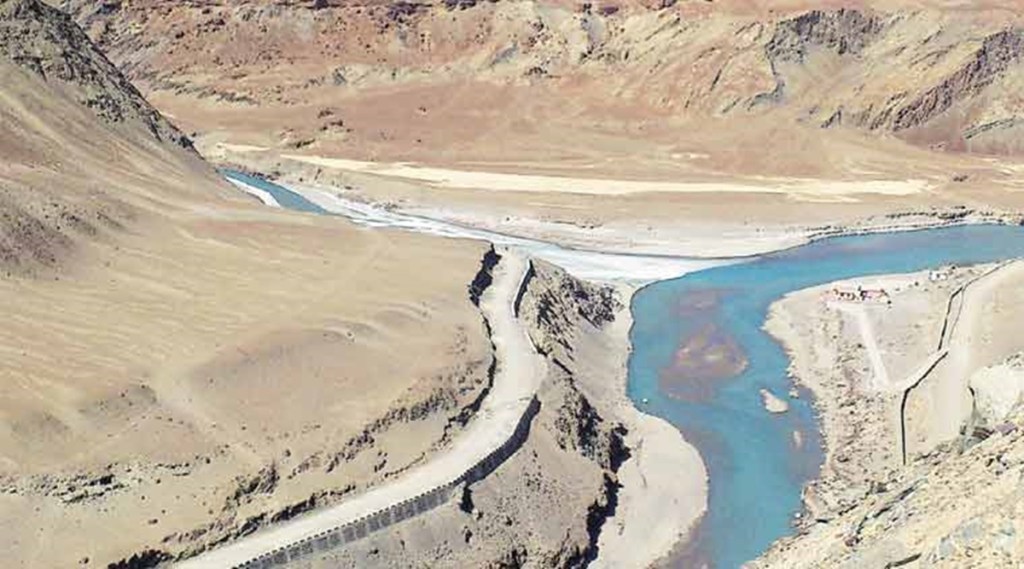 According to sources, in 2015, Pakistan requested for appointment of a neutral expert to examine its technical objections to India’s Kishenganga and Ratle Hydro Electric Projects. (File Photo)




 Share


