


Tags:


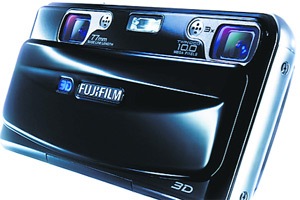
The revolutionary 3D camera from Fujifilm has many drawbacks,but it still gives us a short glimpse of things to come
If you liked 3D movies Chotta Chetan and Final Fantasy,the chances are you will love this new gadget from Fujifilm,a camera that shoots pictures in three-dimension. The Fujifilm Real 3D W1 allows users to capture pictures in three-dimension and even has an LCD screen that displays the pictures directly without any jarringly unattractive glasses to snap on to.
And guess what? It is not a huge DSLR,but a small compact camera that can be carried around in the hip pocket or purse. Measuring a compact 124x68x36 mm in size and weighting just about 260g the W1 definitely deserves a second look.
When humans view objects,our eyes act as separate lenses and send in two images to the brain,which in turn merges them into a solid 3D image. The W1 packs in two lenses and sensors that take two shots from slightly different angles which the camera then merges into a single 3D image. The screen,a 2.8-inch marvel,lets you view the pictures in great depth,again literally. The difference is apparent when you change the depth of field,as the screen gives a realistic picture of what is before its lenses.


For a camera with dual lenses and sensors the shutter is pretty fast. But make sure that the camera is mounted on a tripod while shooting as it takes an arduous 9-10 seconds for the processing of the picture and writing it to the card at maximum quality. The disappointment is the advanced 3-D mode,which as its name suggests does little to advance the effect,but does increase the blurriness a little.
All said and done,the camera does come up with some fantastic shots in three-dimension. A definite improvement that its successors will need to incorporate is flowing ergonomics. The 260g bulk doesnt really justify the weight of the dual lenses and sensors.
The built quality feels like cameras of the late eighties. The standard pictures of the camera in 2-D is acceptable and passable by everyday shooting standards thanks to an adjustable aperture and shutter,full manual modes,ISO 1600 for low-light shooting and face priority mode. A specialised button at the bottom left corner allows for switching between 2D and 3D modes.
The camera also features a 3x optical zoom,a 230,000 pixels screen that lets you view the pics in 3D and a 42 MB internal storage with options for SD and SDHC cards. The two sensors on board are 10-megapixel each with 1/2.3-inch CCD.
It is lame to show off 3D pictures on a 2.8 inch screen,no matter how good the camera. So you might have to consider Fujifilms Real 3D V1 Picture Viewer,an 8-inch screen that reproduces the images in 3D.
The Fujifilm website also offers to print the pictures on special lenticular sheets at Rs 300 for a 5215;7-inch photo.
Being a first generation camera it is bound to be a little pricey,but we were a little taken aback by the Rs 39,999 price tag. So if you are loaded,jump for it just for the oomph factor.
ITS DIFFERENT
Four-way navigation control: A tad different from normal point and shoot compact cameras this one offers the ease of navigation across the macro flash and timer controls and the menu on the whole.
Heavy storage: It will be wise to get a bigger and roomier SD card for this camera. For a high-res 3D file will be around 9.5 MB and the jpeg around 4.7 MB,which is almost a good 14 MB per shot.
Parallax control: There are occasions when the two images taken by the two lenses did not overlap and the quality suffered. In such situations the parallax control takes over to ensure that the two images are accurately positioned on top of each other to get that wow effect with the 3D shot.
Tele Wide shooting: The two lenses take two shots,one at a wide angle,and the other at max zoom. While cynics might question the sensibility of the same,the option allows the photographer to click both the immediate subject and the background behind accurately ensuring a good 3D image.
Colour and ISO: The Colour Mode Dual shooting option takes two pictures with different tones. Sensitivity snaps on the other hand are taken at different ISO settings from which the photographer can choose what he wants.


