© The Indian Express Pvt Ltd
 5 min read


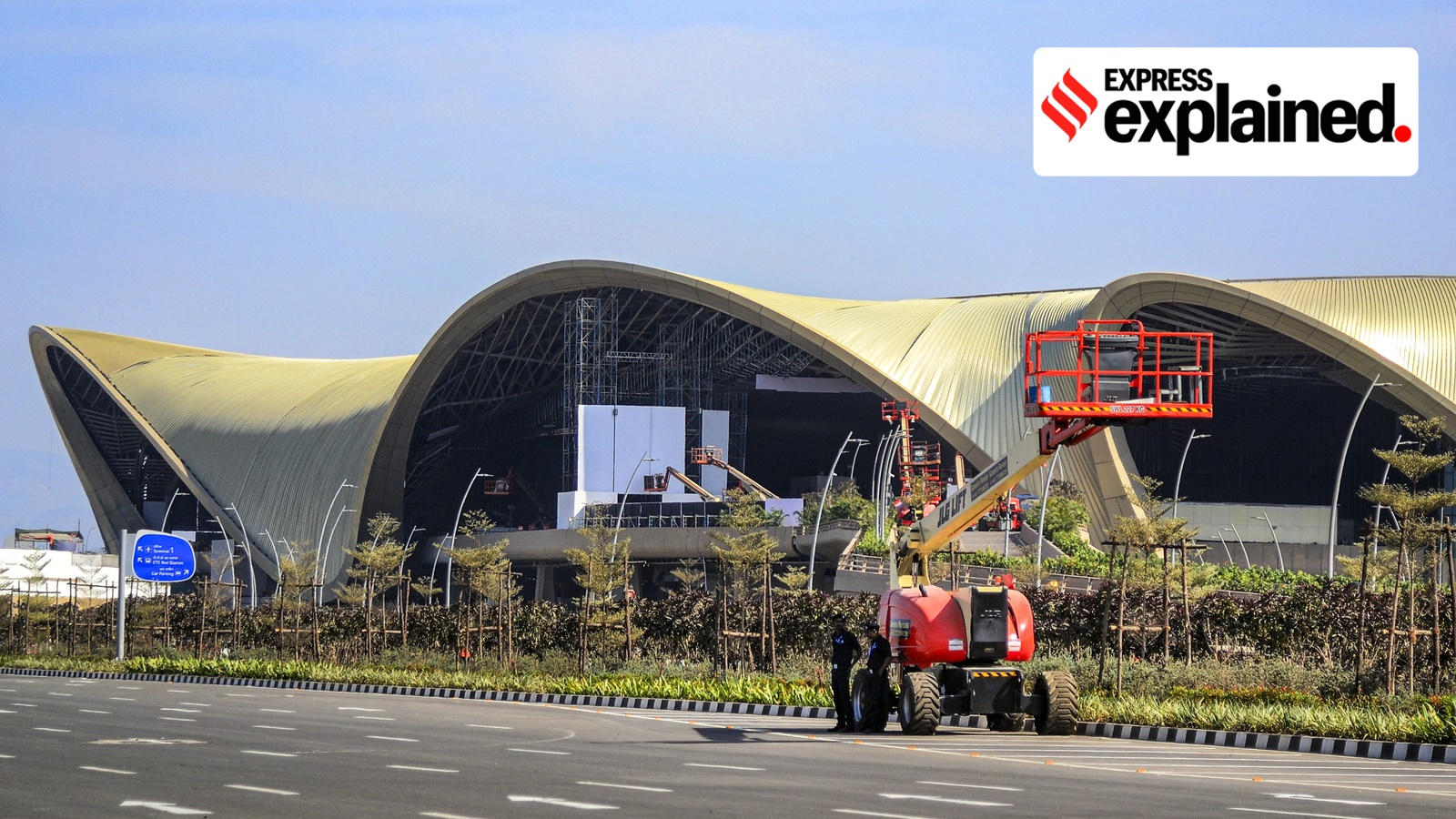 Navi Mumbai Airport Launch Date: A view of the Navi Mumbai International Airport, a day ahead of the first passenger flights scheduled to take off and land, in Navi Mumbai, Wednesday, Dec. 24, 2025. (PTI Photo)
Navi Mumbai Airport Launch Date: The Navi Mumbai International Airport (NMIA) is set to begin commercial operations on December 25, marking a major milestone in Mumbai’s long-delayed second airport project. The first commercial flight is scheduled to depart from Bengaluru and land at NMIA at 8am, formally marking the inauguration of Phase 1 operations at the new airport.
On the opening day, flights will operate to and from Bengaluru, Delhi, Hyderabad, Jaipur, Lucknow, Mangaluru, Nagpur, Ahmedabad, Goa and Nanded, with the Nanded sector being operated by regional carrier Star Air. The airport is expected to handle around 33 aircraft movements (arrivals and departures) on its first day.
While the launch marks a significant step in easing congestion at the Chhatrapati Shivaji Maharaj International Airport (CSMIA), key infrastructure linked to passenger access and amenities around NMIA remain in progress, potentially posing challenges for travellers in the initial phase.
Approach roads and connecting bridges in the airport’s vicinity are incomplete, while the nearest local train station, Targhar is 3.2 km away, on a line with low-frequency services. Urban amenities such as hotels, restaurants, and hospitals near the terminal are still coming up.
In the first phase, flights will link major cities including Ahmedabad, Aurangabad, Bengaluru, Chennai, Kochi, Coimbatore, New Delhi, Goa, Hyderabad, Jaipur, Jammu, Kolkata, Lucknow, Mangaluru, Nagpur, and Vadodara. Connectivity will be scaled up progressively through December and into January.
IndiGo, Akasa Air, and Air India Express will operate daily flights from the airport. Additionally, Star Air is planning regional connections linking Navi Mumbai with Ahmedabad, Goa, Bengaluru and Nanded.
Why did Mumbai need a second airport?
The CSMIA is already operating at or close to its full designated capacity. Mumbai’s existing airport handles one of the highest volumes of aircraft movements in the country on a single runway, leaving little scope to add new flights or increase peak-hour capacity.
The airport is in the busy Juhu area, surrounded by dense urban development. Physical constraints thus restrict its expansion, making a second airport necessary to accommodate future passenger and traffic growth.
The NMIA is being developed in phases, with Phase 1 designed to handle about 20 million passengers annually, and future phases expected to increase total capacity to around 90 million passengers per year through additional terminals and runways.
What are the key features of NMIA?
Giving it an edge over the Chatrapati Shivaji Maharaj airport, the Category II Instrument Landing System (ILS) in place at the new airport will allow it to manoeuver landings and take-offs in poor visibility conditions like fog and rain.
The airport currently has 42 aircraft parking stands to help it achieve a record pre-flight turnaround time for passengers, from arrival to curbside, of 45 minutes. Its 5G-connected system is designed to accelerate turnaround of flights, automate baggage solutions with real-time tracking, and enable contactless travel with Digi Yatra.
The in-house ‘aviio’ app with be a one-stop solution for any information needed.
Cargo operations will also begin simultaneously, as the airport has a capacity of handling 0.5 million tonnes (MT) of cargo annually. Its temperature-controlled corridors aim to maintain cold chain integrity for vaccines, biologics, seafood, fruits and vegetables. Its proximity to the JNPT port makes it a convenient option for cargo transportation.
What is the supporting infrastructure around the airport?
The nearest five-star accommodations are several kilometres away, including The Park Navi Mumbai (around 6km), Courtyard by Marriott Navi Mumbai (around 7 km), and Royal Tulip Hotel, Kharghar (around 10 km). The closest hospitals are Apollo Hospital (around 6 km) and MGM Hospital (around 7km), both located in CBD Belapur.
In January, the airport will introduce The Swirl, an 80-room transit hotel located entirely within the terminal.
Roads and bridges under construction
Key road works still underway include the Ulwe coastal road, intended to link the airport’s western entry with Atal Setu (MTHL), which is only partially complete and cannot yet serve as a seamless access route. As per CIDCO, the bridge’s construction is 60% complete and is targeted for completion by September 2026.
The elevated airport link road over Amra Marg is under construction, as is the Western entry interchange. There is debris on the airport road leading to the terminal gate, due to the construction of Phases 2 and 3.
The Thane–NMIA corridor, a 25.23-km elevated road, is also being planned, with a tentative completion timeline of around 2030.
Meanwhile, the JNPT Chowk Road project under NHAI is tentatively targeted for completion by 2030.
Problem with the Targhar station
The nearest railway station to the Navi Mumbai International Airport, Targhar, is on the Belapur–Nerul–Uran line. While the corridor currently runs around 50 suburban services per day, accessibility remains limited for most passengers. Of these, 13 services originate from Belapur, 12 from Nerul, and 25 from Uran. However, passengers travelling from CSMT, the Western suburbs, or the Central and Harbour line suburbs are effectively limited to the 25 Uran-bound services, resulting in a 30 to 45-minute gap between trains.
From the station, the airport is another 3 km away.
Navi Mumbai Municipal Transport (NMMT) will operate multiple shuttle buses from Targhar, Seawoods, CBD Belapur, and Nerul stations towards the airport terminal. Initially, 50-55 buses will serve both airport staff and passengers, with plans to increase frequency based on demand.