This is an archive article published on December 14, 2020
Explained: John Le Carré, whose George Smiley made James Bond look like an ‘international gangster’
John Le Carré created a murky moral universe of British secret service operations that was far from the prevalent notion of spying as an act of glamorous daredevilry in the service of the nation.
New Delhi | Updated: December 18, 2020 03:13 PM IST
5 min read
Whatsapp
twitter
Facebook
Reddit
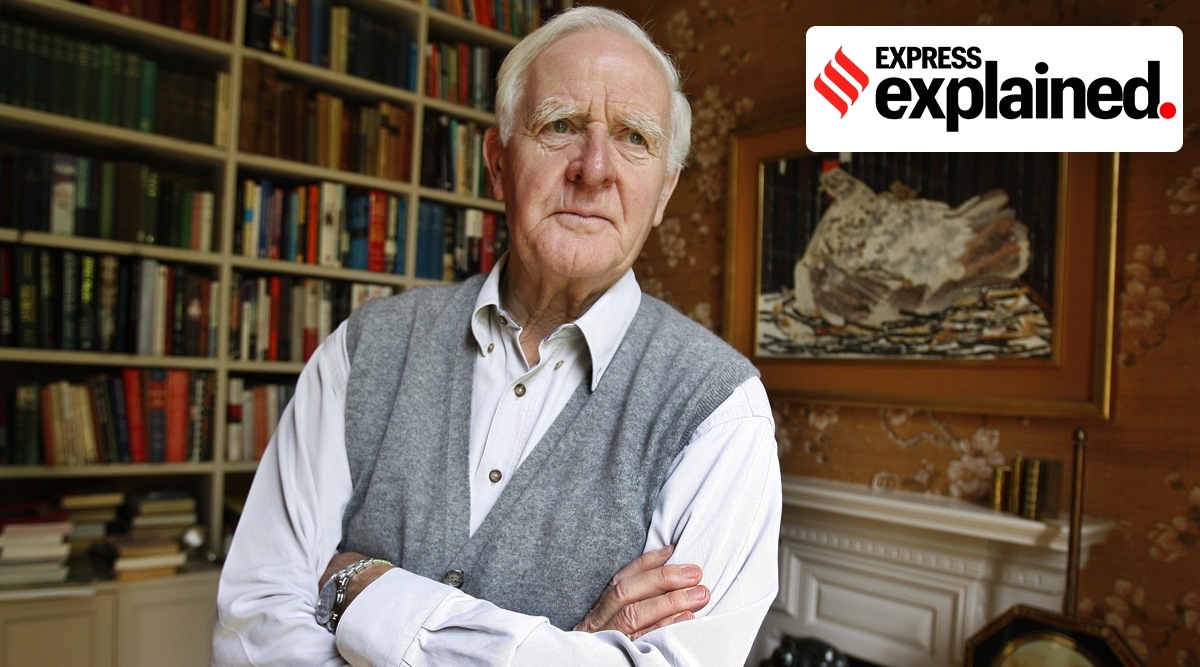
In this Aug. 28, 2008 file photo Author John Le Carre poses for a photo at his home in London. (AP)
British writer John Le Carré, 89, whose Cold-War tales redefined spy novels, passed away on Saturday in the UK’s Cornwall.
Born on October 19, 1931, as David John Moore Cornwell, the writer’s unstable childhood gave him a unique understanding of human nature and its many failings. He wrote his first novel Call for the Dead in 1961, followed by A Murder of Quality (1962). In them, he created George Smiley, a retired, unkempt and unhappy detective, a former spy, who investigates what appears to be a case of suicide and the murder of a schoolboy respectively.
Le Carré himself had served in the British foreign office, in the security service (MI5) and Secret Intelligence Service (MI6). In fact, it was his work as a spy that led him to adopt a pseudonym for his writing career. What began as a series of personal mysteries soon veered into a territory of familiarity for Le Carré with his third novel, The Spy Who Came in from the Cold (1963), his most well-known novel. In it, Le Carré first created a murky moral universe of British secret service operations that was far from the prevalent notion of spying as an act of glamorous daredevilry in the service of the nation — an idea established by Ian Fleming’s James Bond novels. Le Carré, who termed Bond as “an international gangster”, made his plump detective quite the opposite. Smiley was a lonely character fighting loneliness, bureaucratic red tape and moral dilemmas just as any other person, but often with deeper personal and political fallout.
The Cold War and its cultural connotations
Following the end of World War II, uneasy peace marked international relations between the United States and what was then the Soviet Union, and their allies. Nuclear armament meant further war was an unviable option. So, espionage and undercover propaganda campaigns came to play a big role in foreign affairs till the fall of the USSR in 1991. The individual and political impact of the Cold War would go on to inspire many films and spy novels in the years to come.
Le Carré’s books
While a blurb from novelist Graham Greene termed The Spy Who Came in from the Cold as “the best spy story I have ever read”, it was only the starting point of Le Carré’s many successes. In a career that spanned nearly 50 years, he followed up his 1963 novel with several others, often set in troubled conflict zones, including in Chechnya, Rwanda and the Israel-Palestine conflict zone. While almost all his novels were bestsellers, the most well-known ones include Tinker Tailor Soldier Spy (1974), The Honourable Schoolboy (1977), A Perfect Spy (1986), The Tailor of Panama (1996) and The Constant Gardener (2001). He wrote 25 books, in which Le Carré created a universe focussed on the vagaries of human nature and the peaks and abysses they could lead to. Over the years, Le Carré’s novels increasingly became more political, offering veiled commentary on the detrimental fallouts of the use of force to combat acts of insurgency and terrorism. His novels explored the idea of patriotism and blind faith in governments and the rigid moral certainties they created that often did not hold up to reason. His last novel was the spy thriller, Agent Running in the Field, published in October last year. 📣 Follow Express Explained on Telegram
Legacy
Throughout his long and distinguished career, Le Carré refused to allow his books to be sent for awards and prizes. He was equally resolute about not accepting state honours. But his contribution, especially his humanisation of the espionage system, did not go unrecognised by either his readers or his peers. American novelist Philip Roth declared his autobiographical novel, A Perfect Spy, featuring a double agent, Magnus Pym, as the “best English novel since the war”.
Although he wrote several semi-autobiographical accounts in his books, Le Carré was dismissive of the idea of memoirs and autobiographies. “I’m horrified at the notion of autobiography, because I’m already constructing the lies I am going to tell,” he commented famously at an interview. In 2015, however, a biography, John Le Carré: The Biography, was published. It was written by Adam Sisman, after extensive interviews with the writer.
Several of Le Carré’s most famous works, however, have been translated into films and are landmarks of their own. These include The Spy Who Came in from the Cold (1965), featuring Richard Burton in the lead and directed by Martin Ritt; The Looking Glass War (1970), directed by Frank Pierson and with Anthony Hopkins, Christopher Jones and Ralph Richardson in the cast; The Little Drummer Girl (1984), directed by George Roy Hill, with Diane Keaton in the lead; The Constant Gardener (2005), directed by Fernando Meirelles and featuring actor Ralph Fiennes and Tinker Tailor Soldier Spy (2011), directed by Tomas Alfredson.
Paromita Chakrabarti is Senior Associate Editor at the The Indian Express. She is a key member of the National Editorial and Opinion desk and writes on books and literature, gender discourse, workplace policies and contemporary socio-cultural trends.
Professional Profile
With a career spanning over 20 years, her work is characterized by a "deep culture" approach—examining how literature, gender, and social policy intersect with contemporary life.
Specialization: Books and publishing, gender discourse (specifically workplace dynamics), and modern socio-cultural trends.
Editorial Role: She curates the literary coverage for the paper, overseeing reviews, author profiles, and long-form features on global literary awards.
Recent Notable Articles (Late 2025)
Her recent writing highlights a blend of literary expertise and sharp social commentary:
1. Literary Coverage & Nobel/Booker Awards
"2025 Nobel Prize in Literature | Hungarian master of apocalypse" (Oct 10, 2025): An in-depth analysis of László Krasznahorkai’s win, exploring his themes of despair and grace.
"Everything you need to know about the Booker Prize 2025" (Nov 10, 2025): A comprehensive guide to the history and top contenders of the year.
"Katie Kitamura's Audition turns life into a stage" (Nov 8, 2025): A review of the novel’s exploration of self-recognition and performance.
2. Gender & Workplace Policy
"Karnataka’s menstrual leave policy: The problem isn’t periods. It’s that workplaces are built for men" (Oct 13, 2025): A viral opinion piece arguing that modern workplace patterns are calibrated to male biology, making women's rights feel like "concessions."
"Best of Both Sides: For women’s cricket, it’s 1978, not 1983" (Nov 7, 2025): A piece on how the yardstick of men's cricket cannot accurately measure the revolution in the women's game.
3. Social Trends & Childhood Crisis
"The kids are not alright: An unprecedented crisis is brewing in schools and homes" (Nov 23, 2025): Writing as the Opinions Editor, she analyzed how rising competition and digital overload are overwhelming children.
4. Author Interviews & Profiles
"Fame is another kind of loneliness: Kiran Desai on her Booker-shortlisted novel" (Sept 23, 2025): An interview regarding The Loneliness of Sonia and Sunny.
"Once you’ve had a rocky and unsafe childhood, you can’t trust safety: Arundhati Roy" (Aug 30, 2025): A profile on Roy’s recent reflections on personal and political violence.
Signature Beats
Gender Lens: She frequently critiques the "borrowed terms" on which women navigate pregnancy, menstruation, and caregiving in the corporate world.
Book Reviews: Her reviews often draw parallels between literature and other media, such as comparing Richard Osman’s The Impossible Fortune to the series Only Murders in the Building (Oct 25, 2025). ... Read More


 5 min read