Premium
This is an archive article published on October 1, 2019

Explained: How Bangladesh’s economic growth is stealing India’s thunder

The structure of Bangladesh's economy is quite different from India's. Unlike India, where the services sector contributes overwhelmingly while industry's contribution is much lower than desired, Bangladesh has a booming industrial sector.

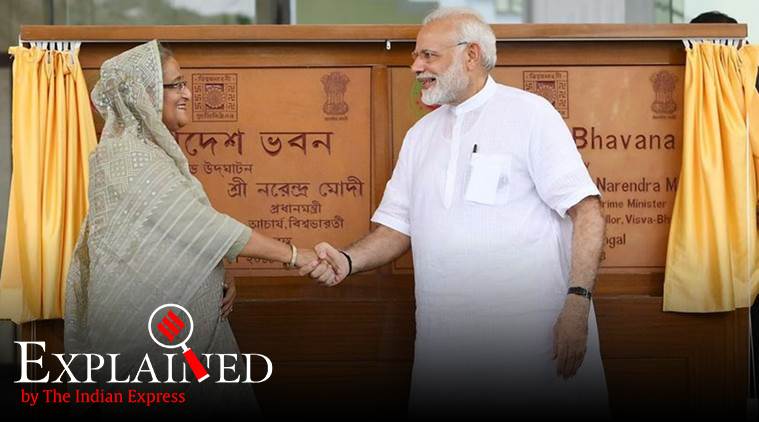
bangladesh economy, bangladesh vs india economy, bangladesh industrial growth, south asian countries economies Prime Minister Narendra Modi with Bangladeshi counterpart Sheikh Hasina (File Photo)
The latest economic outlook update released by the Asian Development Bank has shown how Bangladesh, and not India, is the standout economy in terms of growth momentum in South Asia.

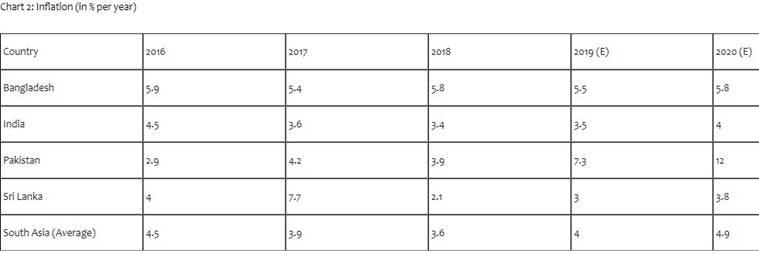
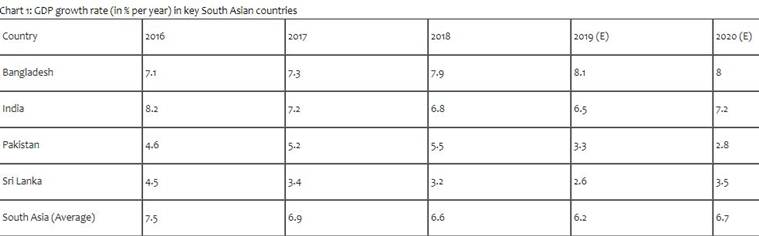
As charts 1 and 2 show, Bangladesh is experiencing high and consistently rising economic growth rate while maintaining a stable level of inflation

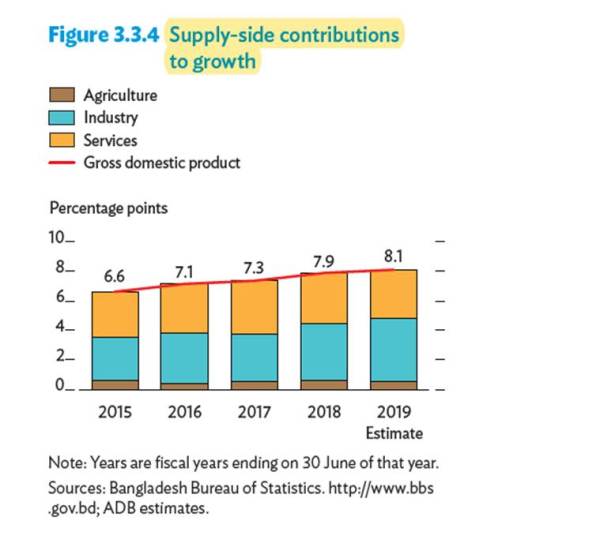
For instance, since 2016, Bangladesh has been growing at over 7 per cent and this financial year will see it cross the 8 per cent threshold as well – a mark it is expected to hit again next financial year, according to ADB estimates.

The other big economies of the region either have modest (like Sri Lanka) or fluctuating (like Pakistan) growth rates to offer.

India has seen a secular decline from the highs of 2016. The constant flow of falling sales and declining industrial productivity data suggests that the current financial year is unlikely to see a big enough change for India to get anywhere close to the 7 per cent-mark.

However, ADB expects the Indian economy to turn around in the next financial year when India is expected to grow by 7.2 per cent.

What distinguishes Bangladesh?

The structure of Bangladesh’s economy is quite different from India’s. Unlike India, where the services sector contributes overwhelmingly while industry’s contribution is much lower than desired, Bangladesh, as the Chart 3 shows, has a booming industrial sector.

Story continues below this ad

This allows its economy to create jobs. In India, by contrast, the bulk of the population is still stuck in the agriculture sector, which contributes the least to the GDP. The industrial sector, which has the maximum potential to absorb surplus labour from agriculture, is struggling to grow fast enough and create employment.

It is the strength of Bangladesh’s domestic industries that, despite the trade war between global superpowers the US and China intensifying over the past year, Bangladesh’s exports have grown from 6.7 per cent in 2018 to 10.1 per cent in 2019.

“Growth in garment exports rose from 8.8% to 11.5%, reflecting strong demand from the US and newer markets for Bangladesh like Australia, Canada, India, Japan, the People’s Republic of China (PRC), and the Republic of Korea,” states the ADB report. Such a remarkable exports performance stands out especially since “garments accounted for 84.2% of exports”.

Even at a time when the global demand is declining, and despite having a limited bouquet of export commodities, Bangladesh was able to push more exports by finding newer markets and edging out other garment exporters such as India. Compare this to India’s anaemic performance wherein exports have grown by just about 1.5 per cent per annum on an average since the financial year 2012-2013.

Udit Misra is Senior Associate Editor at The Indian Express. Misra has reported on the Indian economy and policy landscape for the past two decades. He holds a Master’s degree in Economics from the Delhi School of Economics and is a Chevening South Asia Journalism Fellow from the University of Westminster. Misra is known for explanatory journalism and is a trusted voice among readers not just for simplifying complex economic concepts but also making sense of economic news both in India and abroad. Professional Focus He writes three regular columns for the publication. ExplainSpeaking: A weekly explanatory column that answers the most important questions surrounding the economic and policy developments. GDP (Graphs, Data, Perspectives): Another weekly column that uses interesting charts and data to provide perspective on an issue dominating the news during the week. Book, Line & Thinker: A fortnightly column that for reviewing books, both new and old. Recent Notable Articles (Late 2025) His recent work focuses heavily on the weakening Indian Rupee, the global impact of U.S. economic policy under Donald Trump, and long-term domestic growth projections: Currency and Macroeconomics: "GDP: Anatomy of rupee weakness against the dollar" (Dec 19, 2025) — Investigating why the Rupee remains weak despite India's status as a fast-growing economy. "GDP: Amid the rupee's fall, how investors are shunning the Indian economy" (Dec 5, 2025). "Nobel Prize in Economic Sciences 2025: How the winners explained economic growth" (Oct 13, 2025). Global Geopolitics and Trade: "Has the US already lost to China? Trump's policies and the shifting global order" (Dec 8, 2025). "The Great Sanctions Hack: Why economic sanctions don't work the way we expect" (Nov 23, 2025) — Based on former RBI Governor Urjit Patel's new book. "ExplainSpeaking: How Trump's tariffs have run into an affordability crisis" (Nov 20, 2025). Domestic Policy and Data: "GDP: New labour codes and opportunity for India's weakest states" (Nov 28, 2025). "ExplainSpeaking | Piyush Goyal says India will be a $30 trillion economy in 25 years: Decoding the projections" (Oct 30, 2025) — A critical look at the feasibility of high-growth targets. "GDP: Examining latest GST collections, and where different states stand" (Nov 7, 2025). International Economic Comparisons: "GDP: What ails Germany, world's third-largest economy, and how it could grow" (Nov 14, 2025). "On the loss of Europe's competitive edge" (Oct 17, 2025). Signature Style Udit Misra is known his calm, data-driven, explanation-first economics journalism. He avoids ideological posturing, and writes with the aim of raising the standard of public discourse by providing readers with clarity and understanding of the ground realities. You can follow him on X (formerly Twitter) at @ieuditmisra           ... Read More


 

Latest Comment
Post Comment
Read Comments
Advertisement
Advertisement
Advertisement
Advertisement