Premium
This is an archive article published on October 18, 2022

Explained: What are green crackers & how do we identify them?

According to the National Green Tribunal (NGT), green crackers are permitted only in cities and towns where air quality is moderate or poor,” Dr Khaiwal said. Prof Mor added that there is reduction in emission of sound as well in green crackers.

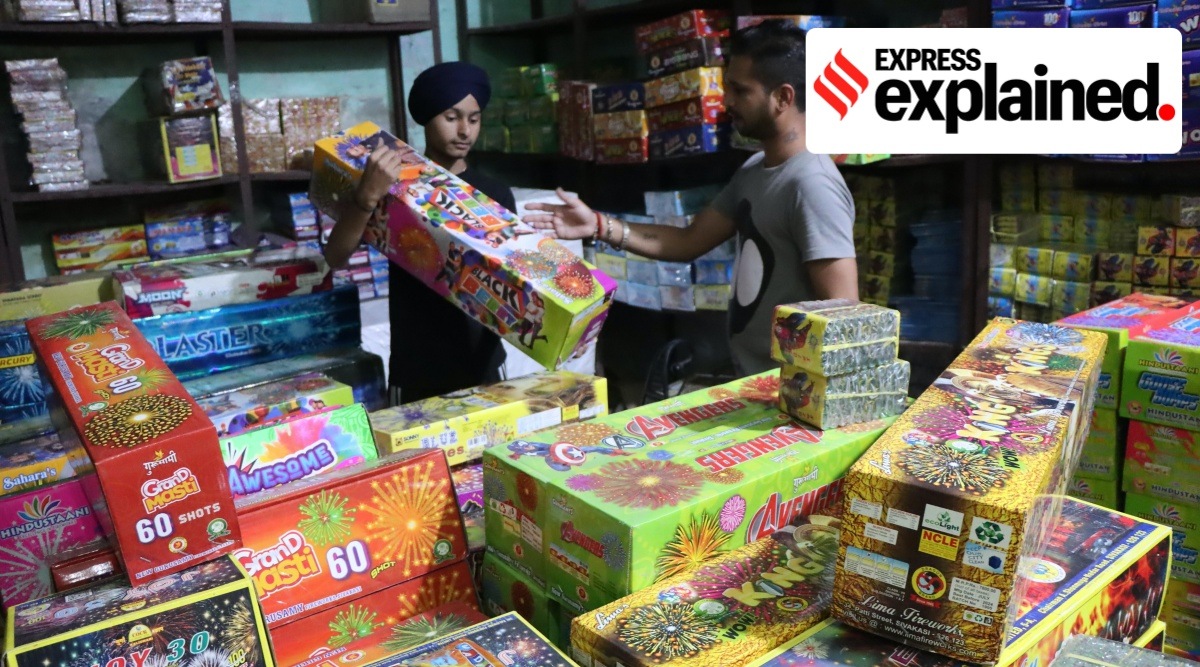
green crackers news, festival, air quality news, indian expressGreen crackers are permitted only in cities and towns where air quality is moderate or poor,” Dr Khaiwal said. (Express Photo/ Representative)

As Chandigarh allows the use of green crackers, PGI’s Dr Ravindra Khaiwal, Additional Professor of Environment, Health, Department of Community Medicine and School of Public Health, recognised as one of the top environmental scientists of India, and Dr Suman Mor, Chairperson, Department of Environment Studies, Panjab University, speak to HINA ROHTAKI about how one should identify green crackers and the harmful toxins crackers emit.

What is the difference between green crackers and traditional crackers?

According to Dr Khawal and Prof Mor, both green crackers and traditional crackers cause pollution and people should refrain from using either. However, the only difference is that green crackers cause 30 per cent less air pollution as compared to traditional ones. “Green crackers reduce emissions substantially and absorb dust and don’t contain hazardous elements like barium nitrate. Toxic metals in traditional crackers are replaced with less hazardous compounds. According to the National Green Tribunal (NGT), green crackers are permitted only in cities and towns where air quality is moderate or poor,” Dr Khaiwal said. Prof Mor added that there is reduction in emission of sound as well in green crackers.

With the UT only allowing use of green crackers, how does one identify and differentiate them?

Dr Khaiwal and Prof Mor said that one should look for green crackers falling only in these three categories- SWAS, SAFAL and STAR: the crackers developed by the Council of Scientific and Industrial Research (CSIR). “SWAS, that is “safe water releaser” should have have a small water pocket/droplets which get released when burst, in the form of vapour,” Prof Mor said.

“SWAS is safe water releaser, which suppresses the dust released by releasing water vapour in the air. It does not comprise potassium nitrate and sulphur and the particulate dust released will reduce approximately by 30 per cent.

Similarly, STAR is the safe thermite cracker, which does not comprise potassium nitrate and sulphur, emits reduced particulate matter disposal and reduced sound intensity. SAFAL is safe minimal aluminium which has minimum usage of aluminium, and used magnesium instead. It ensures reduction in sound in comparison to traditional crackers,” Prof Mor said.

Story continues below this ad

They also suggested not to buy green crackers from street vendors and only from licensed sellers.

“I would also suggest that if chemical identification cannot be done, the identification of green crackers can be done through the CSIR NEERI logo. The scanner may be downloaded using the CSIR NEERI green QR code app from Google Playstore,” Dr Khaiwal added.

What are the toxic metals that traditional crackers release?

Crackers release several toxic metals that can be harmful for health. The white color emitted through crackers is aluminium, magnesium and titanium, while the orange colour is carbon or iron. Similarly, yellow agents are sodium compounds while blue and red are copper compounds and strontium carbonates. The green agent is barium mono chloride salts or barium nitrate or barium chlorate.

Story continues below this ad

What damage and harm can these chemicals do when a person is exposed? Who is vulnerable to the exposure?

According to Dr Khaiwal, lead in crackers impact the nervous system while copper triggers respiratory tract irritation, sodium causes skin issues and magnesium leads to mental fume fever. Cadmium not just causes anemia but also damages the kidney while nitrate is the most harmful that causes mental impairment. The presence of nitrite causes irritation in mucous membrane, eyes and skin. He also added that the most vulnerable population though are infants, children, pregnant women, elderly and people with underlying medical conditions. Yet no one remains untouched from the harm these chemicals cause.

What should people keep in mind while bursting green crackers?

We suggest people that they buy green crackers only from a licensed shop and not from street vendors. People should prefer using a long candle or phooljhari for igniting these crackers and keep elbow joint straight to increase the distance between the body and the cracker, rather keep them at arm’s length. “I would also suggest to wear shoes while bursting crackers and burst these at open spaces like playgrounds. Keep a couple of buckets of water handy while lighting the green crackers,” Dr Khaiwal said. Prof Mor added that the green crackers should not be burnt in crowded areas and long loose synthetic clothes should not be worn while
bursting them.

Why are green crackers being preferred over conventional ones?

Story continues below this ad

Dr Khaiwal said, “Firecrackers made with reduction in size of shell, elimination of ash usage, reduced usage of raw materials, uniform acceptable quality, etc., leading to reduction of particulate matter and gaseous emission is why green crackers are being preferred”.

Hina Rohtaki is a Special Correspondent at The Indian Express, based in Chandigarh. She is one of the most prominent journalists covering the Chandigarh Administration, civic issues, and the unique political status of the Union Territory. Professional Background Experience: She has been in the field for over a decade and is known for her investigative reporting on administrative waste and urban governance. Awards: She is a recipient of the prestigious Ramnath Goenka Excellence in Journalism Award, which was presented to her by the President of India in January 2020. She was also awarded the Jethmalani prize (The Will of Steel Awards) in 2025 in the Empowerment category for a series of articles that highlighted the struggles of Covid widows. Core Beat: Her primary focus is the Chandigarh administrative structure, the Union Territory's financial management, and urban development projects. Recent Notable Articles (Late 2025) Her recent work highlights a focus on government accountability, administrative expenditures, and civic trends: 1. Investigative & Financial Reporting "Fuelling power: Senior UT IAS officers guzzled petrol worth Rs 30 lakh in 2 yrs" (Dec 14, 2025): An investigative report detailing the high fuel bills of top bureaucrats, including the Finance Secretary and Chief Secretary’s staff. "Admn spends Rs 1.5 crore on dismantling road railings and fixing again after increasing height" (Dec 8, 2025): Highlighting administrative waste on "non-viable" solutions for pedestrian control. "Chandigarh’s finances under ministry’s watch now" (Nov 27, 2025): Reporting on the new requirement for MHA approval for all new projects in the UT. 2. Governance & Constitutional Status "What will it mean for Chandigarh if it is brought under Article 240?" (Nov 24, 2025): An "Explained" piece on the potential constitutional shift that would grant the President more power over the UT's governance. "MP Manish Tewari moves Bill seeking directly elected Mayor with 5-year tenure" (Dec 6, 2025): Covering the legislative push to reform Chandigarh's municipal leadership structure. "No proposal to increase Mayor's term in Chandigarh by 5 years: Centre" (Dec 10, 2025): Reporting on the Union government's response to demands for a longer mayoral term. 3. Urban Infrastructure & Environment "Chandigarh admn cuts power to India's tallest air purifier, asks firm to dismantle it" (Nov 17, 2025): A critical report on the failure of a high-cost environmental project deemed "of no use" by experts. "UT rethinks 24/7 water supply project as costs soar" (Nov 26, 2025): Detailing the financial challenges and delays in modernizing the city's water network. "Centre 'obfuscating, covering up' MC's shifting deadlines for clearing Dadu Majra dump" (Dec 12, 2025): Reporting on the ongoing controversy surrounding the city's major waste dump. 4. Lifestyle & Local Trends "Chandigarh turns into a Thar city as women fuel the surge" (Dec 2, 2025): A feature on a unique automotive trend in the city, with a record 600 registrations by women drivers this year. "After fivefold spike in 2023, EV sales struggle to pick pace in Chandigarh" (Dec 2, 2025): Analyzing the slowdown in electric vehicle adoption despite previous surges. Signature Beat Hina is known for her meticulous tracking of RTI (Right to Information) data to expose administrative inefficiency. Her "Ground Zero" reporting on the Dadu Majra garbage dump and her scrutiny of the Chandigarh Smart City projects have made her a key figure in the city’s civil society discourse. X (Twitter):  @HinaRohtaki ... Read More


Latest Comment
Post Comment
Read Comments
Advertisement
Advertisement
Advertisement
Advertisement