7 min read
© The Indian Express Pvt Ltd



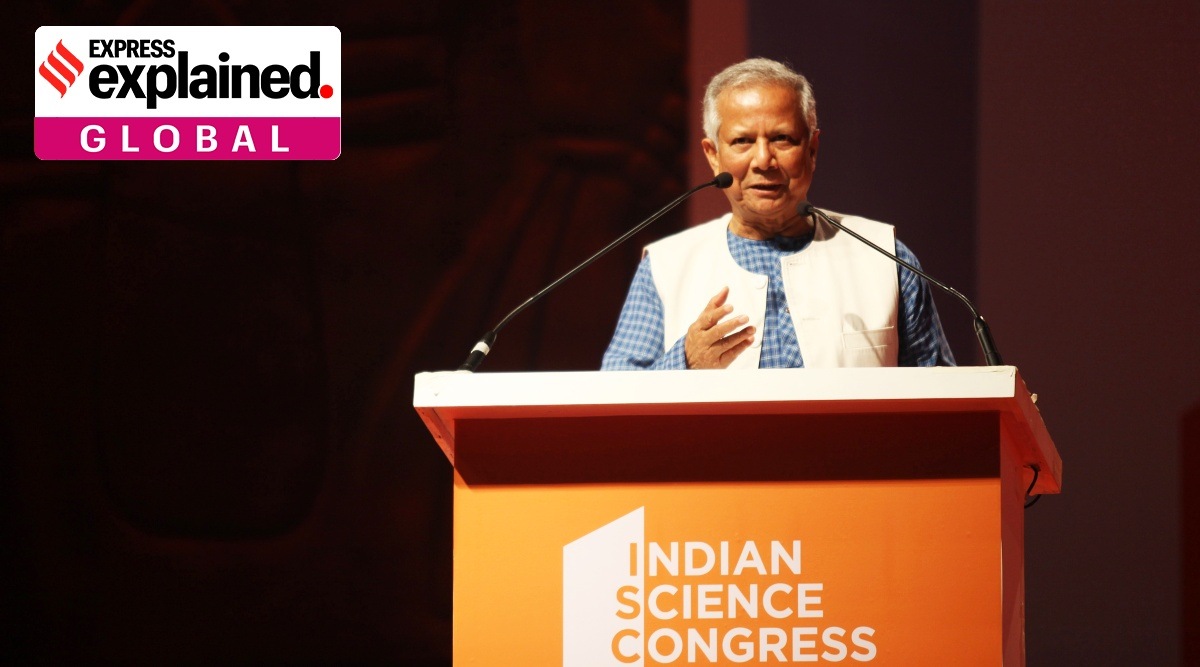 Muhammad Yunus at the Indian Science Congress in 2015. (Express photo by Prashant Nadkar)
 More than 100 Nobel prize winners and some other global figures have urged Bangladeshi Prime Minister Sheikh Hasina to suspend her government’s ongoing legal proceedings against economist Muhammad Yunus. Signatories to the August 28 letter include Former US President Barack Obama and former US Secretary of State Hilary Clinton.
Earlier in March, 40 people had also written a letter regarding the safety of Yunus, including Infosys founder Narayan Murthy. These letters point to Yunus’s contributions to the field of poverty eradication in Bangladesh and the recent legal proceedings initiated against him by the State.
Yunus is an Economist who studied in Bangladesh and the USA. He was later appointed as a professor of economics at the University of Chittagong in Bangladesh.
He is best known for his ideas on microfinance, that is, extending loans of small amounts to people who are marginalised in society, those who are poor and have limited means to earn a living, and people who are, in general, overlooked by the finance sector. Microfinance also believes that the lack of collateral should not stand in the way of someone receiving a loan.
In an interview with The Indian Express in 2018, Yunus said, “The financial system should be built the other way: if you have nothing you get the highest priority. The question is, is it the state’s responsibility to make someone who has money make more money, or to make someone who has no money make money?” He added, “I would say the state’s priority should be the one who has no money. That’s where microfinance came in.”
Yunus founded the Grameen Bank on the principles of “trust and solidarity” to provide micro-credit without collateral to the “poorest of the poor” in rural Bangladesh. According to its website, the Bank provides services in over 80,000 villages and has about 2,500 branches.
It says, “From its origins as an action-research project in 1976, Grameen Bank has grown to provide collateral-free loans to 7.5 million clients in more than 82,072 villages in Bangladesh and 97% of whom are women. Over the last two decades, Grameen Bank has loaned out over 6.5 billion dollars to the poorest of the poor, while maintaining a repayment rate consistently above 98%.” The organisation formally began work as a bank in 1983, and its model has been replicated elsewhere in the world.
Yunus also told The Indian Express in 2018 that the Grameen Bank “has given profits of 10-20% over all the years and the borrowers are the owners of the Bank, so they get money for themselves.”
He and the organisation gained widespread international attention in 2006 when they were jointly awarded the Nobel Peace Prize “for their efforts to create economic and social development from below”.
According to the August 28 letter, signatories said, “One of the threats to human rights that concerns us in the present context is the case of Nobel Peace Prize laureate Prof. Muhammad Yunus. We are alarmed that he has recently been targeted by what we believe to be continuous judicial harassment.”
Prime Minister Sheikh Hasina responded by saying she would welcome international experts and lawyers to come to Bangladesh to assess the legal proceedings. “If they send the experts and lawyers, many more things will get revealed, which remain untouched. Many such things will come out,” Hasina said.
The allegations against Yunus and the Bank range from pursuing aggressive methods in collecting loans with a high-interest rates to diverting funds and not following norms for appointments. The Bank’s problems began around 2007 – when Yunus briefly forayed into politics .
In an open letter that was published in the Bangladeshi newspaper The Daily Star, Yunus asked for people’s views on floating a political party. “He observed that the current political climate seeks to destroy the potential of the country and so without a comprehensive change there, it would never be possible to take the nation ‘to the height it deserves’,” The Daily Star had reported.
Sheikh Hasina’s government came to power in 2009.
In 2010, a Danish documentary made allegations against Yunus and the Grameen Bank of diverting funds worth about $100 million given to the Bank by the Norwegian Agency for Development Cooperation (NORAD). The allegations were subsequently disproved.
Prime Minister Hasina has called Yunus a “bloodsucker” and accused him of using force and other means to recover loans from poor rural women as head of Grameen Bank. Her government began a review of its activities in 2011, and Yunus was fired as managing director for allegedly violating government retirement regulations and staying on beyond the age of 60.
In 2013, the new Grameen Bank chairman, appointed by the government, was involved in appointing a selection committee to decide on Yunus’s successor instead of the Bank’s elected board. Yunus said in an interview with the Harvard Business Review around that time that this “fundamentally damaged the very essence of Grameen Bank. With this change, the government has practically taken over management, and this will set in motion the end of the Bank.” Currently, the government has 25 percent ownership of the Bank.
Grameen Bank, according to a 2022 report in The Daily Star, says it has explained the matter to the government’s Bangladesh Bank (BB) in one of its regular inspection reports.
According to the Associated Press, he was put on trial in 2013 on charges of receiving money without government permission, including his Nobel Prize award and royalties from a book. He later faced more charges involving other companies he created, including Grameen Telecom, which is part of the country’s largest mobile phone company, GrameenPhone. Yunus and 13 others were named in a case brought by the Anti-Corruption Commission in a related matter.
In 2015, Yunus was summoned by Bangladesh’s revenue authorities over non-payment of taxes amounting to $1.51 million.
Earlier this month, 18 former Grameen Telecom workers filed a case against Yunus accusing him of siphoning off their job benefits. Defence lawyers called the case harassment and vowed to fight the allegations. Separately, Yunus went on trial on August 22 for allegedly violating labour laws.