5 min read
© The Indian Express Pvt Ltd



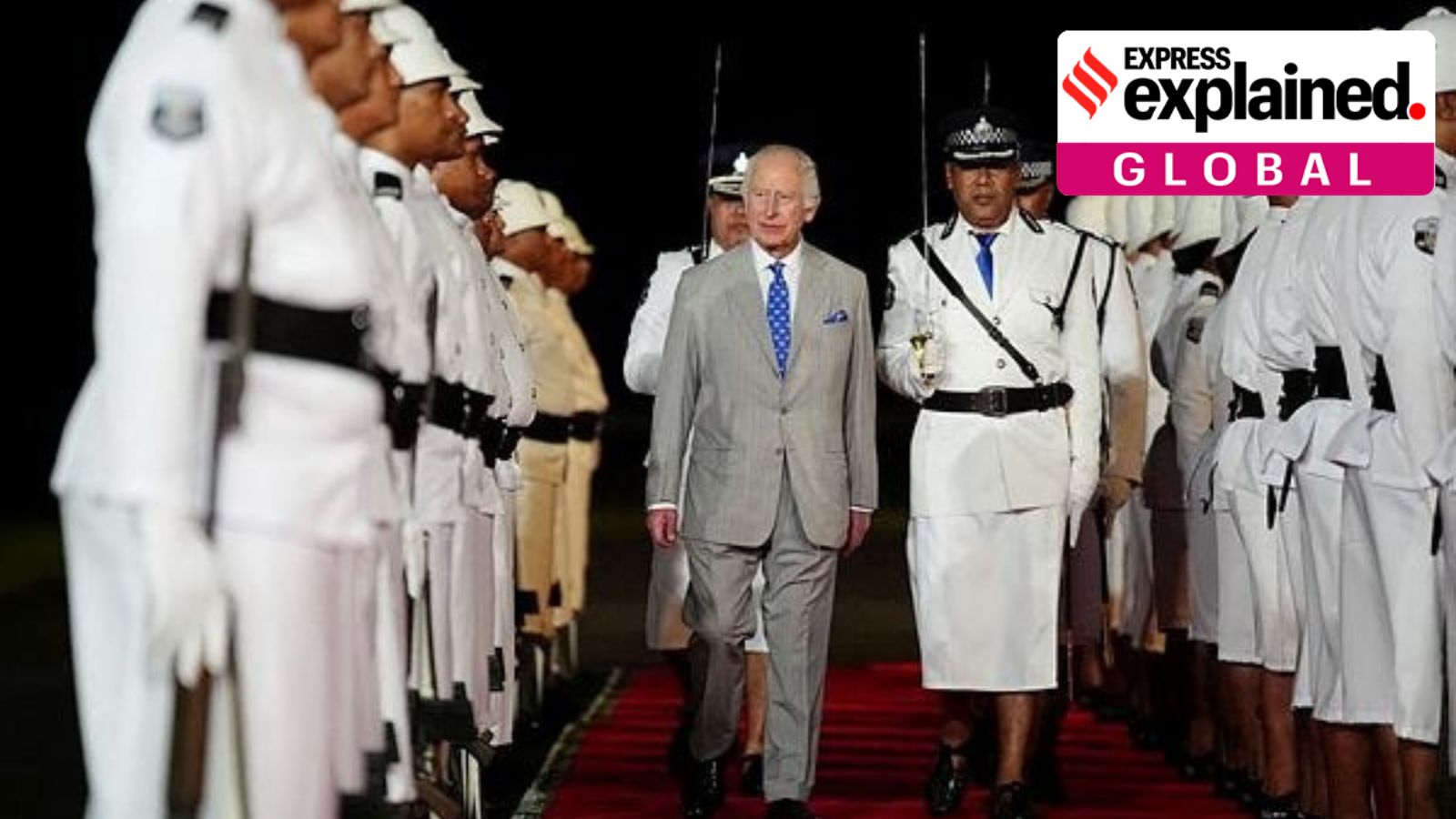 Britain's King Charles arrives at Faleolo International Airport in Samoa to attend the Commonwealth Heads of Government Meeting, during a visit to Australia and Samoa. (Photo - Reuters/Aaron Chown)
King Charles III’s visit to Australia this week, the first by a sitting British monarch since Queen Elizabeth 70 years ago, has rekindled the debate on ending the country’s constitutional link to the British monarchy.
His address to Australia’s Parliament House on Monday (October 21) was interrupted by a protest from indigenous Senator Lidia Thorpe, who declared “you are not our king” and demanded the return of indigenous lands.
“You are not our king. You are not our sovereign. You committed genocide against our people. Give us our land back. Give us what you stole from us,” Thorpe said before being escorted away by security.
The king and his wife, Queen Camilla, arrived in Sydney on Friday on a six-day trip that will see the two travel to Canberra and Sydney. They will travel onward to Samoa, host of this year’s Commonwealth Heads of Government meeting, where the king will meet global leaders and discuss climate change.
This marks King Charles’s first major trip since he began treatment for cancer this February.
Australia is part of the Commonwealth realm, a group of 14 countries where King Charles III is the head of state — a position explicitly named in the constitutions and laws of some of these countries. Apart from Australia, the Commonwealth realm includes Antigua and Barbuda, the Bahamas, Belize, Canada, Grenada, Jamaica, New Zealand, Papua New Guinea, Saint Kitts and Nevis, Saint Lucia, Saint Vincent and the Grenadines, the Solomon Islands and Tuvalu.
The commonwealth realm is distinct from the larger Commonwealth which comprises 36 republics (including India) and five monarchies. The realm represents the last vestiges of Britain’s colonial empire, a thread that binds the British monarch to about 150 million people outside of the UK. Most living residents of the Commonwealth realms have never experienced a direct relationship with Britain.
In 2021, Barbados became the newest republic in the world by removing Queen Elizabeth, then the monarch, as its head of state.
Australia was originally a group of British penal colonies between 1788 and 1901, meant to rehabilitate prisoners. This period culminated a two-century-long violent occupation by British settlers jostling for control over the indigenous aboriginal population who had inhabited the land for over 60,000 years. It was marked by overt and covert displacement campaigns, including massacres, forced displacement and assimilation policies imposed on the indigenous residents.
In 1901, six colonies banded together to form the Commonwealth of Australia, becoming a self-governing dominion within the empire. The country fought alongside Britain and the Allied forces in both world wars.
The British parliament continued to legislate for Australia until 1986, when the passage of the Australia Act severed the remaining legal ties.
In 1999, the country voted against transitioning to a republic with the Queen and Governor-General being replaced by a President appointed by a two-thirds majority of the members of the Commonwealth Parliament. The result is now understood as a vote against the process of appointing a President rather than expressing support for continuing the monarchy.
Thus, Australia remains a constitutional monarchy, with the King as the head of the state, a symbolic title with no legislative power.
The king is represented in Australia via the governor-general at the federal level – currently Samantha Mostyn – and by a governor in each state. These appointments are made by the king on the recommendation of the prime minister and respective premiers. The governor general operates in the name of the King and is authorised to open and dissolve Parliament, appoint ministers after elections, gives assent to laws passed in the Parliament and serves as the Commander-in-Chief of Armed Forces.
The king’s visit also highlights the distinctions between the monarchists, who favour the status quo, and republicans, who advocate for an Australian-appointed head of state.
The debate has persisted for decades, with Australian Prime Minister Bob Hawke weighing in on a TV interview to ABC News in 1983, “I believe we’d be better off as a republic but I don’t think it’s a matter of great importance.”
Thorpe’s protest on Monday is a sign of growing support for the shift to republicanism, a view held by the Australian Republican Movement.
This was evident on Monday as the king’s Parliamentary address was snubbed by the premiers of six states. Prime Minister Anthony Albanese himself is a long-term republican. However, his government ruled out holding a second vote on the subject after the failure of the 2023 referendum to recognise the First Peoples of Australia in the constitution.
Monarchists have welcomed the king’s visit, saying this will strengthen Australians’ connection to their sovereign. The Australian Republican Movement on the other hand have likened the visit to a farewell tour, calling it “something of a show that comes to town.” The movement’s co-chair Esther Anatolitis said that this was a reminder that the Australian head of state “isn’t full-time, isn’t Australian. It’s a part-time person based overseas who’s the head of state of numerous places.”