

 4 min read
Click here to follow Screen Digital on YouTube and stay updated with the latest from the world of cinema.
Premium
This is an archive article published on May 9, 2014
Balancing Act
Anita Ratnam’s latest performance Circles of Love talks about the joys and sorrows of being a mother



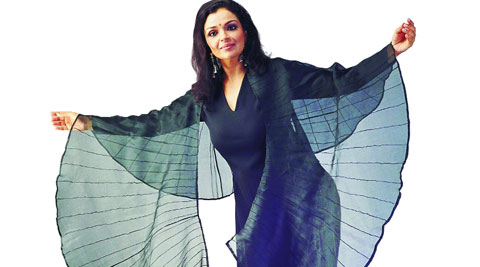 Ratnam has developed a contemporary style of dancing called Neo Bharatam
From experience, Anita Ratnam knows that no one can prepare a woman for childbirth and there’s no manual to deal with motherhood. It is unique to each woman and formed the theme of Ratnam’s contemporary dance performance at the Mudra Dance Festival held at the National Center of Performing Arts in Mumbai.
Titled Circles of Love, the performance saw the internationally-acclaimed dancer and choreographer in the role of a mother, daughter as well as granddaughter. An ode to an heirloom sari handed down by her mother, stories of Yashoda and Devaki — two of the most admired characters of mothers in Hindu mythology — were weaved into the dance narrative interspersed with poetry. “The performance is a mosaic of all these elements,” says Ratnam, who equates the relationship between a mother and daughter to dance. “There is always some kind of ebb and flow of emotions. There is love, trust, and sometimes even jealousy in that relationship,” says Ratnam, mother to a 27-year-old daughter and 25-year-old son.
For Ratnam’s performance, columnist and poet Malavika Sangghvi read out poems on motherhood by writers from Hawaii, Jamaica, Nigeria and India. “One of the poems is by a Caribbean poet Lorna Goodison, titled ‘I am becoming my mother’. It talks about how many of us say we don’t want to become like our mothers, but eventually end up like them,” she adds. Her own poem, titled Heirloom, is about a 70-year-old silk sari handed down to her by her mother, and featured in the dance performance. Another interesting piece was a Rudaali from Rajasthan sing a Tamil lullaby.
With a career that spans over four decades, she has done over 1,000 performances in 25 countries. Coming from an illustrious Brahmin family of doctors, diplomats, priests and entrepreneurs, Ratnam is a first generation artiste. After a formal training in Bharatanatyam that started at the age of three, Ratnam studied literature and acquired a post-graduate diploma in dance from Rukmini Devi Arundale’s Kalakshetra in Chennai. While she was at the school, Ratnam was drawn to theatrical elements in other forms of dance, such as Kathakali and Mohiniattam. To enhance expressions through body movements, she then trained in martial arts technique like Kalarippayattu and even T’ai chi. Around 1998, Ratnam created her own unique contemporary style of dancing and termed it “Neo Bharatam”, a form influenced by theatre. This name was inspired by the Hollywood film Matrix. “Like Keanu Reeves’ character Neo, I wanted to stimulate and provoke people to question the things around them,” she explains. A more fluid form of dancing, Neo-Bharatam requires body movements to be more articulate with endless improvisations.
Although a seasoned performer, Ratnam admits she often finds it difficult to strike a balance between her roles as a mother and a performer, as would be true for any working mother. “Motherhood demands a lot. I have been a single parent for the last 25 years and my children were raised by their grandmother, just as I was raised by my grandmother,” she says. After her first marriage fell apart, Ratnam moved to New York and had a successful stint as a TV producer and anchor for a local network. In 1990, Ratnam returned to her roots with a new outlook towards dance. “I didn’t want to be a typical classical dancer and didn’t want to dress like them in such finery,” she says. Ratnam’s performances are a cohesive mix of dance, music, theatre and design. For Circles of Love, she will be collaborating with musicians such as Anil Srinivasan, Viji Krishnan and Vedanth Bharadwaj who will experiment with instruments such as guitars, didgeridoo among others.
“Bombay is an interesting city and the audience is open to experiments. People who come to watch a performance really mean to be present there,” says Ratnam, who plans to take this production to smaller and more intimate venues.
Advertisement
Loading Taboola...


More Entertainment




Advertisement
PHOTOS

PHOTOS





Top Stories










Must Read







Advertisement
- 01
- 02
- 03
- 04
- 05
Advertisement
