5 min read
Stay updated with the latest - Click here to follow us on Instagram

Journalism of Courage



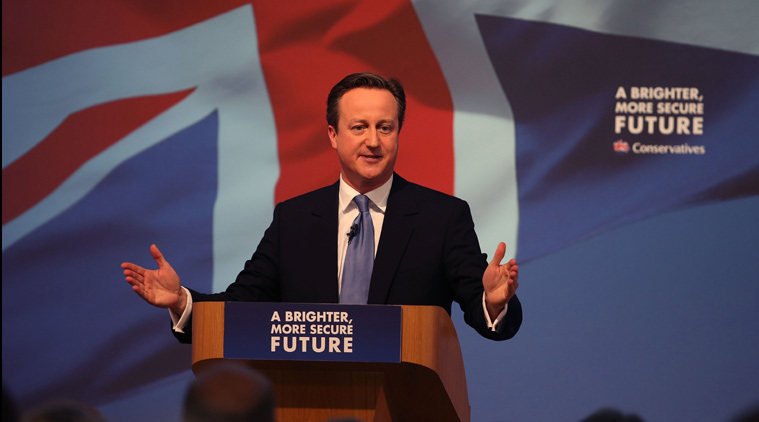 UK Election results showed that the Conservatives led by PM David Cameron is ahead
David Cameron on Friday is set for a second term as Prime Minister with his Conservative Party winning a majority in the UK’s hotly-contested polls, as he vowed to hold a referendum on the country’s EU membership and quick devolution of powers to Scotland and Wales.
[related-post]
His Modi-style “Phir ek baar Cameron sarkar” slogan seems to have resonated with most of the electorate as the Tories were projected to win 329 in the final tally, three more than the 326 required for a majority in the 650-member House of Commons.
Predictions of a neck-and-neck contest between the Conservative Party and Leader of the Opposition Ed Miliband- led Labour looked like being off the mark as the forecast, with well over half of the results in, was 329 seats for the Conservatives, 233 for Labour, Liberal Democrats at eight, the Scottish National Party (SNP) at 56, Plaid Cymru at three, UKIP at two with the Greens one and others 19.
BREAKING: In surprise win, British Prime Minister David Cameron’s Conservative Party wins enough seats to form U.K. government on its own
— The Associated Press (@AP) May 8, 2015
According to the results declared so far, the Conservatives had won 325 seats, Labour tally stood at 229, SNP at 56, Liberal Democrats at 8, UKIP at 1 and others at 15.
Earlier, the exit poll had suggested the Tories will get 316 MPs to Labour’s 239 once all the results are in.
Cameron, 48, all but declared victory in a speech after being returned as MP for Witney, in which he set out his intention to press ahead with an in/out referendum on Britain’s membership of the European Union and to complete the Conservatives’ economic plan.
“My aim remains simple — to govern on the basis of governing for everyone in our United Kingdom,” Cameron said.
Despite having warned against the threat of Scottish nationalism in Westminster during the campaign, he said now was the time to mend divisions between England and Scotland.
“Above all, I want to bring our country together, our United Kingdom, implementing as fast as we can devolution both for Wales and Scotland,” Cameron said.
“I want my party and a government I would like to lead to reclaim the mantle of one nation, one United Kingdom. That is how I will govern if I am fortunate enough to form a government,” he said.
Indian Prime Minister Narendra Modi tweeted to congratulate his re-elected British counterpart.
Congratulations @David_Cameron. As you rightly pointed out- its “Phir Ek Baar, Cameron Sarkar!” My best wishes. pic.twitter.com/xf5tJfW0SE
— Narendra Modi (@narendramodi) May 8, 2015
Labour leader Miliband, who also won in Doncaster North, nearly conceded party defeat as he described the general election as “disappointing and difficult”. After the disastrous fate of the Labour’s party was revealed, Ed Miliband decided to step down as the party leader.
Labour Party leader @Ed_Miliband concedes defeat and steps down as UK opposition leader: AFP
— The Indian Express (@IndianExpress) May 8, 2015
In a massive loss, the Liberal Democrats, which had been in a coalition government with the Tories so far, were routed by the electorate, already losing 39 of its 57 seats won in the 2010 polls. While Nick Clegg held on to his own Sheffield Hallam seat, some of the party’s heavyweights like Vince Cable and Simon Hughes suffered humiliating defeats, in light of which the Liberal Democratic leader resigned.
Leader of Britain’s Liberal Democrats, @nick_clegg resigns after disastrous #ukelection2015 results
— The Indian Express (@IndianExpress) May 8, 2015
The real success story of the election has been that of the SNP and an unprecedented surge of nationalism in Scotland led by the charismatic leader Nicole Sturgeon.
Read also: 20-year-old student, Mhairi Black becomes youngest MP in UK in centuries
The SNP has won 55 of the 59 seats already, completely decimating the Labour Party in its traditional stronghold.
Jim Murphy, leader of the Scottish Labour Party, and shadow foreign secretary Douglas Alexander have both lost their seats to the SNP.
The first election result came in from Sunderland just 50 minutes after the close of polling at 2200 local time on Thursday and it was a victory for Labour, which held on to its traditional stronghold.
The exit polls left a number of poll pundits baffled as it was not in line with the opinion polls which had suggested a far more neck-and-neck race between the Conservatives and Labour.
A total of 650 Westminster MPs are to be elected, with about 50 million people registered to vote in an election which has reported a fairly high turnout.
Cameron looks like he will be able to remain in Number 10 Downing Street as the head of a government without the need for a coalition -– although he might have to rely on the support of the Northern Irish DUP or even the Lib Dems for a few MPs.
Even if Miliband had been able to persuade the Lib Dems to join the SNP in backing a Labour government, he would not have the necessary numbers to get his legislative programme through Parliament in a Queen’s Speech, scheduled for May 27.
The finishing line needed to form an absolute majority is 326, but because Northern Irish Sinn Fein MPs have not taken up seats and the Speaker does not normally vote, the finishing line has, in practice, been 323.
Stay updated with the latest - Click here to follow us on Instagram