7 min read


© IE Online Media Services Pvt Ltd



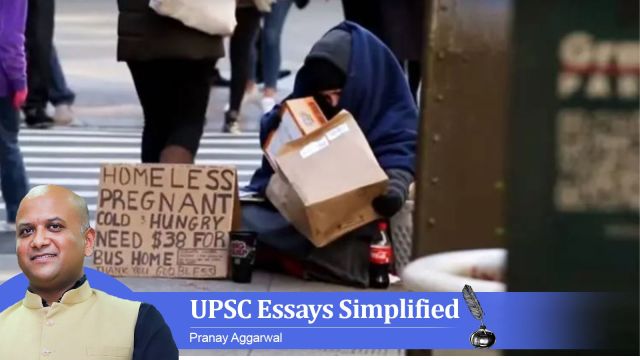 A video director from US decided to help the homeless in a unique way. (Source: Rob Bliss/YouTube)
Dear UPSC Aspirants,
Whenever you hear words like society, justice, or charity, pause and picture what comes to mind. Don’t stop there—go a step further. Ask yourself: how can that image be improved? What other words come to mind that could enrich or reshape it? Can you envision a way forward?
Think of similar quotes or reflections. For instance, Gandhi ji once said: “Recall the face of the poorest and the weakest person you have seen, and ask yourself if the steps you are contemplating will be of any use to them. Will they gain? Will it restore them to control over their lives and destiny? Will it lead to freedom for the hungry and starving millions?”
This kind of introspective exercise should come naturally as you plan the blueprint for your UPSC CSE Essay. In UPSC Essentials’ special series ‘UPSC Essays Simplified’, we take you through some of the sample essays written by our expert Pranay Aggarwal covering questions of past years.
— Pranay Aggarwal
A cold winter night in Delhi. Outside a lavish banquet hall, a poor old woman sat on the roadside, hoping for a kind soul to drop a few coins into her wrinkled hands. Inside, a charity gala was underway, raising lakhs for the underprivileged. The irony is stark – if justice prevailed, would she need to beg at all? A just society would eliminate the very need for charity. Justice is not subject to generosity. It ensures that people do not have to rely on the kindness of others to live with dignity.
Charity, while well-meaning, often serves as a bandage over deep wounds. It does offer relief but rarely addresses the root cause of suffering. A society that engages in a lot of charity is one that acknowledges inequality but does nothing substantive to dismantle it. For instance, wouldn’t it be better to ensure that every child, regardless of wealth, has access to quality education rather than waiting for a donor’s goodwill?
Of course, charity is feel-good. It enables the donor to redeem himself, feeling that he has done his bit for the society. It enables the privileged to acknowledge their own blessed state of existence, feel that they have ‘given back’ to the society and see themselves as noble. Governments and civil society encourage charity. Organized religions also deem giving a virtue – for instance, Zakat in Islam, or the Christian belief that Charity is one of the seven heavenly virtues. Consequently, those who engage in charity see themselves as upright citizens, as engaged members of the community, and as pious and moral beings. However, charity is more about the donor than the donee.
Except for making donors feel good about themselves, charity does little to remove or even reduce systemic injustices. No matter how much charity prevails, there is little to no large-scale redistribution of wealth in society because of it. Bluntly put, after all their charity, the rich remain rich and the needy remain poor and needy.
Indian philosophy has long recognized Justice as the highest virtue. Dharma, the central tenet of the Hindu world-view, is righteous action to ensure Justice. Amongst modern thinkers, Amartya Sen points out that justice is about expanding freedoms, ensuring that people are not merely given aid but are enabled to live fulfilling lives. Western political philosophers like John Rawls too contend that justice is about fairness, ensuring that no individual is disadvantaged by circumstances of their birth. Real justice lies in creating systems where individuals can stand on their own feet, not in perpetually offering them crutches.
MGNREGA (Mahatma Gandhi National Rural Employment Guarantee Act) is a great example of justice-driven policy – it ensures that workers earn their livelihood with dignity rather than relying on handouts. Microfinance initiatives and Self-Help Groups empower women by providing access to credit and skill development, fostering self-reliance instead of dependence on charity. When justice is embedded in policy, charity becomes unnecessary.
Our Constitution is a testament to Justice. Dr. Ambedkar envisioned a nation where social, economic, and political justice would replace well-entrenched, centuries-old structures of exploitation. Article 21-A of the Constitution is an example par excellence of justice in action – ensuring education as a right, not a privilege bestowed by charity. The hotly-debated policy of reservation for marginalized communities must also be seen as a necessary correction for historical injustices, and not as an act of generosity.
Institutions are the custodians of justice. An efficient and effective judiciary and a robust legal framework are sine qua non to ensure justice in society.
Precisely for this reason, there is an urgent need of judicial reforms. At present, timely delivery of justice is not being ensured; with more than 5 crore cases pending in different courts across the country. To clear this huge backlog will require comprehensive reforms including addressing infrastructure deficiencies in courts, leveraging technology, filling judicial vacancies and promoting alternate dispute resolution mechanisms.
Would you rather live in a society where the rich donate, or where poverty itself is eradicated? Nations like Sweden and Norway, with their strong and equitable social systems, have minimal dependence on personal charity.
In contrast, societies with greater inequalities rely on acts of benevolence to compensate for systemic failures. A case in point is the USA, which, despites all its riches, has systemic racial, gender, and class inequalities – it vigorously promotes a culture of corporate and personal philanthropy.
Charity should be a temporary fix, not a permanent necessity. Our goal should not be to increase charity but to make it obsolete – by creating a society where fairness, equity, and access to equal opportunities become the foundation of progress.
A just society does not need to rely on the generosity of the privileged or stray acts of kindness. It ensures that no one has to stretch out their hands in need in the first place. As a society, we must confront the difficult question: Do we want to be a nation of donors, or a nation that no longer needs donations?
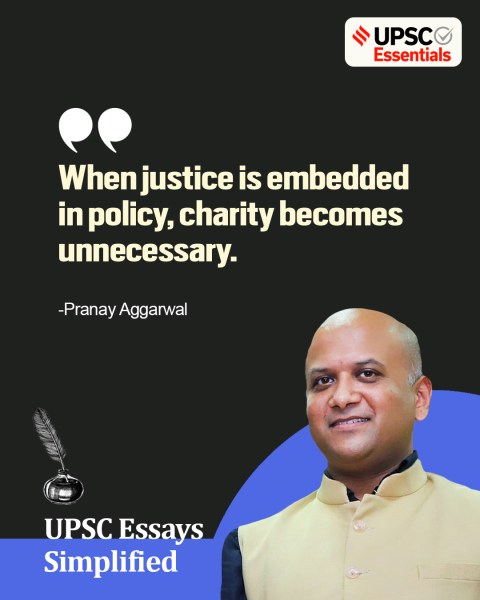
About our Expert: Pranay Aggarwal is an educator and mentor for aspirants preparing for UPSC Civil Services exam. With more than 10 years of experience guiding civil service aspirants, he is acknowledged as an expert on civil service exam preparation, especially on subjects like Social Issues and Sociology. He is the India representative on the Research Committee on Education, Religion and Political Sociology for UNESCO’s International Sociological Association and a committee member of Indian Sociological Society and its committee on social movements. He is also the Convenor of Indian Civil Services Association, a think tank of senior bureaucrats.
Subscribe to our UPSC newsletter and stay updated with the news cues from the past week.
Stay updated with the latest UPSC articles by joining our Telegram channel – Indian Express UPSC Hub, and follow us on Instagram and X.
For your queries and suggestions write at manas.srivastava@indianexpress.com.

Read UPSC Magazine