
Opinion This time in Kathmandu
India must be more forthright in displaying its capacity to play an honest broker...

Madhav Nepals resignation as prime minister of Nepal seems to have caught everyone in his country by surprise. What brought it about? In an interview to the Republica of Kathmandu shortly after he resigned,Nepal claimed that he agreed to step down after senior Maoist leader Mohan Baidya met him and agreed to take the conciliatory process forward. According to other versions,opposition from his own party chairman,Jhalanath Khanal,and statements from Nepali Congress leaders about it being their partys turn to lead the government spurred the prime ministers decision.
President Ram Baran Yadav has asked for a consensus government to be formed,as per the priority laid down in Article 38(1) of the interim constitution. If such a government does not materialise by July 7,the deadline set by the president,then he would ask the parties in the constituent assembly (CA) to form a majority government. There is no provision in the interim constitution for the president to invite any particular party to form a government. The procedure envisaged is for the CA,which is also the parliament,to meet and elect a prime minister,on whose recommendations a council of ministers would be formed.

What is likely to happen now? The Maoists want a consensus government,headed by their party. However,there seems to be problems within the party. Prachanda made a public statement last week that he was under siege from his own. This was generally believed to imply that his senior colleagues Baburam Bhattarai,Mohan Baidya and Ram Bahadur Thapa had got together to clip his wings. At the same time,the Maoists have stolen a march over other parties in the post-resignation scenario by announcing on July 1 that they had decided to stake a claim to lead a consensus government which would be led by Prachanda and had formed a three-man committee consisting of Prachanda,Baidya and Baburam Bhattarai to hold talks with other parties.
The NC,CPN(UML),and the Madheshi Janadhikar Forum are clearly looking at at a majority government excluding the Maoists,in which case the stalemate is likely to continue. But there is also speculation that the Maoists may welcome CPN(UML) Chairman Jhalanath Khanal as prime minister,in which case the NC would be sitting in the opposition. Maoist leader C.P. Gajurel is on record as saying that if consensus is not possible,his party would go in for a majority government. He did not clarify whether his party would insist on leading such a government. Despite all this,the likely scenario at the moment is that of the Maoists remaining in the opposition. Hence the crucial question is whether the Maoists will cooperate with the government from the opposition benches. Being in the opposition could help the Maoists to focus on the more important task of framing the constitution without the distraction of running the government. Given their numbers,the views of the Maoists cannot be ignored in constitution-making whether they are in government or not. However,there are several reasons why they would want to lead the government,including the perception that incumbency would be an advantage in the elections under the new constitution.
What is in Indias best interests? A stable Nepal is our highest priority. The failure to move forward towards the framing of a constitution is the single most destabilising factor in Nepal today. Regardless of the anti-India rhetoric emerging from various political parties in Nepal from time to time,all of them look to India for help in troubled times. It is in our interests to help them find solutions to their problems. When faced with a common enemy who threatened them with extinction in 2005-06,all the parties in Nepal came together,and in the bargain a long-running insurgency came to a close. Today,we must strive to convince the Nepalese parties that the danger that they face from not being able to write a constitution is as grave as the one they faced in 2005-06 from monarchical dictatorship. The fact that all except a handful of the constituent assembly members voted to extend its tenure shows that Nepals parliamentarians are not totally ignorant of these dangers.
Our prime minister often stresses the need to think out-of-the-box to find solutions to problems that vex the nation. Basically,what this implies is that we must display the ability to shed some of our prejudices and long-held theories. In order to be able to play the role of an honest broker,we have to get rid of some of our prejudices. There is a tendency in the Indian establishment to equate the Maoists in Nepal with the left-wing extremists in India. Whether such prejudices are warranted even after the Maoists in Nepal opted to join the democratic mainstream and fought and won an election is worth pondering over.
As our internal security organisations take on the threat of left-wing extremism in India,what is most demoralising to them is the support that their adversaries receive from the intelligentsia in our country who argue that the deprived in India have no way out except to take to arms. The Maoists in Nepal showed that it was possible to rejoin the democratic mainstream and come to power through democratic means,which strikes at the very root of the intellectual basis for armed rebellion against the state. It is a pity that this potent development did not trigger some out-of the-box thinking as to how it could be leveraged to our advantage in the fight against left-wing extremism in India. The developments in Nepal since May 2009 have only helped to endorse the viewpoint of the Indian Maoists that Prachanda and company were foolish to rejoin the democratic mainstream.
The resignation of Madhav Nepal is perhaps the last opportunity to put out-of-the-box solutions to test in the Nepal context. This opportunity should not be missed if we do not want to witness the sad spectacle of Nepal tumbling down the rapids.
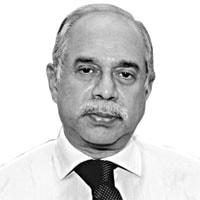
The writer is former chief of the Research and Analysis Wing
express@expressindia.com
 Share
Share


