Journalism of Courage
 5 min read



I was among the group of journalists who accompanied Atal Behari Vajpayee to Pakistan in 1978 when he was foreign minister in the first Janata government. During our stay in Karachi I suggested to my colleagues that they experience something not uppermost in their minds whenever they contemplate the Indo-Pak equation: divided families.
K.K. Katyal of The Hindu, M.L. Kotru, The Statesman, that outstanding photographer, Raghu Rai, and myself were driven to my aunt8217;s house in the vicinity of Clifton. My aunt, a quintessential creature of Avadh culture, having been raised in our village Mustafabad near Rae Bareli, hugged each one of us with warmth and ceremony. She had tears rolling down her cheek. Seeing me with my friends reminded her of my school days in Lucknow when I generally strolled into our house with Vinod, Ashok and others.
But for my niece, in her early teens, it was a startling experience. She took me aside and whispered, 8220;Bhaiyya brother, are all these people accompanying you Hindus?8221;
8220;Ofcourse8221;, I said, somewhat surprised at the query. 8220;Why do you ask?8221;8220;But they look like you8221;, she continued with touching innocence.Some years later my younger brother Shanney, professional raconteur, singing bard and a man of many eccentricities, returned after visiting his cousins in Pakistan. I asked him for his impressions.
8220;Oh! The cousins are very happy, dodging around in their BMWs8221;. Sha-nney seemed to be striking a positive note. 8220;It8217;s a nice place,8221; he emphasised. Then he furrowed his brow, and added. 8220;Nice place, but too many Muslims!8221;Now, my niece in Karachi and my brother in Lucknow, both have to be understood in their respective circumstances, as creatures of their different environments.
My niece was growing up in a new country which had set itself up as an Islamic state. She had been indoctrinated into a system of simulated apartheidMuslims are different from Hindus in speech, manners, form and feature. Authors of the state in which she was evolving considered it important for theconsolidation of their nation state to set themselves up as an entity totally separate from the civilisational pull of Hindustan. The success of the project is reflected in the simplicity and innocence of the question my niece posed when she saw me with my colleagues. That question, patently naive, says something of the project itself.
Shanney, on the other hand, is the creature of our composite culture. No religious observance from Moharram to Eid is considered a success unless Shanney is at the heart of it all. Shanney8217;s capacity to keep an audience enthralled with his musical rendering of soz and salam, set to specific ragas, during religious gatherings in Mustafabad was eclipsed only when that golden voiced friend, Jyoti Pande, visited us in our village.
Shanney is as thoroughbred a Muslim as any but his religious observances would be incomplete without Pras-ad Sahib, Jyoti Pande or Dixitji being somehow incorporated into the proceedings. Their Di-walis and Holi would likewise be incomplete withoutShanney8217;s and my mother8217;s participation. Little wonder he found the unbroken chain of Muslim names in the environment of his cousins in Pakistan somewhat monotonous. Homogeneity can be a habit but diversity is a romance. And Shanney is nothing if not a romantic.There is a subcontinental romance as well, one which my friend Katyal experienced during that same journey to Pakistan.
In Lahore he suggested that we visit the neighbouring district of Jhang from where his family had migrated to India after partition. No sooner had the suggestion been made than Katyal, Raghu Rai and myself were on our way to Jhang in a car provided by members of Pakistan8217;s protocol department.Once in Jhang, Katyal directed the car to the school where he was once a student. The principal, his trimmed beard matching his grey suite, heard Katyal8217;s story with some surprise. Migrations make for an exotic social mix.
The principal was from one of the better known districts of UP. I found this rather effete looking gentleman from Avadh aquaint presence in the land I had associated with Heer-Ranjha and Sohini-Mahwal. Indeed, I could not even square Katyal with the location custom made for lyrical movie scripts.Once the principal was able to dispel his disbelief that a journalist accompanying the Indian foreign minister from New Delhi had travelled from Lahore to Jhang simply to visit places associated with his formative years, he held Katyal in the tightest embrace. He had tears in his eyes. 8220;Yeh to aapne haj kiya hai8221; Your visit to your old school is like the pilgrimage to Kaaba.
Katyal was even able to locate his old house. In fact, the friendship he struck with the new occupants of his house, a Muslim family from Amritsar, has continued to this day. Katyal and his wife have visited them in Jhang; they have stayed with Katyal in New Delhi.
For me these are poignant vignettes that bind two distant neighbours in a peculiar sort of way. And now that Prime Minister Atal Behari Vajpayee is embarked on a historic bus journey toPakistan, one can only hope that the interaction between the two countries will acquire normalcy and momentum that unfortunate political currents have prohibited so far.

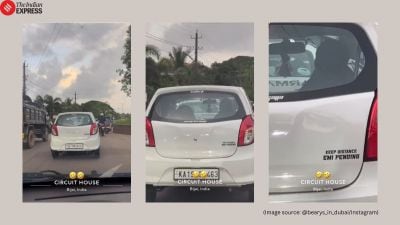
A short clip of a car sticker has struck a chord online, turning an everyday traffic moment into a viral laugh-fest. The video, posted on Instagram by @bearys_in_dubai, captures a white hatchback navigating traffic on Circuit House Road in Mangaluru, Karnataka. What really caught viewers’ attention wasn’t the car itself, but a sticker pasted on its rear that read, “Keep distance, EMI pending.”