Journalism of Courage
 13 min read


Saurav Singh was among 22 sailors on board oil tanker Royal Grace who were held hostage by Somali pirates for over a year till their release on March 8. Singh speaks to Vijaita Singh and recalls those harrowing 371 daysthe beatings,the sailor they had to dump in the sea and the calendar of hope that kept them going
January 26,2012
Saurav Singh finally got the call he had been waiting for. The caller from the Mumbai-based East India Shipping Agency said MT Royal Grace needed sailors and called him to Mumbai for an interview. He felt vindicated. His BSc in Aeronautical Science from Indian Maritime University in Mumbai had been with a purpose. My parents wanted me to do my engineering but I had different plans. I wanted to be a sailor.
From Mumbai,I went to the companys office in Dubai and I got the offer letter on January 30. They needed men to sail immediately, says Singh,23,sitting in his house in Meeruts Jaidev Vihar,a couple of days after coming home from over a year spent in captivity in the deep sea somewhere off the Oman coast.
On February 28,2012,Royal Grace set sail from Mina Khalid port in Sharjah with Singh and 21 other members of the crew17 Indians,three Nigerians,one Pakistani and one Bangladeshi. Singh was a senior deck cadet on the ship,monitoring the navigation system. The ship,a Panama-flagged oil tanker owned by a Nigerian businessman,was on its way to Nigeria for repairs,a 45-day journey,and they planned to first anchor at Cape Town for refuelling and refreshments.
March 2,2012
At 4 pm,Singh came back to his cabin after his morning shift. He thought he would watch Jumper on his DVD but fell asleep half way through the sci-fi thriller. I woke up with the sound of someone banging on my cabin door. It was my colleague. He said everyone had to assemble on the deck within a minute. He sounded nervous. The ship had been hijacked by Somalian pirates. We came out and saw a fishing launch near our ship. Short men with AK-47s,rocket launchers,pistols and SLRs had surrounded our vessel. They did not appear to be pirates,they were so poorly dressed and were bare chested.
After clambering on board the ship,the pirates worked fast. Within an hour of hijacking the vessel,they had turned it into a warship,even fitting it with anti-aircraft guns. None of the pirates spoke English,except for a Ugandan who called himself Star. He was the negotiator. Always clad in military fatigues and with an AK-47 slung over his shoulder,Star did all the coordinating between the crew and the pirates. In the beginning,he was our only hope,but we soon realised that he was unreliable, says Singh.
Soon after the vessel had been hijacked,the pirates started negotiating with the ships Nigerian owner,a businessman called Colonel Alupo. For the first four months,the hostages were treated well as the pirates hoped to strike a good deal with the owner. But soon,Colonel Alupo stopped responding.
The ship was anchored in the middle of the seaand it was to stay this way for the next one year.
March 20,2012
One of the three Nigerians on board suffered a heart attack. He died due to lack of medication. We tried to resuscitate him but he died. We kept his body in the meat room,which had a deep freezer. Star asked for the body. He said it was a practice in Uganda to eat the dead. We fought with him and managed to keep the body back in the freezer. But on April 23,when the ship started running out of fuel,we had to throw his body in the sea. It was painful to see one among us meeting that fate.
May 26,2012
It was Singh8217;s cellphone that provided the crucial turning point in the hostage story. He had hid one of his phones from the pirates.
The day our ship was attacked,they had asked us to deposit all our belongings and phones with them. I had two phones. I slipped one of them into an electricity duct. They could not find it. Some days later,I took out the phone,coated it with black paint,dried it,wrapped it in a plastic bag and threw it in an oil tank, he says.
On May 26,Singh put his hand in the oil tank and fished out his cellphone. That was a big day. They had also stolen a SIM card from one of the pirates. We got to know that the pirates had got new SIM cards and they had kept them in one of the cabins. My friend and I decided to steal a SIM. For the next few days,we hung around that cabin. Finally,we got our moment. So now we had a phone and a SIM card. I made a call to my family. My heart raced,but nobody at home answered the callit was around 11.30 pm. Then I called my girlfriend. All I remember is that she cried. I asked her to inform my family. Meanwhile,my sister called back on my number and we spoke for about 10 minutes. That was the first time since I left home that I was talking to my family. Till then,they hadnt even known that we had been hijacked. I wanted to cry my heart out,but I could not. The pirates would have come to know. After that first call,I made more calls to my family. But communication was a struggle. The network was poor and the signal depended on the direction of the wind.
That call on May 26 was the first time that news of the hijack reached India and the families of the crew. The families started petitioning the government and sat on a dharna outside the Ministry of Shipping in Delhi for a month.
On the ship,Singh and the others kept waiting. They often spent hours chatting and making heroic,but futile,escape plans. We had a pack of cards that we managed to keep with ourselves. That was our only recreation. Most of the day was spent thinking about good food. We could not even shout for help,nobody would have heard us. There was only the deep sea all around.
Two months later
The wait on the ship had grown longer. There were no signs of the ship owner paying ransom and Singh got no news from India. Thats when the torture began.
The Royal Rothmans cigarettes that the pirates had earlier treated us to stopped. They drastically cut down on the supply of rice. They would simply give us a few grams of raw rice. No spice,no salt. We had a stove where we took turns to cook. We used sea water to boil the rice to get the taste of salt. If the pirates were in a good mood,they would give us some tomato paste to go with our rice. That would be a big day for us,a feast. Sometimes,the group went without food for days. One of my colleagues who used to weigh 60 kg a year ago,now weighs only 38 kg, says Singh,who himself lost 16 kg.
Singh was forced to spend the year in a single pair of trackpants. When they took my luggage away,I hid a pair of pants. I gave them to one of my friends. When my pants began tearing,I stitched a patch with a rag.
Singh made a pair of slippers too,with a rubber gasket. Afternoons on the deck would be scorching hot,with the temperature going up to 48 degrees Celsius,and the gasket slippers worked like magic.
At any given moment,around 40 pirates would be on board the ship. Other pirates came in boats to replenish supplies and to take each other8217;s place. They had taken care to keep the vessel away from the coast. I have seen at least 200 of them in the last one year, says Singh.
He says that as the days wore on,there were petty quarrels among crew members,usually over rice and flour. Some of the members hid the food they got. The supply was irregular,I do not blame them. For days,we would go without food. All this led to a lot of suspicion and distrust. We sometimes stole from the pirates. We ate whatever came our waysometimes,grasshoppers that the pirates gave us,sometimes live crabs that we caught from the sea, says Singh.
Through all this,it was the calendar of hope which kept them goinga 2012 calendar on which the crew wrote everything from the choicest expletives for their kidnappers to their secret schedules. When the year ended and their wait continued,they made their own calendar on a piece of paper. Though the pirates had taken away most of their stuff,paper and pens didnt interest themmost of them were illiterate. So they let this 2012 calendar and some other stationery alone. But when they abandoned the ship,they destroyed everything.
But sometimes,even the calendar didnt lift spirits. The pirates would kill a goat every day and the blood would be splattered all over the deck. They would not even bother to throw away the goat8217;s head. After they were done with their cooking and eating,we would pick up the goat head and throw it in the sea. We would clean up the floor and then go to sleep. There was nothing we could do anyway. Sometimes,I would stare for hours at the sky,hoping to walk free someday. I even thought of jumping into the sea but it would have made no sense. There was no way we could have swum through and the sea was full of sharks, says Singh.
December 20,2012
Star had stopped helping the crew,so Singh and the others decided to negotiate with the hijackers on their own. They mostly used sign language and some operative words like money,get out.
Our families told us that the government had promised them that we would be released on December 16. We told the pirates that the money would come that day. Four days went by,nothing happened. On December 20,they called us on to the deck and tied our hands and legs. They made us kneel down in a line and kept us like that for hours under the scorching sun. We couldnt move. When they finally set us free,we could barely move. Our limbs were numb.
The torture got worse after thatthere were daily beatings on the ship. Singh was beaten up too. While they tortured the hostages,the pirates would call up the hostages families and subject the relatives to their cries for help. The pirates were frustrated. They wanted money at any cost. Killing us would not have got them anything, says Singh.
March 8,2013
The first ray of hope came when the owner of MT Smyrni,another ship that had been hijacked on May 10,2012 in the same area,agreed to pay the ransom to free his ship. Singh says they heard that the money was so big,around 1.8 million,that the pirates soon began losing interest in Royal Grace. There was no sign of anyone paying a ransom to free us and they had anyway got good money that they were eager to share. So the pirates simply abandoned our ship, he says.
The day they were released,Singh woke up at 8 am. He had been beaten up a day earlier and had gone to sleep only at 4 am. They was a loud buzz. Everyone spoke about being free. We saw a motorboat in the distance and the pirates went there in their boat. Big bags of money were loaded on to the pirates8217; boat. The pirates then came back to our ship,destroyed whatever paper they could lay their hands on and left. We then called the European Union navy channel No. 16 from our ship and asked for help. A warship arrived and we were free. It was a scene straight out of a movie, says Singh.
The first thing I did was to call my sister, he says.
On March 10,we reached Muscat. I cut my long and tangled hair. Later,we were given foodjuice,cakes,fruits. I drank juice and it tasted divine. I had forgotten what it tasted like, says Singh.
While waiting to be rescued,Singh and his friends had made notes in a diary that they managed to save. They now plan to turn it into a book. We have documented everything. I have even secretly clicked photographs of the pirates on my phone. It will all be part of a book that I write, says Singh.
When Singh came back to India last week,his family broke into an unending celebration. We celebrated Holi,Diwali,Raksha Bandhan,all at the same time, says Singhs father Ram Das Singh,an assistant supervisor at Chaudhuri Charan Singh University in Meerut.
The family looks happy,but they already disagree on something.
I will not send him back to the sea, the father says.
I will soon join another shipping company. I am a seafarer at heart, says Singh.

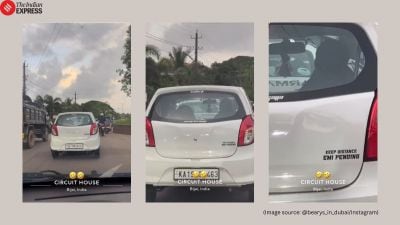
A short clip of a car sticker has struck a chord online, turning an everyday traffic moment into a viral laugh-fest. The video, posted on Instagram by @bearys_in_dubai, captures a white hatchback navigating traffic on Circuit House Road in Mangaluru, Karnataka. What really caught viewers’ attention wasn’t the car itself, but a sticker pasted on its rear that read, “Keep distance, EMI pending.”