📣 For more lifestyle news, click here to join our WhatsApp Channel and also follow us on Instagram
© The Indian Express Pvt Ltd
 6 min read


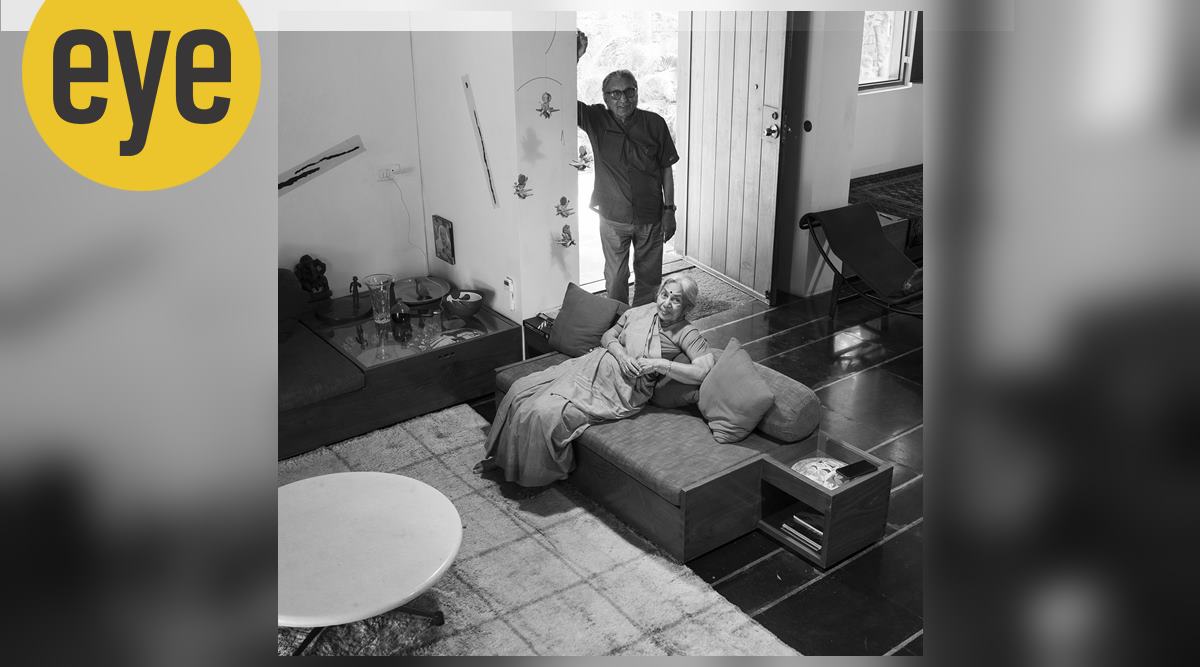 Late architect BV Doshi with wife Kamala Parikh, from the book, Portrait of a House, Conversations with BV Doshi. (Photo Courtesy: Dayanita Singh)
 Architecture reveals itself in the relationships that it builds between people, and, for BV Doshi, architecture was not about the design but the ability to create life through it. There was something about the houses that he built that drew me back time and again, and I realised that it is not just the architecture, but how the spaces were thought of for people to live in, love in and grow in. I felt a strong connection to these houses where relationships are nurtured, and light creates its magic. There was a warmth I felt the instant I entered Kamala House in Ahmedabad in 2018 for a commissioned portrait of Mr Doshi.
He had just won the Pritzker Prize, and I had been a follower of his work for years. As a student at NID (National Institute of Design) I had often spent time at CEPT (Centre for Environmental Planning and Technology). This was an opportunity for me to meet him. I did a recce of the house, measured the light and decided where I’d photograph him. A chair and tripod were set up and I tested the shot with his grandson. But when Mr Doshi walked into the room, he asked ‘So, Dayanita, tell me, how are you going to make a still photograph speak?’ and I knew this was going to be an incredible conversation as he opened the shutters in the room to show me how many different lights could be created.
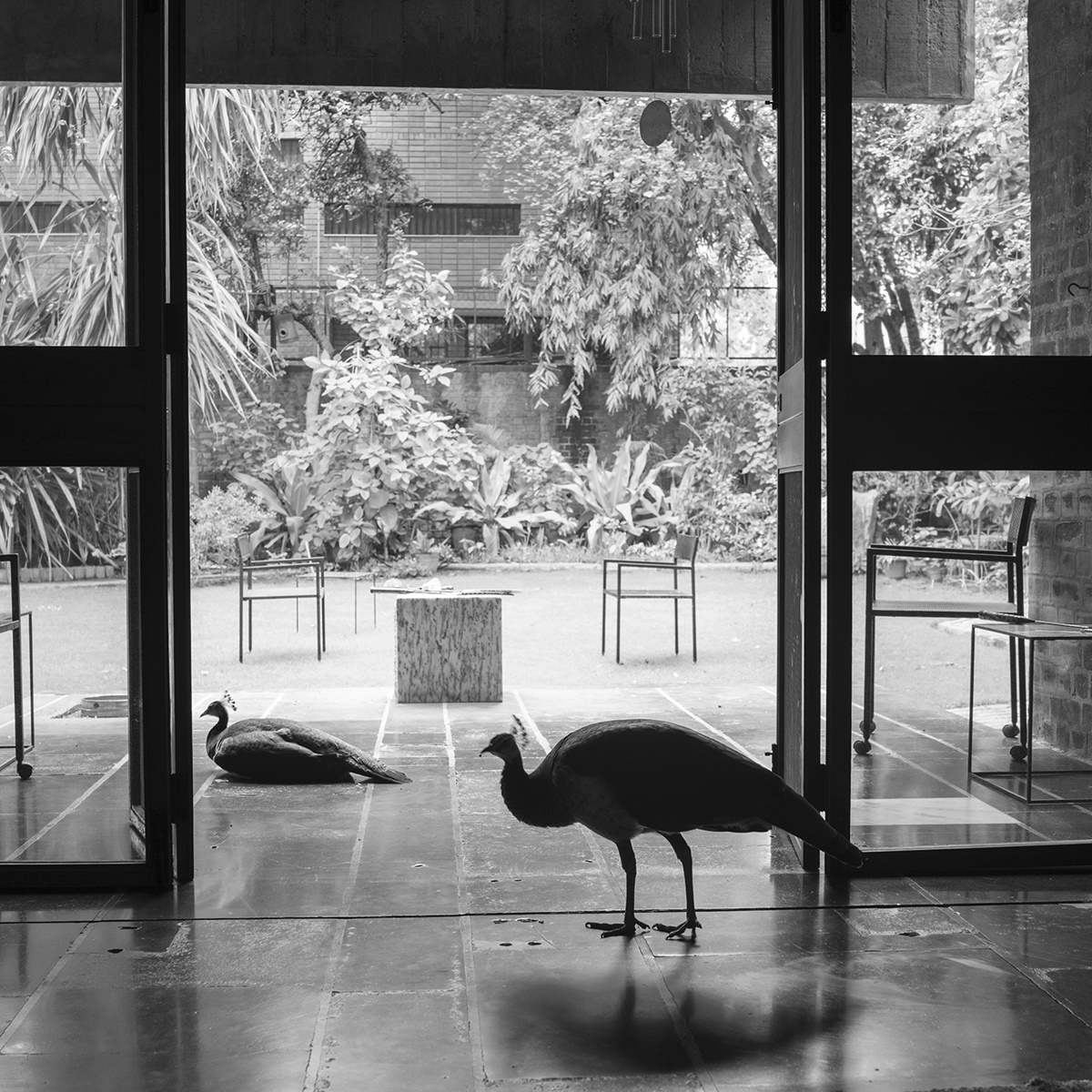 It’s not uncommon to have peacocks and peahens enter the Kamala House. (Photo Courtesy: Dayanita Singh)
A session that was to take 15 minutes, extended to the entire week and several subsequent visits where I photographed him, his family and the numerous spaces designed by him. I don’t know what it was about the Kamala House that was such a magnet, but there is something in the way the walls allow the light to dance around in the space. There are no curtains, no glass, only wooden panels and it feels like there are all these different apertures and different angles, so you’re continuously surprised by the interplay of light and shadow. One of my favourite photographs is of him sitting on the floor, leaning against his wife’s leg, the two of them sharing a moment that feels comfortably intimate. The reason he could sit like that is because of the furniture, or the lack of it. One could sit on the ground, the staircase, or the landing, utilising every corner. Every element was a kind of seat or bed even. There is no big architectural statement, and that actually is the best architectural statement.
I felt a strong feminine energy that defines the space, and an ease that one feels while entering the house as one turns in from the side entrance. In the absence of a lobby or garden, you run straight into domesticity, between the dining and living area, almost looking into the kitchen. The comfort, vulnerability and tenderness I experienced reflected in the photographs, and marked the return of these elements that I had thought had gone from my work since I started working with the Hasselblad camera in 1997.
Obviously, as a photographer, I am obsessed with light. With Mr Doshi it was fantastic to find someone who was equally, if not more, obsessed with what light does and able to articulate it. So, we spoke at length about light and life. He would read the images brilliantly, and saw much more than what others do in my photographs. He could gather the intent, and I don’t know whether that came from his architecture or just who he was.
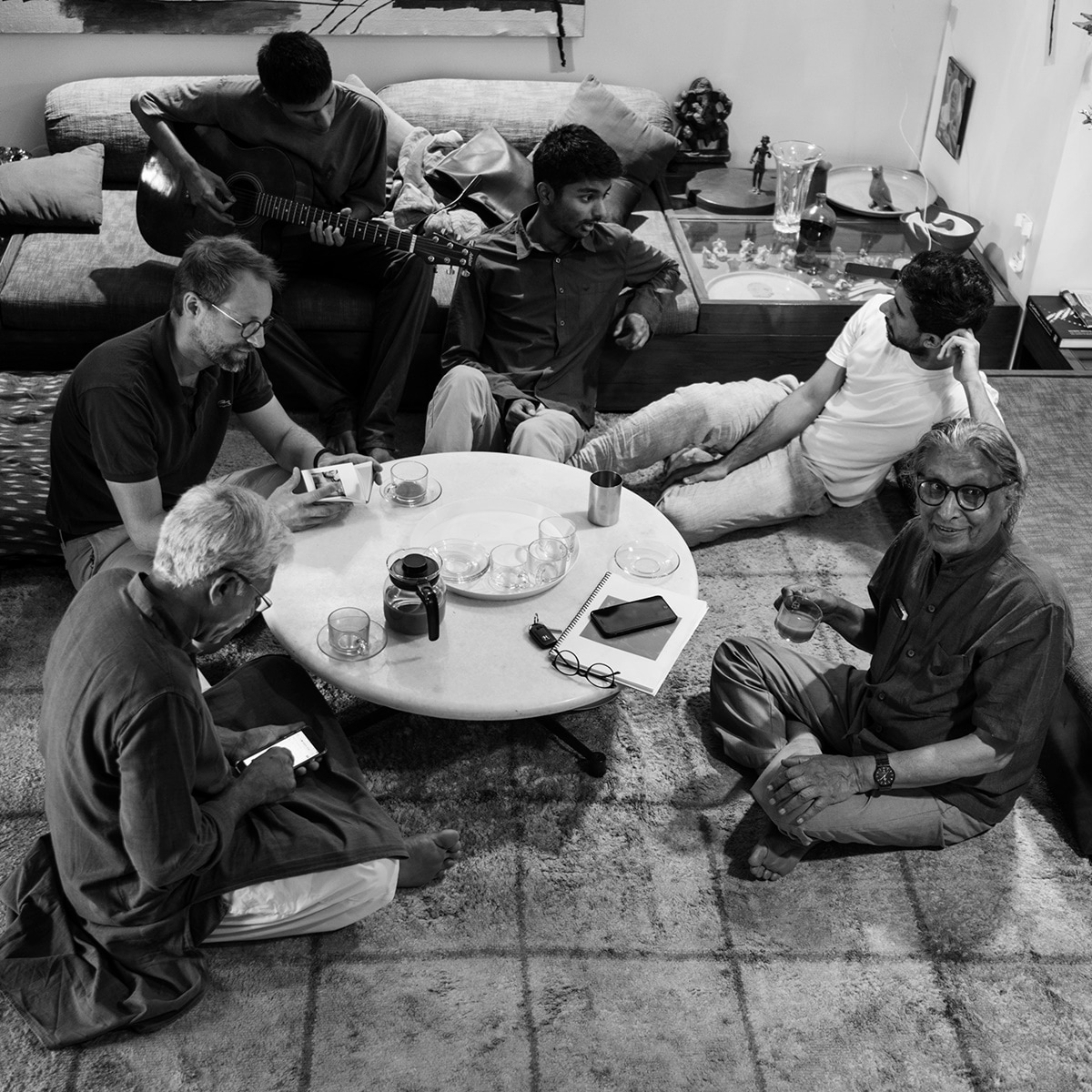 Doshi at home with family (Photo Courtesy: Dayanita Singh)
During Covid when I was wondering what to do with all the photos I had made of Mr Doshi’s house, I had the idea to use my images as prompts for him and we just used the resulting conversations over zoom. he was so generous with his time and thoughts, I was astonished at how closely he read each image. Gradually the idea of a book emerged and I knew I had to do this myself and not wait for Steidl. I went to the brilliant book designer Rukmini Guha Thakurta, and to Nayantara Patel for the editing. That balance between text and image is critical, a centimetre here or there changes the meaning of the book. I asked them to make it like a jugalbandhi rather than a sawaal jawab. The book was called Portrait of a House, Conversations with BV Doshi and published by my own imprint- Spontaneous Books, in time for his 93rd birthday.
We decided to end the book with a discussion between him and my mother Nony Singh, where they recall their respective visits and impressions of the Ellora caves. I am due to visit them next month. Mr Doshi had recommended that I do, and was supposed to have accompanied me if possible, or else join over a video call. Maybe he will be there in the light.
Dayanita Singh is a Delhi-based photo artist
As told to Vandana Kalra