This is an archive article published on January 11, 2022
New research: Omicron and immune response after vaccination
What could explain the rapid spread of Omicron? A study suggests the new Covid-19 variant significantly reduces the neutralising ability of antibodies — those induced by vaccines as well as by hybrid immunity.
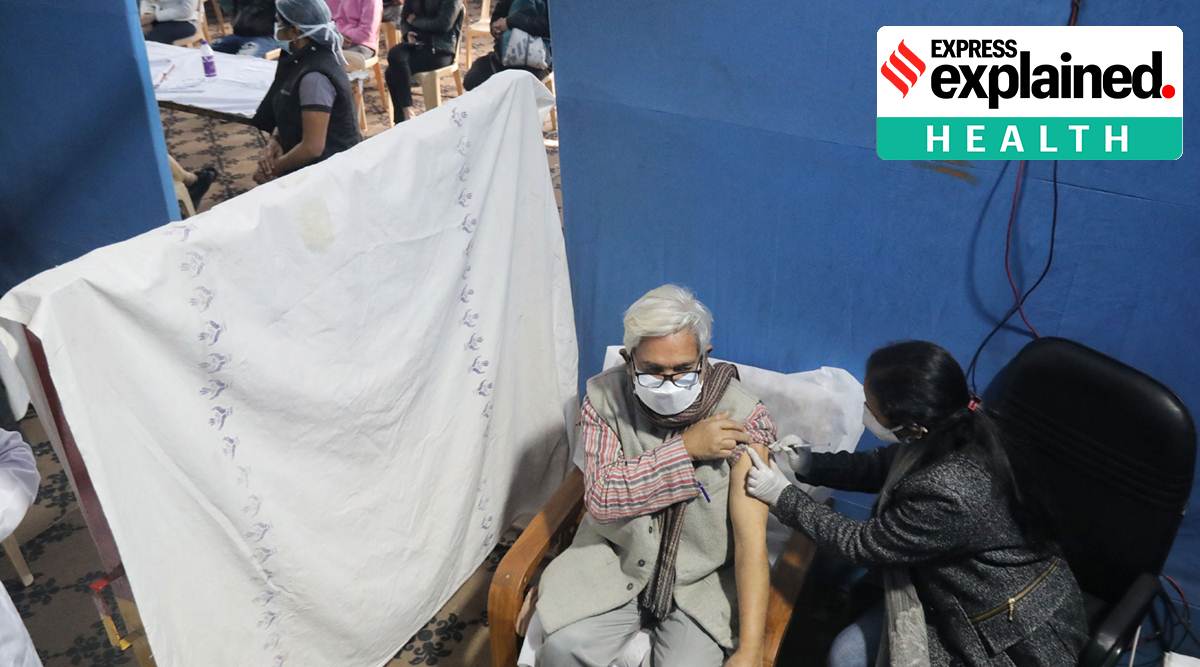
‘‘Precautionary’ dose given at Maulana Azad Medical College, Delhi. (Express photo by Abhinav Saha)
With its multiple mutations, the Omicron variant of SARS-CoV-2 significantly reduces the neutralising ability of antibodies — those induced by vaccines as well as by hybrid immunity, a study has found. This might explain its rapid spread even amid widespread vaccine coverage, suggests the study, conducted by the Translational Health Science and Technology Institute (THSTI). The researchers have stressed, however, that reduced neutralisation may not translate into drastic reduction in vaccine effectiveness.
The study, ‘Sub Optimal neutralisation of Omicron (B.1.1.529) variant by antibodies induced by vaccine alone or SARS CoV2 infection plus vaccine (hybrid immunity) post six months’, is currently published as a preprint (bit.ly/31Jht9Z).
Researchers tested the ability of antibodies to neutralise Omicron among people with vaccination alone, and among vaccinated people who also had had a prior natural SARS-CoV-2 infection. “We included a total of 80 participants — 20 each with ChAdOx1 nCoV-19 (Covishield) and BBV152 (Covaxin) vaccination alone, and 20 each with ChAdOx1 nCoV-19 vaccine plus natural infection and BBV152 vaccine plus natural infection,” said Dr Pramod Garg, Executive Director of THSTI.
The study compared the extent of neutralisation using a measure called geometric mean titre (GMT). For antibodies against the original virus strain, the GMT was 384 in those vaccinated with Covaxin alone, and 383 in those vaccinated with Covishield alone. For the hybrid groups, the values were 795 and 1424 respectively.
Against Omicron, only 5 out of 20 in both vaccine-only groups, 5 out of 19 in the Covaxin-plus-infection group, and 9 out of 20 in the Covishield-plus-infection group exhibited neutralisation titres above the lower limit of quantification. This suggested better neutralisation in those with prior infection.
The proportion of neutralisers was significantly reduced against Omicron compared to the original strain and Delta. Among those without prior infection, GMT was significantly lower against Omicron than against the original strain and Delta. Among those with previous infection, the titres followed the same pattern — but the neutralising ability was better in them than in those without previous infection.
Vaccination does help
Story continues below this ad
“However, reduction in neutralisation may not translate into drastic reduction in vaccine effectiveness. We have to give a balanced message to people, that in general, the body’s own defence mechanism even before vaccines were good enough to prevent symptomatic infections in a large majority of people. Among those clinically infected a large majority had mild disease, due to natural immune defence mechanism in humans,” Dr Garg said. Even if Omicron is spreading, being vaccination prevents severe disease in 80%-90% of the people, Dr Garg said. “Boosting may be required in a sub group of people which is allowed from today onwards.”
There was no difference in the neutralisation levels between the two vaccines.
Antibodies, T cells & boosters
A recent study by THSTI published in The Lancet Infectious Diseases has shown that besides neutralising antibodies, T-cell immune responses are important for controlling SARS-CoV-2 infection. The researchers said this seems to be true for Omicron too, as demonstrated by South African researchers.
“From a policy perspective, a significant correlation between serum IgG titres and neutralisation GMT against the omicron in the face of immune escape by this variant would lend support for an additional dose of vaccine to augment antibody response. This is being implemented in a few countries including India and has the potential to offer better protection in vulnerable people…,” the study said.
Story continues below this ad
Lead author Guruprasad Medigeshi and other researchers have said in the study that the drop in neutralisation might be alarming, but the real-world impact of these reduced neutralisation titres on hospitalisation rates and mortality rates have to be interpreted along with other factors such as pathogenicity of the variant, immunisation uptakes and seroprevalence from natural infection in different geographical regions and the expected role of cellular immune responses to the variant.
Anuradha Mascarenhas is a Senior Editor at The Indian Express, based in Pune. With a career spanning three decades, she is one of the most respected voices in Indian journalism regarding healthcare, science and environment and research developments. She also takes a keen interest in covering women's issues .
Professional Background
Education: A gold medalist in Communication and Journalism from Savitribai Phule Pune University and a Master’s degree in Literature.
Author: She authored the biography At The Wheel Of Research, which chronicles the life and work of Dr. Soumya Swaminathan, the former Chief Scientist at the WHO.
Key Focus: She combines scientific accuracy with storytelling, translating complex medical research into compelling public and human-interest narratives.
Awards and Recognition
Anuradha has won several awards including the Press Council of India's national award for excellence in journalism under the gender based reporting category in 2019 and the Laadli Media award (gender sensitivity -2024). A recipient of the Lokmat journalism award (gender category-2022), she was also shortlisted for the RedInk awards for excellence in journalism-2021. Her debut book At The Wheel Of Research, an exclusive biography of Dr Soumya Swaminathan the inaugural chief scientist of World Health Organisation was also nominated in the Popular Choice Category of JK Paper AUTHER awards. She has also secured competitive fellowships including the Laadli Media Fellowship (2022), the Survivors Against TB – New Research in TB Media Fellowship (2023) and is part of the prestigious 2025 India Cohort of the WomenLift Health Leadership Journey.”
Recent Notable Articles (Late 2025)
1. Cancer & Specialized Medical Care
"Tata Memorial finds way to kill drug-resistant cancer cells" (Nov 26, 2025): Reporting on a breakthrough for triple-negative breast cancer, one of the most aggressive forms of the disease.
Discipline, diet and purpose; How a 97-year-old professor defies ageing'' (Nov 15, 2025) Report about Prof Gururaj Mutalik, the first Head of Department at Pune's B J Government Medical College who at 97 credits his longevity to healthy habits and a strong sense of purpose.
2. Environmental Health (The "Breathless Pune" Series)
Long-term exposure even to 'moderate' air leads to chronic heart, lung, kidney issues" (Nov 26, 2025): Part of an investigative series highlighting that even "safe" pollution levels are damaging to vital organs.
"For every 10 µg/m3 increase in PM2.5 level, there was 6-8% jump in medicine sales" (Nov 23, 2025): Using commercial data to prove the direct link between air quality and respiratory illnesses in Pune.
3. Lifestyle & Wellness News
"They didn't let cancer, diabetes and heart disease stop them from travelling" (Dec 22, 2025): A collaborative piece featuring survivors who share practical tips for traveling with chronic conditions.
At 17, his BP shot up to 200/120 mmHG; Lancet study flags why child and teen hypertension doubled between 2000 and 2020'' (Nov 12,2025)--A report that focusses on 17-year-old-boy's hypertensive crisis and reflects the rising global trend of high blood pressure among children and adolescents.
4. Scientific Recognition & Infrastructure
For promoting sci-comm, gender diversity: IUCAA woman prof highlighted in Nature" (Nov 25, 2025): Covering the global recognition of Indian women scientists in gender studies and physics.
Pune researchers find a spiral galaxy like the Milky Way from early universe'' (December 3, 2025)- A report on how Indian researchers discovered a massive galaxy that existed when the universe was just 1.5 billion years old , one of the earliest to have been observed so far.
Signature Beat: Health, Science & Women in Leadership
Anuradha is known for her COVID-19 reportage, where she was one of the first journalists to provide detailed insights into the Covishield and Covaxin trials. She has a dedicated interest in gender diversity in health and science, often profiling women researchers who are breaking the "leaky pipeline" in STEM fields. Her writing style is scrupulous, often featuring interviews with top-tier scientists and health experts from various institutions.
... Read More


 4 min read