Many of you might have heard a casual comment roughly translating to the following: RBI has acted proactively. There was little it could do, after all, inflation is a global problem at present. Just look at the US; even the US Federal Reserve (or Fed) had to raise interest rates.
Does that mean, India and the US — just to take two examples — are in the same boat when it comes to inflation?
The short answer is: No. India and the US are facing the same crisis — i.e. high inflation — but they are not in the same boat. And that is why the same steps (read higher interest rates and curtailed money supply) that the two central banks take to control inflation can be expected to hurt the Indian economy far more than they’ll hurt the US economy.
In particular, as interest rates rise, India should brace for even higher levels of unemployment in the coming months.
Now for the long answer.
To understand the contrast between the two economies, one must consider four factors:
Story continues below this ad
- What was the underlying strength of the economy before it faced the two back-to-back shocks (i.e. the Covid-induced disruption and the geopolitical upheaval in Ukraine)?
- How robust was the recovery in the two countries?
- What are the causes of inflation? What is it that the respective central banks are hoping to achieve?
- What was the level of unemployment as the respective central banks started to tighten monetary policy? How will it be affected?
State of the underlying economy before Covid
Just because both India and the US are facing high inflation at present does not mean that the two underlying economies are equally unhealthy before Covid.
As detailed in last week’s ExplainSpeaking, which used the latest RBI report on currency and finance, India’s economic growth had been steadily losing its growth momentum since October 2016.
In a country like India which often experiences jobless growth, fast deceleration in economic growth came with its most obvious repercussion — massive joblessness, faltering wage growth, and growing disillusionment among workers (especially the educated youth)
Story continues below this ad
Contrast this with the US, which was enjoying the longest expansion (over 10 years) in its economic history.
An important thing for readers to note here is that, in terms of overall GDP, the US economy is roughly ten times the size of the Indian economy. The contrast is even more when it comes to per capita incomes — US per capita incomes being more than 30 times.
That is why it is misleading to think that a 4% growth in annual GDP means the same thing in the two countries.
How robust was the recovery post-Covid?
It is a fact that both economies went into recession for a brief while, thanks to the Covid-induced lockdowns and disruptions. However, there are crucial differences.
Story continues below this ad
While India has barely managed to get back to the same level of GDP that it had before the Covid pandemic, the US is one of those rare cases, where the recovery has been so sharp that the economy has barely lost a step.
 Chart 1: This shows IMF’s projections of the level of real GDP of countries in 2022
In Chart 1 (sourced from Nomura Research) the data is based on the IMF’s projections of the level of real GDP of countries in 2022 made at two points in time, April 2022 (latest) and October 2019 (pre-pandemic). The percentage change is shown in the columns. The results show that for most countries, the IMF’s projections made in April 2022 are lower than those made in October 2019.
Note, the dramatically contrasting recoveries of the US and Indian economies.
What are the causes of inflation?
This brings us to what is causing inflation in the US and India, respectively, and for how long.
Story continues below this ad
For one, in India, inflation was much higher than the RBI’s target (4%) long before the Covid-induced nationwide lockdowns were announced in March-end.
Contrast this with the US inflation, which stayed well within the US Fed’s target of 2% right up to the first couple of months in 2021.
That said, in the US, inflation has now hit a four-decade high while in India the situation is still not as alarming.
But there is a flip-side when it comes to what is causing high inflation in the two countries.
Story continues below this ad
In the US, higher inflation is in large part because of the rapid economic recovery. This is called the “demand-pull” inflation. In the wake of the pandemic, the US government extended massive support to the economy in the form of giving stimulus money and this created a huge surge in overall demand that not only boosted the GDP but also bumped up the price level.
There was another cause for inflation — the so-called “cost-push” inflation. This was in the form of supply bottlenecks — such as shortage of workers or breaking up supply chains — leading to higher costs, such as higher wages for workers, which, in turn, led to higher prices and higher inflation. The spurt of higher food and energy prices in the wake of the Ukraine crisis added to this cost-push inflation.
In India, by contrast, inflation has been high despite there being a demand deficit. Of course, a big part of the inflationary pressure can be explained by the supply bottlenecks but it is crucial that in India overall demand is barely above the pre-pandemic level. To that extent, higher inflation in India even without the recovery in demand is a worrisome fact.
Add to that India’s much greater vulnerability because the country is dependent on imports for 80% of its total fuel needs.
Story continues below this ad
Status of unemployment
This is perhaps the most crucial factor.
In India, unemployment had been the highest in the past almost 45 to 50 years even before the pandemic. The sharp contraction and anaemic recovery have not helped matters. Partly that has to do with the fact that India is also going through a phase when millions enter the working-age population each year.
Contrast this with the situation in the US. While inflation is at a four-decade high, the unemployment rate in the US is at a five-decade low. There are 11.5 million job vacancies in the US and only 6 million unemployed people. That means there are two job vacancies for each unemployed person in the US as of last week.
“Employers are having difficulties filling job openings, and wages are rising at the fastest pace in many years,” said Fed Chair J Powell. “Over the first three months of the year, employment rose by nearly 1.7 million jobs. In March, the unemployment rate hit a post pandemic and near five- decade low of 3.6 percent. Improvements in labor market conditions have been widespread, including for workers at the lower end of the wage distribution, as well as for African Americans and Hispanics. Labor demand is very strong,” he stated.
Story continues below this ad
In fact, according to Chair Powell, the central point of raising the interest rates is to dampen hiring in the US economy and thus reduce the demand-supply mismatch in the job market. That’s because massive mismatch is leading to wages registering such fast increases that there is an apprehension that the wage increases may spiral out of control and lead to higher inflation.
“Wages are running high, the highest they’ve run in quite some time. And they are one good example of —or good illustration, really—of how tight the labor market really is, the fact that wages are running at the highest level in many decades. And that’s because of an imbalance between supply and demand and the labor market,” he said during a media interaction.
What do these factors tell us about the likely impact of containing inflation in India and the US?
Typically, a tighter monetary policy (that is, higher interest rates and reduced money supply) dampens overall demand. Central banks resort to this policy when they find that the economy is overheating — that is, growing gap between demand and supply — and causing inflation.
Containing inflation comes at the cost of reduced economic growth and higher unemployment.
This is where the underlying status of the two economies — India vs the US — makes all the difference.
India was struggling with anaemic economic growth and high unemployment before the crisis. Further, despite the RBI’s efforts to boost growth, India’s recovery is both uneven and iffy even as unemployment continues to be a massive concern.
In sharp contrast, the US entered the Covid recession after enjoying its longest economic expansion in history. Further, its recovery is possibly the best in the world with unemployment touching a historic low and wages registering sharp increases.
In other words, the high inflation in the US economy is genuinely because it is overheating. Actions to retard its overall growth will dampen the growth of jobs but then — and this is the crucial bit — the US already has two jobs per unemployed person and, as such, it can take that hit. In fact, reducing this demand for workers by companies is the central goal of the Fed policy.
India, on the other hand, has no such comfort when it comes to unemployment.
Can the US go into recession? Can India experience stagflation?
These are valid concerns.
When asked, Chair Powell said this about the prospects of the US economy experiencing recession:
“I think we have a good chance to restore price stability without a recession, without, you know, a severe downturn and without materially higher unemployment. And I mentioned the reasons for that. So I see a strong economy now. I see a very strong labor market, for example. Businesses can’t find the people to hire. They can’t find them. So typically in a recession you would have unemployment. Now you have surplus demand. So there should be room, in principle, to reduce that surplus demand without putting people out of work,” he stated.
As for India facing stagflation — which is described as a phenomenon when an economy suffers from stagnant economic growth (predictably leading to high unemployment) and persistently high inflation — some argue India is already facing it.
But even if such views are disregarded, the fact remains that even before persistent high inflation hit India, it was experiencing high unemployment. That is why policies that dampen growth now will only exacerbate unemployment — at least in the short term.
Newsletter | Click to get the day’s best explainers in your inbox


 11 min read



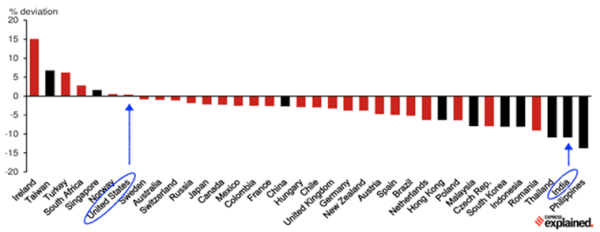 Chart 1: This shows IMF’s projections of the level of real GDP of countries in 2022