This is an archive article published on November 7, 2021
Explained: Why Chennai received ‘heaviest rainfall’ since 2015
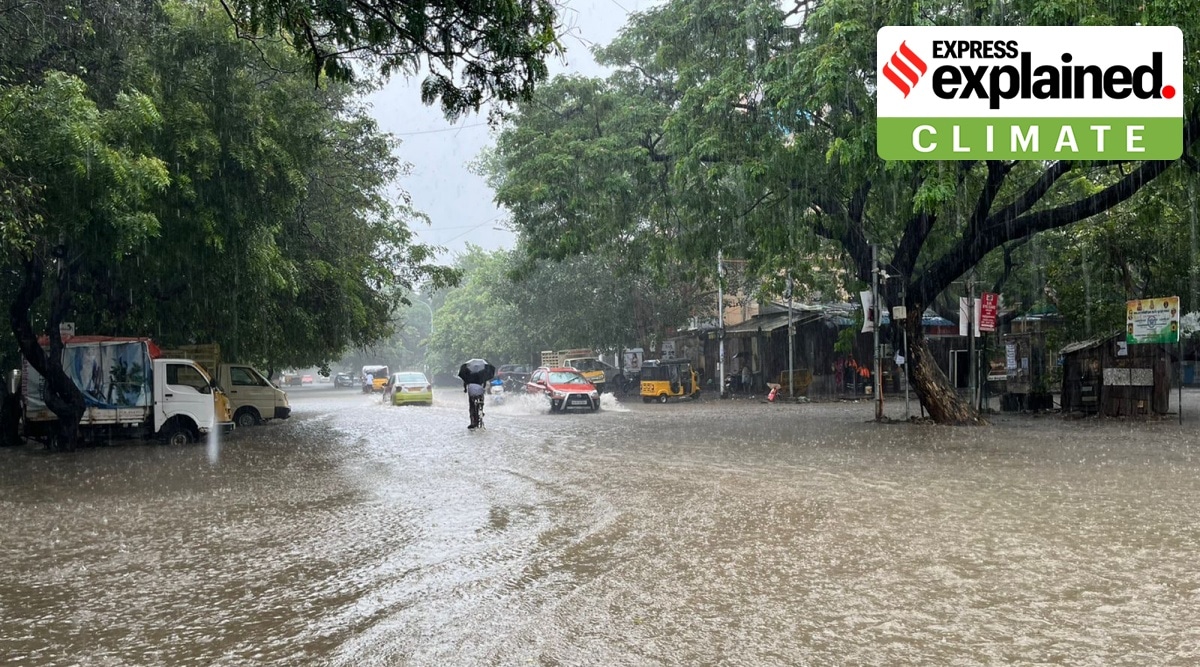
Chennai rain: The showers on Saturday night and early morning on Sunday caused flooding in several neighbourhoods of the city, including T Nagar, Vyasarpadi, Adyar, Velachery, Royapettah and Mylapore.
The overnight rain, which was reportedly the heaviest since 2015, was part of a formation of a low pressure over the Bay of Bengal. (Express photo)
The heavy rain that lashed Chennai on Saturday night led to flooding in at least 40 busy residential and commercial neighbourhoods in the city. The overnight rain, which was reportedly the heaviest since 2015, was part of a formation of a low pressure over the Bay of Bengal.
Overnight Impact
The rains on Saturday night and early morning on Sunday caused flooding in several city neighbourhoods including T Nagar, Vyasarpadi, Adyar, Velachery, Royapettah and Mylapore.
Jawaharlal Nehru Nagar, Madhavram, Tondiarpet High Road, Northern Trunk Road, Royapuram, Teynampet, Khader Nawaz Khan Road, interior areas of Velachery, several stretches of Sholinganallur in the city suburb were among those areas reported flooding or water inundation early morning on Sunday.
According to a government release, 500 Cusecs of water from Puzhal reservoir will be released around 11 am and the local authorities issued alerts to people living in low-lying habitations on the banks of the surplus canal. The government has also announced that the water from the Chembarambakkam reservoir will be released by 1.30pm on Sunday.
Data from two rain recorders – Nungambakkam in Chennai city and Meenambakkam in the city suburb – shows that the city and suburbs received 21.5 cm and 11.3 cm rains respectively by 8.30am on Sunday.
In one of the heaviest episodes of rain witnessed in 2015, on November 15 to 16, Chennai recorded 24.6 cm rainfall in 24 hours, which was breaking the previous record of 14.2 cm from November 2005.
Story continues below this ad
But the maximum rainfall recorded in 24 hours time may be from November 1976, when Chennai had recieved 45.2cm of rainfall. Another record rainfall, in two days, was registered in 1985 – which was November 12 (25cm) and November 13 (33cm). The 14.2 cm rainfall in 2005 was the next.
North East monsoon bring rains to Chennai
Chennai’s monsoon is largely about the Northeast Monsoon, rains during October to December, with easterly winds starting from mid-October, precisely the usual onset that begins between October 10 to 20. It is the Northeast Monsoon, also known as the ‘primary monsoon of Tamil Nadu,’ that brings sufficient rains to the state when all other states depend on the South West monsoon for rains that sets in from May, June and July. The South West monsoon, after a prolonged summer, helps Tamil Nadu to maintain the ground water tables, it is the North East monsoon that elevates the table.
Tamil Nadu’s coastal districts get 60% of the annual rainfall and the interior districts get about 40-50% of the annual rainfall from the North East monsoon.
The meteorological department predicts a likely formation of low pressure over the Bay of Bengal moving towards the northern Tamil Nadu coast with moderate rain in the coming days ahead of the formation of the low pressure.
“An upper air cyclonic circulation lies over southeast Bay of Bengal and adjoining equatorial Indian Ocean extending up to 3.1 km above mean sea level. Under its influence, a low-pressure area is likely to form over southeast Bay of Bengal and neighbourhood around November 9. It is likely to become more marked during subsequent 48 hours and move towards the north Tamil Nadu coast,” said a statement from the Regional Specialised Meteorological Centre – Tropical Cyclones. It also predicts chances of squally winds of 40 kmph to 50 kmph gusting to 60 kmph might prevail over the sea from November 9, and along and off the Tamil Nadu coast and south Andhra Pradesh coast from November 11 and 12.
A heavy rainfall warning also has been issued for November 10 as a thunderstorm with heavy to very heavy rain is likely to occur at isolated places over Chennai, Tiruvallur, Kancheepuram, Chengalpet, Villupuram, Cuddalore, Mayiladuthurai, Nagapattinam, Tiruvarur, Thanjavur and Pudukottai districts of TN, Puducherry and Karaikal.
Arun Janardhanan is an experienced and authoritative Tamil Nadu correspondent for The Indian Express. Based in the state, his reporting combines ground-level access with long-form clarity, offering readers a nuanced understanding of South India’s political, judicial, and cultural life - work that reflects both depth of expertise and sustained authority.
Expertise
Geographic Focus: As Tamil Nadu Correspondent focused on politics, crime, faith and disputes, Janardhanan has been also reporting extensively on Sri Lanka, producing a decade-long body of work on its elections, governance, and the aftermath of the Easter Sunday bombings through detailed stories and interviews.
Key Coverage Areas:
State Politics and Governance: Close reporting on the DMK and AIADMK, the emergence of new political actors such as actor Vijay’s TVK, internal party churn, Centre–State tensions, and the role of the Governor.
Legal and Judicial Affairs: Consistent coverage of the Madras High Court, including religion-linked disputes and cases involving state authority and civil liberties.
Investigations: Deep-dive series on landmark cases and unresolved questions, including the Tirupati encounter and the Rajiv Gandhi assassination, alongside multiple investigative series from Tamil Nadu.
Culture, Society, and Crisis: Reporting on cultural organisations, language debates, and disaster coverage—from cyclones to prolonged monsoon emergencies—anchored in on-the-ground detail.
His reporting has been recognised with the Ramnath Goenka Award for Excellence in Journalism.
Beyond journalism, Janardhanan is also a screenwriter; his Malayalam feature film Aarkkariyam was released in 2021. ... Read More


 4 min read