© The Indian Express Pvt Ltd
 5 min read


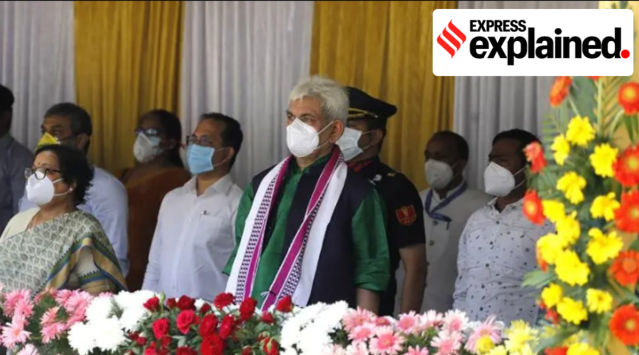 The awards were instituted as an encouragement to the police force that was fighting Pakistan-sponsored terrorism in Jammu and Kashmir.(File)
The Jammu and Kashmir government decided on Monday (May 23) to remove the image of former Chief Minister Sheikh Abdullah and the emblem of the erstwhile state from the J&K Police medals that are awarded for gallantry and meritorious service. The medals will now carry the national emblem of India and the words “Jammu and Kashmir Police Medal for Gallantry” or “Jammu and Kashmir Medal for Meritorious Service”, as the case may be.
Following the abrogation of Article 370 and bifurcation of the erstwhile state into two Union Territories after August 5, 2019, the J&K government had in 2020 replaced the words “Sher-i-Kashmir” in these medals with “Jammu and Kashmir”.
Buy Now | Our best subscription plan now has a special price
The latest decision has evoked strong criticism from all the mainstream opposition parties including the National Conference, who have described it as a move to erase the history of Jammu and Kashmir.
What are the Sher-i-Kashmir Police Medals for Gallantry and Meritorious Service?
Made of 3 tola pure gold, both these medals were instituted in 2001 by the then National Conference government of the state headed by Dr Farooq Abdullah. These had the image of the founder of the National Conference, the late Sheikh Mohammad Abdullah, popularly called Sher-i-Kashmir (Lion of Kashmir), on one side, and the emblem of the then Jammu and Kashmir state on the other.
On whom were these medals conferred, and when?
The awards were announced on the eve of every Independence Day and Republic Day on the lines of the announcements made by the Government of India, for police officers/ officials serving in Jammu and Kashmir, for extraordinary bravery in the line of duty, or for distinguished service.
The medals were given in addition to the police medals announced for police officers/ personnel by the Government of India on both occasions every year.
Was there a cash prize attached to the awards as well?
Apart from the gold medal and a citation, the recipient of the Sher-i-Kashmir Police Medal for Gallantry received an additional Rs 1,000 per month as award money in his salary, while the recipients of the meritorious service medal received a one-time award of Rs 5,000.
How many such awards were announced by the J&K government every Independence Day and Republic Day?
While there was no ceiling on the number of Sher-i-Kashmir Police Medals for Gallantry, the number was fixed at six for each occasion in the case of Medals for Meritorious Service.
And when were the medals actually handed over to their recipients?
The medals were formally conferred on the awardees at an investiture ceremony held by the J&K Police Headquarters later. However, there was a delay in the actual conferment, and according to police officers, the recipients of the Sher-i-Kashmir Police Medical for Gallantry/Meritorious Service in 2018 are still to get their medals.
The delay, according to these officers, was caused by the time taken by the Government of India’s Mint at Mumbai in preparing the medals.
Under what circumstances were these medals instituted?
The awards were instituted as an encouragement to the police force that was fighting Pakistan-sponsored terrorism in Jammu and Kashmir. The then state government did so in exercise of the powers vested in it by virtue of Article 370, which gave the then state of Jammu and Kashmir special status under the Constitution, enabling it to have its own Constitution, Flag and Emblem.
No other Indian state gives its own medals in addition to the honours announced by the Government of India on the eve of Independence Day and Republic Day, even though they may offer incentives in the form of land or cash to boost the morale of police personnel.
And what was the emblem of the erstwhile J&K state?
From 1947 until the abolition of the monarchy in 1952, the erstwhile state used the coat of arms of the princely state of Jammu and Kashmir as its emblem. In November 1952, the then state government adopted a new emblem, the central element of which was a lotus rising out of a lake, with the lake flanked by two ploughs supported by ears of grain and a triangular representation of a mountain peak below it.
The emblem carried the name of the state in English. It also carried three broad stripes within the lake to represent the three geographical areas of the then state of Jammu and Kashmir — Jammu, Kashmir, and Ladakh.
Do the changes announced this week make any difference to the serving and retired police officers who have received these medals?
No — just that future recipients of the medals will have the emblem of Government of India and J&K Police embossed on its two sides.