Premium
This is an archive article published on October 21, 2020

Explained: What Punjab’s three new farm Bills say, and what they seek to achieve

A special session of the Punjab Assembly on October 20 rejected the Centre's three farm laws and passed its own amendment Bills removing Punjab from the ambit of the central laws.

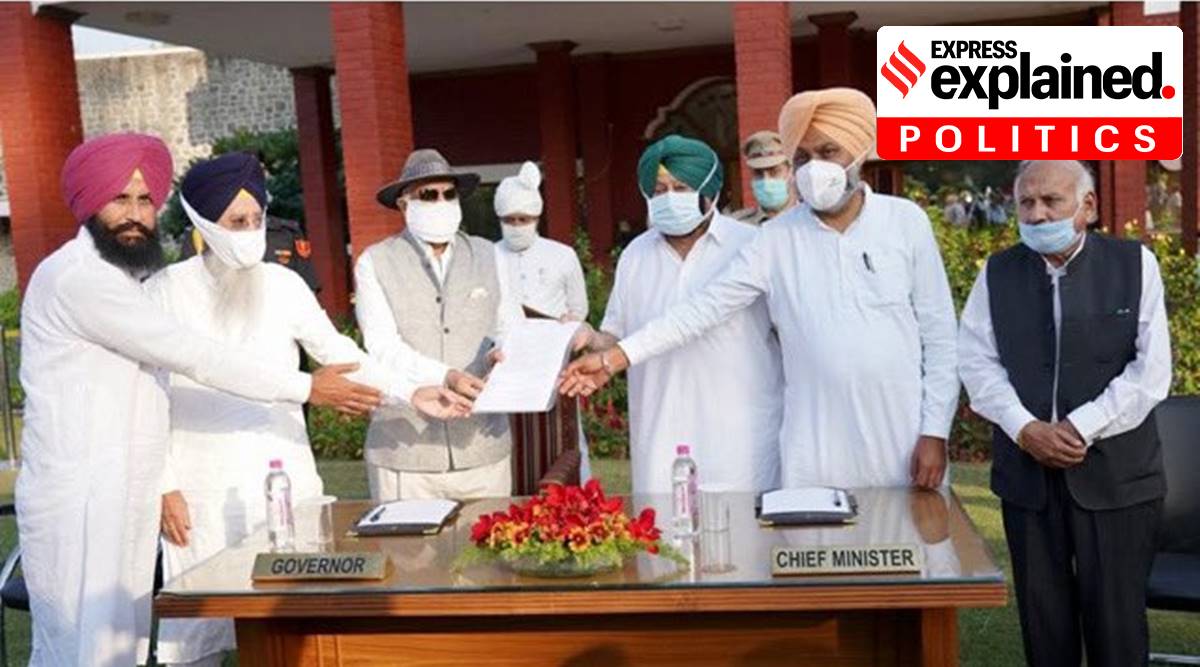
Punjab farm bills, what are the farm bills Punjab assembly passed, Centre farm laws, MSP, Punjab farmers protest, indian express, express explainedPunjab CM Captain Amarinder Singh along with MLAs meets Governor VP Singh Badnore Tuesday, to request his assent to the farm Bills passed by the Assembly. (Photo: Twitter/ @capt_amarinder)

After over a month of protests by farmers against the three farm laws enacted by the central government, a special session of the Punjab Assembly on Tuesday (October 20) not only rejected the laws by a unanimous resolution but also passed three farm amendment Bills removing Punjab from the ambit of the central laws.

What is the rationale given by the state to amend the three central farm laws?

In each of the three Bills, the Punjab government has claimed that the application of central laws to the state is being changed to “restore the agricultural safeguards for the farmers through the regulatory framework of Punjab Agricultural Produce Markets Act, 1961 to secure and protect the interests and livelihoods of farmers and farm labourers as also all others engaged in agriculture and related activities”.

The three Bills mention the agriculture census 2015-16 to underline that 86.2 per cent of farmers in the state are small and marginal, with the majority owning less than two acres of land. Consequently, they have limited access to multiple markets, and lack the negotiation power needed to operate in a private market.

EXPLAINED
What the Bills really mean

Apart from the Governor, the Punjab government's new farm Bills need the assent of the President since they seek to amend laws passed by the central government. If not, they can at best serve as a symbolic political statement against the Centre's farm laws.

All the three Bills underscore the importance of farmers getting a level playing field in the form of a fair price guarantee.

The Bills also point out that agriculture, agricultural markets, and land is the primary legislative domain of the state. 📣 Express Explained is now on Telegram

So, what are the key features of the Farmers (Empowerment and Protection) Agreement on Price Assurance and Farm Services (Special Provisions and Punjab Amendment) Bill, 2020?

Story continues below this ad

The Bill seeks to address the fears of state farmers about being forced to sell their produce at less than the minimum support price (MSP) with an amendment whereby sale of wheat and paddy shall be valid only if the seller pays a price equal to or greater than the MSP announced by the central government.

It states that any person or company or corporate house will be punished with imprisonment of not less than three years and a fine if he signs a contract wherein the farmer is compelled to sell his produce at less than the MSP.

This Bill also allows the farmer to approach a civil court, besides seeking remedies available under the central act in case of any differences with the buyer of his produce.

The thrust on only wheat and paddy can be explained by the dominance of these two crops in the state. According to Punjab Mandi Board, Punjab contributes 32 per cent of these two foodgrains to the central pool despite its relatively small land area.

Story continues below this ad

Also in Explained | Why Punjab farmers marched to Delhi despite the state passing its own farm Bills

What do experts say about the amendments?

The amendments received a mixed response from agronomists of the state.

Dr Sucha Singh Gill, former director general of the Centre for Research in Rural and Industrial Development (CRRID) said, “This has been done to meet the demands of the farmers, and will discourage private players to buy at rates less than MSP.”

However, he asked, “Why have they covered only two crops? They should cover the whole gamut of crops; we have marketable surplus of cotton, maize, some pulses and even milk, for which the state decides the MSP.”

Story continues below this ad

Dr S S Johl, a former Vice Chancellor of Punjab Agricultural University and national professor of agricultural economics at Indian Council of Agricultural Research, however, called the Bill a part of “vote-bank politics”, and said the amendments will all but block private players from the state.

Besides MSP, what is the other big change made under the amended Bills?

While the central law abolished any market fees or licences for private players outside the APMCs, the Punjab bills have reintroduced it.

The Bills say the state government can notify a fee to be levied on private traders or electronic trading platforms for trade and commerce outside the mandis established under the Punjab Agricultural Produce Markets Act, 1961.

Story continues below this ad

These fees will go towards a fund for the welfare of small and marginal farmers.

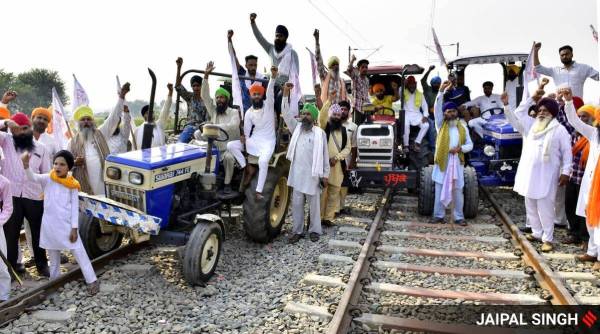
Farm Bills, Farm laws, Punjab farm bills, Punjab farmers, farmer protests, Ram Nath Kovind, Amarinder Singh, Punjab news, Indian Express Farmers block a railway line with their tractors during a protest in Punjab. (Express Photo: Jaipal Singh)

And what are the amendments in The Farmer’s Produce and Commerce (Promotion and Facilitation) Special Provisions and Punjab Amendment Bill 2020?

Stating that one of the direct consequences of the central Act will be to nullify the MSP mechanism, this Bill also provides for punishment to sellers who buy wheat or paddy at less than the MSP.

It declares status quo in the state with regard to the APMC Act 2016. Dr P S Rangi, former consultant, Punjab State Farmers Commission, said that by bringing the entire state under its ambit, the Bill ensures that the private players will also be regulated by the rules of government mandis. They will have to procure licences and pay the market fees to buy produce from the state.

Story continues below this ad

The Bill also states that no punitive action will be taken against anyone for violating the provisions of the central Act.

Finally, what are the amendments in The Essential Commodities (Special Provisions and Amendment) Bill, 2020?

This Bill, says the state, aims to protect consumers from hoarding and black marketing of agri produce. Underlining that production, supply, and distribution of goods is also a state subject, the Bill claims the central Act seeks to give unlimited power of stocking essential commodities to traders.

Under this Bill, the state of Punjab will have the power to order, provide for regulating or prohibiting the production, supply, distribution, and imposing stock limits under extraordinary circumstances, which may include famine, price rise, natural calamity or any other situation.

Story continues below this ad

Also in Explained | How Punjab mandis procure more paddy than state produces; the UP-Bihar link

Manraj Grewal Sharma is a senior journalist and the Resident Editor of The Indian Express in Chandigarh, where she leads the newspaper’s coverage of north India’s most politically and institutionally significant regions. From Punjab and Haryana to Himachal Pradesh and the Union Territory of Chandigarh, she oversees reporting at the intersection of governance, law, politics and society. She also reports on the diaspora, especially in Canada and the US. With a career spanning journalism across several countries, academia and international development, Manraj brings a rare depth of perspective to regional reporting. She is widely regarded as a leading chronicler of Punjab’s contemporary history and socio-political evolution, particularly its long shadow of militancy, federal tensions and identity politics. Her book, Dreams after Darkness, remains a definitive account of the militancy years and their enduring aftermath. Professional Background & Expertise A gold medalist in mass communication and a post-graduate in English literature, Manraj has a multifaceted career spanning journalism, academia, and international development. She was also awarded a fellowship by National Foundation of India and did several in-depth pieces on Manipur. Internationally, she has reported from Israel, US, UK, Myanmar, and Mauritius Her key focus areas include: Regional Politics, History, Agriculture, Diaspora, and Security. Of late, she has started focusing on Legal & Judicial Affairs: Much of her recent work involves reporting on high-stakes cases in the Punjab and Haryana High Court, ranging from environmental policy to civil rights. International Consulting: She previously served as a consulting editor for the Asia Pacific Adaptation Network and a publishing consultant for the Asian Development Bank (ADB) in Manila. Academia: For five years, she was the managing editor of Gender, Technology and Development, a peer-reviewed international journal at the Asian Institute of Technology, Bangkok. Recent Notable Articles (Late 2025) Her recent reportage focuses heavily on judicial interventions and regional governance: 1. Environment & Governance "‘NGT can’t test legality of policy’: HC hears challenge to Punjab’s ‘Green Habitat’ plan" (Dec 22, 2025): Covering a critical legal battle over whether the National Green Tribunal has the authority to strike down a state policy regularizing farmhouses on delisted forest land. "High court pulls up Punjab poll panel over audio clip probe" (Dec 10, 2025): Reporting on judicial concerns regarding the transparency and fairness of local body elections. 2. Legal Rights & Social Welfare "HC issues notice to Punjab, Haryana over delay in building old age homes" (Dec 22, 2025): Reporting on a contempt petition against top officials for failing to establish government-run homes for the elderly as promised in 2019. "Victims can appeal acquittals in sessions court without seeking special leave" (Dec 19, 2025): Highlighting a significant procedural shift in criminal law following a Supreme Court ruling. "HC upholds benefits for Punjab FCI officer acquitted in 20-year-old bribery case" (Dec 19, 2025): A report on the concept of "honourable acquittal" and its impact on employee benefits. 3. Human Rights & Identity "As Punjab denies parole to MP Amritpal Singh, HC asks it to submit ‘foundational material’" (Dec 1, 2025): Covering the legal proceedings regarding the radical preacher and sitting MP's request to attend Parliament. "Protecting life paramount: HC backs Muslim woman in live-in after verbal divorce" (Nov 6, 2025): Analyzing judicial protections for personal liberty in the context of traditional practices. Signature Beats Manraj is recognized for her ability to decode complex judicial rulings and relate them to the everyday lives of citizens. Whether it is a 30-year-old land battle in Fazilka or the political implications of Kangana Ranaut’s candidacy in Mandi, her writing provides deep historical and regional context. Contact @grewal_sharma on X manrajgrewalsharma on Instagram ... Read More


 

Latest Comment
Post Comment
Read Comments
Advertisement
Advertisement
Advertisement
Advertisement