6 min read
© The Indian Express Pvt Ltd



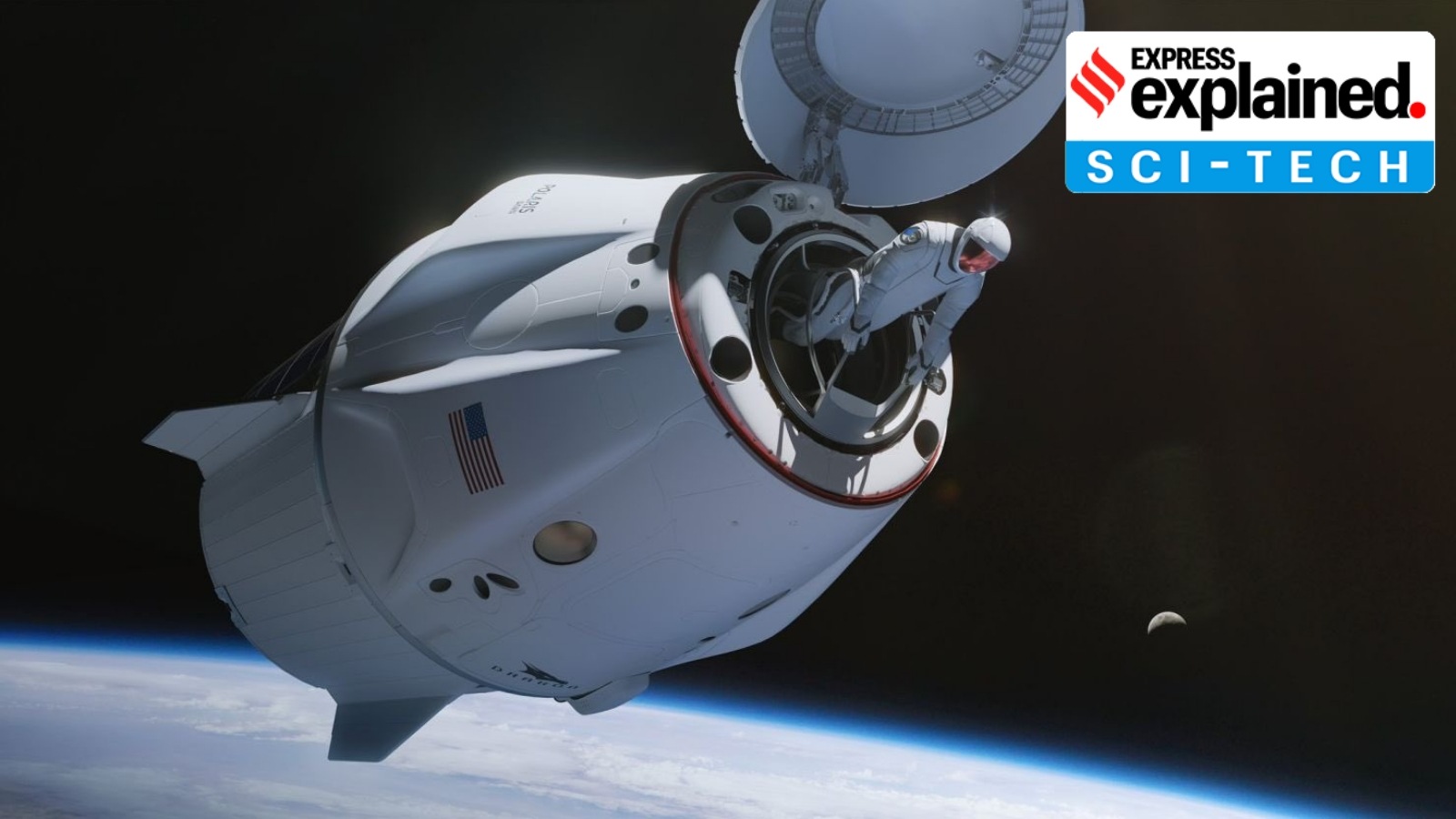 The first private spacewalk was carried out as a part of the Polaris Dawn mission. (X/@SpaceXPolaris)
The crew of the Polaris Dawn mission conducted the first ever private spacewalk on Thursday (September 12), crossing yet another milestone for private industry in the space sector.
The mission executed by billionaire Jared Isaacman and Elon Musk’s SpaceX is not regulated by NASA or the US government in any way. This, some have pointed, violates a treaty that the country signed more than 50 years ago. Here is how.
“This is a mission which violates Article VI of the Outer Space Treaty (OST),” Tomasso Sgobba, executive director of the Netherlands-based International Association for the Advancement of Space Safety told Al Jazeera.
The ‘Treaty on Principles Governing the Activities of States in the Exploration and Use of Outer Space, including the Moon and Other Celestial Bodies’, or simply the OST, entered into force in October 1967, during the peak of the Cold War. It provides the basic framework on international space law that remains in place till date.
The fundamental principles laid out by the treaty are as follows:
The OST emerged from a similar agreement signed regarding the sovereignty of Antarctica in 1959, which put restrictions on territorial expansion, nuclear testing, and utilisation of the resources of the southern continent.
A major sticking point, when the treaty was being negotiated, was the role of private players in space. The USSR wanted to limit space exploration only to nation states whereas the US wanted to open it for private players. Eventually, a compromise was struck.
Article VI of the OST explicates this compromise. It reads: “The activities of non-governmental entities in outer space, including the moon and other celestial bodies, shall require authorisation and continuing supervision by the appropriate State Party to the Treaty.”
Effectively, the home country would be responsible for space activity that originated from their soil, and also be liable for any mishaps. “The Soviet Union in the end was willing to mitigate its point of view to the extent that whomever would happen to be active in outer space, one state or another should be held responsible for its activities,” legal scholar Frans G von der Dunk wrote in ‘The Origins of Authorisation: Article VI of the Outer Space Treaty and International Space Law’ (2011).
Notably, for the past two decades, the US Congress has limited the Federal Aviation Authority’s (FAA’s) oversight on private space players to only rocket and spacecraft safety on Earth. “Under federal law, the FAA is prohibited from issuing regulations for commercial human spaceflight occupant safety,” the regulator told Al Jazeera. Even NASA, the US space agency, does not have any oversight responsibility.
This, some scholars believe, is in violation to Article VI, and theoretically, Russia — the successor state to the USSR — can object to such missions. “I believe that Article VI does not leave much room to interpretation [and] the Polaris Dawn mission [which] is not currently subjected to authorisation and continuous supervision of any US government agency” violates it, Sgobba said.
Others disagree. “There exist no internationally binding regulations that provide precise definition of this term and no international technical standards and procedure for effectively implementing this obligation,” Ram Jakhu, former director of the Institute of Air and Space Law at McGill University, told Al Jazeera.
But as private players become more prominent in space, the Cold War-era OST might need to be revisited, and ambiguities cleared. Some have suggested that an international, independent space safety institute that would provide third-party reviews for space companies must eventually be established.
This is because as things stand, players like Virgin Galactic and SpaceX can effectively do whatever they please in space. And that is not necessarily a positive, with the lack of oversight and regulation having potentially deadly consequences.
In November 2023, the US National Space Council (NSC) released a draft bill that assigns oversight responsibility for novel space activities and infrastructure, including private space stations, off-Earth manufacturing and space junk removal. This bill is yet to be passed.
Moreover, even if it were to be passed, private players could theoretically change their location to get around rules. This is why experts have called for an international solution to the matter.