Premium
This is an archive article published on February 24, 2021

Explained: New findings on the scribbling on Edvard Munch’s The Scream; other works that hide messages

A look at the significance of Edvard Munch’s 1893 masterpiece The Scream and some other prominent artworks with hidden messages.

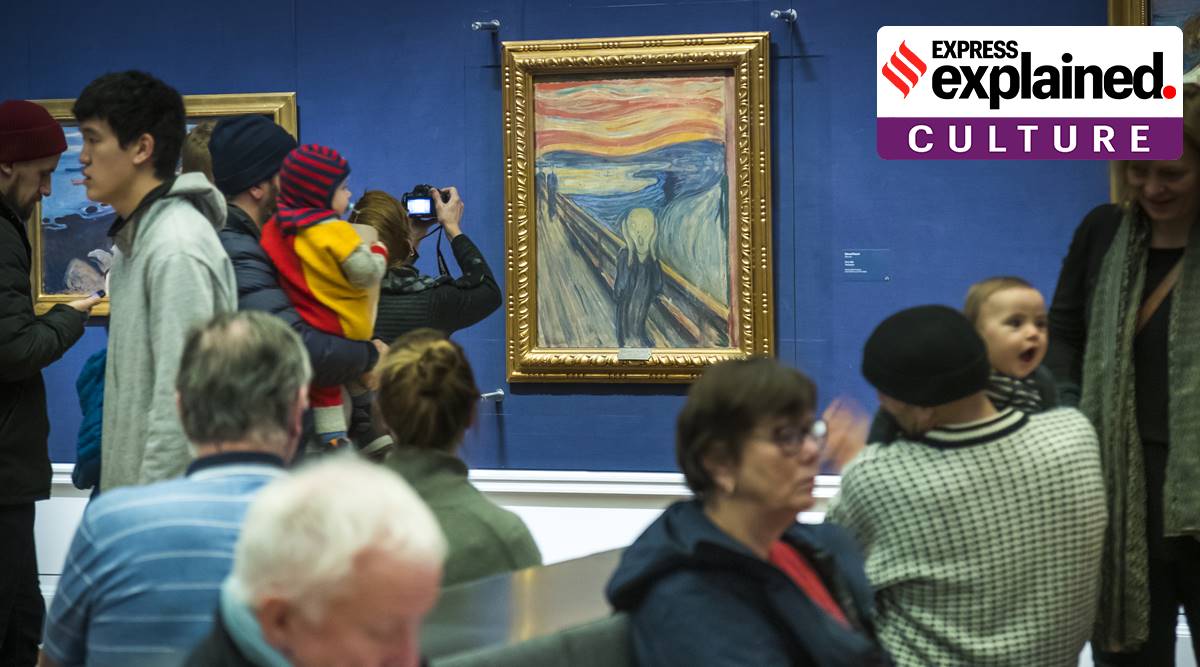
Edvard Munch The Scream, The Scream new findings, The Scream Munch scribbling, Norway National Museum, artworks with hidden messages, express explained, indian expressIn this January 13, 2019 file photo, people look at "The Scream" at the National Gallery in Oslo. (Heiko Junge/NTB Scanpix via AP, file)

Considered one of the most recognised works of art representing anguish and despair, Edvard Munch’s 1893 masterpiece The Scream, depicting a face screaming in horror, has seen several adaptations over the years.

A scribbled sentence on one of its four versions — “can only have been painted by a mad man” — has remained a mystery.

Written on the top left-hand corner of the painting, the sentence has often been attributed to an act of vandalism. Now, Norway’s National Museum has proposed that the writing is by the Norwegian artist himself.

A look at the significance of the iconic work and some other prominent artworks with hidden messages.

The inspiration behind The Scream and its significance 

In one of his diary entries titled “Nice 22 January 1892”, Munch is said to have written: “One evening I was walking along a path, the city was on one side and the fjord below. I felt tired and ill. I stopped and looked out over the fjord—the sun was setting, and the clouds turning blood red. I sensed a scream passing through nature; it seemed to me that I heard the scream. I painted this picture, painted the clouds as actual blood. The color shrieked. This became The Scream.”

Believed to have been painted by the expressionist master when he was experiencing psychological unease, The Scream became one of the most expensive artwork ever sold at an auction when a pastel version fetched nearly $120million at Sotheby’s in New York in 2012.

While another pastel version and a 1910 painted version are in the collection of the Munch Museum in Oslo, the version with the writing has been in the collection of Norway’s National Museum since 1910. It has been a subject of extensive research in recent years, before it goes on display at the museum’s new building that is scheduled to open in 2022, where it will be on the walls alongside other Munch paintings, including Madonna, The Dance of Life and Self-Portrait with Cigarette.

Story continues below this ad
📣 JOIN NOW 📣: The Express Explained Telegram Channel

What is the latest finding

Munch is known to have suffered from mental illnesses, and several of his works portray his agony and anxiety. Mai Britt Guleng, curator at the National Museum, has proposed that the inscription was added by Munch on top of the work after he attended a discussion in 1895, where a young medical student questioned Munch’s mental health, claiming that his paintings proved he was not of sound mind.

The artist, Guleng is reported to have said, who was already fighting his inner demons and had a history of illness in the family, was left hurt by the incident. Both Munch’s father and sister suffered from depression and Munch was hospitalised after a nervous breakdown in 1908, Guleng stated. Several diary entries by Munch also indicate that the artist was hurt by the accusation.

Guleng and his team came to the recent conclusion after using infrared technology to analyse the handwriting on the painting and comparing it with Munch’s letters.

Story continues below this ad

Other prominent artworks with hidden messages

Over the centuries, several works of art have been believed to contain secret codes or messages. Here are some of them:

The Last Supper, Leonardo Da Vinci: The 15th-century artwork is believed to hold several secret messages, the most popular being that the “beloved disciple” on Jesus’s right is Mary Magdalene and not John.

The Italian High Renaissance artist also arguably hid a musical composition in the mural. In 2003, Italian musician and computer technician Giovanni Maria Pala started studying the work to decipher the musical arrangement, leading to the book La Musica Celata (The Hidden Music).

Story continues below this ad

The Starry Night, Vincent van Gogh: Painted by the post-impressionist Dutch artist in 1889, during his stay at the Saint-Paul-de-Mausole asylum in southern France, the work in recent years has been studied by numerous scientists. A short animation for TED-Ed by educator Natalya St Clair explores how the oil on canvas “sheds light on the concept of turbulent flow in fluid dynamics”.

In 2004, NASA and The Hubble Heritage Team shared images of a “light echo” captured by the Hubble Space Telescope’s Advanced Camera for Surveys, with a press release reportedly stating, “[The] Starry Night, Vincent van Gogh’s famous painting, is renowned for its bold whorls of light sweeping across a raging night sky. Although this image of the heavens came only from the artist’s restless imagination, a new picture from NASA’s Hubble Space Telescope bears remarkable similarities to the van Gogh work, complete with never-before-seen spirals of dust swirling across trillions of miles of interstellar space.”

Mona Lisa, Leonardo da Vinci: One of the most famous artworks in history, the canvas that hangs at The Louvre in Paris hides numerous layers, and for years, art aficionados have tried to interpret its half-smile. While historically it is believed that the woman in the painting is Lisa Gherardini, wife of Florentine merchant Francesco del Giocondo, others argue it is a portrait of a man or a self-portrait of the artist himself.

In 2011, Italian researcher Silvano Vinceti claimed that he found letters ‘S’ and ‘L’ in the woman’s left and right eye, respectively, and the number ‘72’ under the bridge in the backdrop. According to him, the letter ‘L’ stood for Leonardo, “S” for a woman in the Sforza dynasty that ruled Milan and ‘7’ and ‘2’ may refer to important numbers in Christianity and Judaism.

Vandana Kalra is an art critic and Deputy Associate Editor with The Indian Express. She has spent more than two decades chronicling arts, culture and everyday life, with modern and contemporary art at the heart of her practice. With a sustained engagement in the arts and a deep understanding of India’s cultural ecosystem, she is regarded as a distinctive and authoritative voice in contemporary art journalism in India. Vandana Kalra's career has unfolded in step with the shifting contours of India’s cultural landscape, from the rise of the Indian art market to the growing prominence of global biennales and fairs. Closely tracking its ebbs and surges, she reports from studios, galleries, museums and exhibition spaces and has covered major Indian and international art fairs, museum exhibitions and biennales, including the Venice Biennale, Kochi-Muziris Biennale, Documenta, Islamic Arts Biennale. She has also been invited to cover landmark moments in modern Indian art, including SH Raza’s exhibition at the Centre Pompidou in Paris and the opening of the MF Husain Museum in Doha, reflecting her long engagement with the legacies of India’s modern masters. Alongside her writing, she applies a keen editorial sensibility, shaping and editing art and cultural coverage into informed, cohesive narratives. Through incisive features, interviews and critical reviews, she brings clarity to complex artistic conversations, foregrounding questions of process, patronage, craft, identity and cultural memory. The Global Art Circuit: She provides extensive coverage of major events like the Kochi-Muziris Biennale, Serendipity Arts Festival, and high-profile international auctions. Artist Spotlights: She writes in-depth features on modern masters (like M.F. Husain) and contemporary performance artists (like Marina Abramović). Art and Labor: A recurring theme in her writing is how art reflects the lives of the marginalized, including migrants, farmers, and labourers. Recent Notable Articles (Late 2025) Her recent portfolio is dominated by the coverage of the 2025 art season in India: 1. Kochi-Muziris Biennale & Serendipity Arts Festival "At Serendipity Arts Festival, a 'Shark Tank' of sorts for art and crafts startups" (Dec 20, 2025): On how a new incubator is helping artisans pitch products to investors. "Artist Birender Yadav's work gives voice to the migrant self" (Dec 17, 2025): A profile of an artist whose decade-long practice focuses on brick kiln workers. "At Kochi-Muziris Biennale, a farmer’s son from Patiala uses his art to draw attention to Delhi’s polluted air" (Dec 16, 2025). "Kochi Biennale showstopper Marina Abramović, a pioneer in performance art" (Dec 7, 2025): An interview with the world-renowned artist on the power of reinvention. 2. M.F. Husain & Modernism "Inside the new MF Husain Museum in Qatar" (Nov 29, 2025): A three-part series on the opening of Lawh Wa Qalam in Doha, exploring how a 2008 sketch became the architectural core of the museum. "Doha opens Lawh Wa Qalam: Celebrating the modernist's global legacy" (Nov 29, 2025). 3. Art Market & Records "Frida Kahlo sets record for the most expensive work by a female artist" (Nov 21, 2025): On Kahlo's canvas The Dream (The Bed) selling for $54.7 million. "All you need to know about Klimt’s canvas that is now the most expensive modern artwork" (Nov 19, 2025). "What’s special about a $12.1 million gold toilet?" (Nov 19, 2025): A quirky look at a flushable 18-karat gold artwork. 4. Art Education & History "Art as play: How process-driven activities are changing the way children learn art in India" (Nov 23, 2025). "A glimpse of Goa's layered history at Serendipity Arts Festival" (Dec 9, 2025): Exploring historical landmarks as venues for contemporary art. Signature Beats Vandana is known for her investigative approach to the art economy, having recently written about "Who funds the Kochi-Muziris Biennale?" (Dec 11, 2025), detailing the role of "Platinum Benefactors." She also explores the spiritual and geometric aspects of art, as seen in her retrospective on artist Akkitham Narayanan and the history of the Cholamandal Artists' Village (Nov 22, 2025). ... Read More


 

Latest Comment
Post Comment
Read Comments
Advertisement
Loading Taboola...
Advertisement
Advertisement
Advertisement