Premium
This is an archive article published on October 7, 2021

Explained: Malaria and the vaccine hunt

WHO has allowed widespread use of the world’s first malaria vaccine, which has reduced disease as part of a pilot project in parts of Africa. But its efficacy is modest, and the hunt for newer vaccines continues.

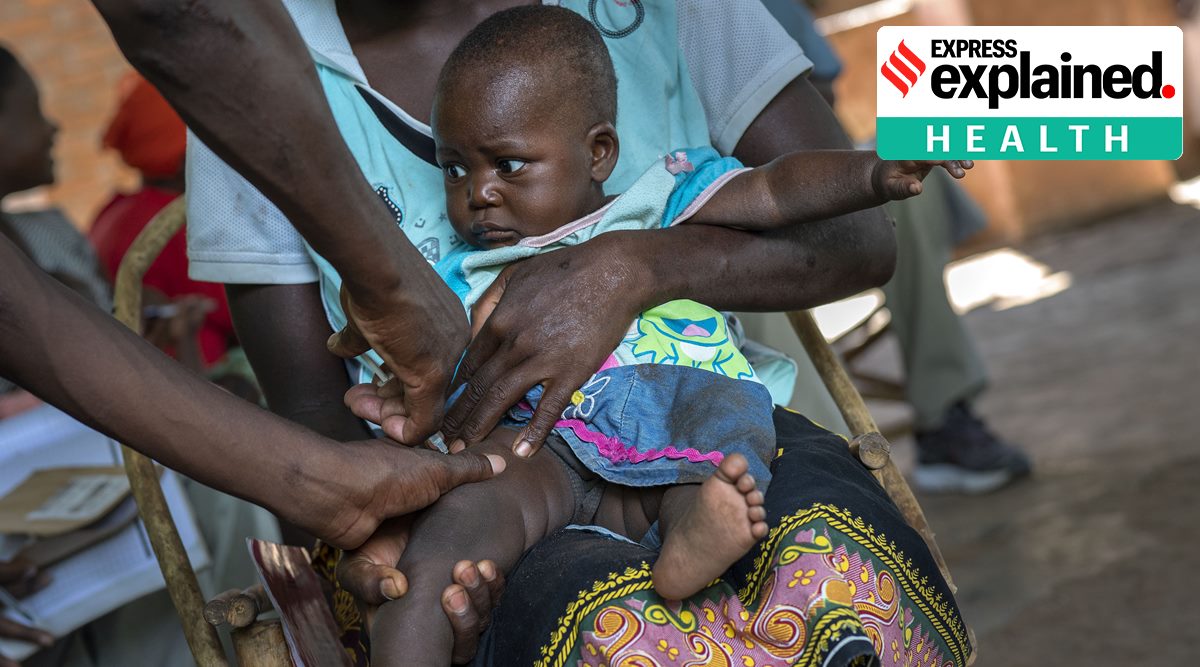
A baby from the Malawi village of Tomali is injected with the world's first vaccine against malaria in a pilot programme. (AP Photo/Jerome Delay, file)A baby from the Malawi village of Tomali is injected with the world's first vaccine against malaria in a pilot programme. (AP Photo/Jerome Delay, file)

The World Health Organization (WHO) on Wednesday allowed “widespread use” of the world’s first vaccine against malaria, a common mosquito-borne disease that claims more than four lakh lives every year. Developed by GlaxoSmithKline (GSK), the vaccine, known as RTS,S/AS01, has already been administered to nearly 8 lakh children in Ghana, Kenya and Malawi as part of a pilot programme since 2019.

The WHO endorsement paves the way for its use outside the pilot programme, in all areas where malaria is widely prevalent. But RTS,S/AS01, known by its brand name Mosquirix, is considered only the first step towards effective immunisation of the global population. RTS,S/AS01 is able to prevent severe cases in only 30% of cases; the quest for more effective vaccines is still underway.

Why is a vaccine against malaria important?

Malaria is one of the deadliest diseases in human history, having claimed millions of lives. Even today, it kills over four lakh every year, according to WHO. This is still a huge improvement from 20 years ago, when close to twice this number were dying of the disease.

Malaria is most endemic in Africa, with Nigeria, Congo, Tanzania, Mozambique, Niger and Burkina Faso together accounting for over half the yearly deaths.

In the last few years, significant progress has been made in reducing its impact. A few countries have also been able to eliminate malaria, mainly through spray of insecticides to kill mosquitoes, and cleaning up areas where mosquitoes breed. In the last 20 years, 11 countries have been declared by WHO as malaria-free, after zero cases were recorded in these countries for three consecutive years. These include the United Arab Emirates, Morocco, Sri Lanka and Argentina. In 2019, 27 countries reported less than 100 cases. Two decades ago, only six countries had less than 100.

India is one of the countries badly affected by the disease. Although deaths due to malaria have come down sharply in the last few years — officially these are only in hundreds now —infections continue to be in millions.

What is the vaccine that has been cleared for widespread use?

Story continues below this ad

RTS,S/AS01 is the result of a partnership between GlaxoSmithKline and the global non-profit PATH’s Malaria Vaccine Initiative, with grant funds from the Bill & Melinda Gates Foundation. It is a recombinant protein vaccine, which means it includes DNA from more than one source. It targets a protein called circumsporozoite in Plasmodium falciparum — the deadliest malaria parasite globally and the most prevalent one in Africa. It offers no protection against P vivax malaria, which predominates in many countries outside of Africa.

The vaccine is formulated with an adjuvant called AS01. It is designed to prevent the parasite from infecting the liver, where it can mature, multiply, and infect red blood cells, which can lead to disease symptoms.

The vaccine, which requires four injections, is for children under the age of five. Its efficacy is modest, as demonstrated in phase 3 trials from 2009 to 2014, on 15,000 young children and infants in 7 African countries. Four doses prevented 39% cases of malaria over 4 years of follow-up and 29% cases of severe malaria, with significant reductions also seen in overall hospital admissions.

Why has it taken so long to develop a vaccine against malaria?

Story continues below this ad

Although there have been decades of research, and over 20 candidates have entered clinical trials in the last few years, the best prevention of malaria remains the use of mosquito nets — which do nothing to eradicate malaria. Mosquirix itself is the result of more than 30 years of research and development.

“The difficulty in developing effective malaria vaccines stems largely from the complexity of the malaria-causing parasites’ life cycle, which includes mosquitoes, human liver, and human blood stages, and subsequent antigenic variations of the parasite. These parasites are also able to hide inside human cells to avoid being recognised by the immune system, creating further challenges,” a group of Australian and Chinese researchers wrote in an open-access journal last year.

They cited another challenge: “The most common mouse models of malaria employ the rodent-specific parasite species P. berghei, P. yoelii, and P. chabaudi… While they are still employed to model various manifestations of human disease, the immune response patterns observed in these models are not fully transferable to humans.

Navneet Arora, Lokhesh Anbalagan and Ashok Pannu from the Postgraduate Institute of Medical Education and Research (PGIMER) in Chandigarh point to the lack of funding and interest in developing a malaria vaccine. “Because malaria disproportionately affects LMIC (low and middle income countries) lacking the robust health infrastructure, the vaccine manufacturers have little incentive for malaria vaccines and continued targeting vaccines for industrialized world markets,” they wrote in a paper last year.

Story continues below this ad

Other scientists have also mentioned that research for a malaria vaccine never received the same kind of attention as, say, HIV/AIDS.

📣 JOIN NOW 📣: The Express Explained Telegram Channel

When is RTS,S coming to India?

In January this year, GSK, PATH and Bharat Biotech signed a product transfer agreement to help ensure the long-term supply of the RTS,S vaccine. However, experts The Indian Express spoke to feel there is no immediate “rush” to introduce it in India. Although malaria is a concern in India, the burden has reduced through interventions such as antimalarial drugs, mosquito nets and insecticide: from 1,018 deaths in 2010 to 93 in 2020.

Besides, the vaccine’s efficacy is modest. Officials with the National Malaria Control Programme said that a vaccine has to give protection of over at least 65%.

What other vaccines are in development?

Story continues below this ad

Several are being tested, and at least one has shown promise. Called R21/Matrix M, this candidate vaccine showed an efficacy of 77% in phase 2 trials in May this year. R21/Matrix M is a modified version of Mosquirix, and has been developed by researchers at the University of Oxford. Lead researcher Adrian Hill, director of Jenner Institute and professor of vaccinology at Oxford University, had said he believed this vaccine was the first to reach WHO’s goal of at least 75% efficacy.

Dr V S Chauhan, former director of Delhi-based International Centre for Genetic Engineering and Biology, and known for his efforts to develop a recombinant malaria vaccine, said R21/Matrix M held a lot of promise. “This vaccine is definitely a big hope, but it still has to undergo phase 3 trials,” he said.

Anuradha Mascarenhas is a Senior Editor at The Indian Express, based in Pune. With a career spanning three decades, she is one of the most respected voices in Indian journalism regarding healthcare, science and environment and research developments. She also takes a keen interest in covering women's issues . Professional Background Education: A gold medalist in Communication and Journalism from Savitribai Phule Pune University and a Master’s degree in Literature. Author: She authored the biography At The Wheel Of Research, which chronicles the life and work of Dr. Soumya Swaminathan, the former Chief Scientist at the WHO. Key Focus: She combines scientific accuracy with storytelling, translating complex medical research into compelling public and human-interest narratives. Awards and Recognition Anuradha has won several awards including the Press Council of India's national award for excellence in journalism under the gender based reporting category in 2019 and the Laadli Media award (gender sensitivity -2024). A recipient of the Lokmat journalism award (gender category-2022), she was also shortlisted for the RedInk awards for excellence in journalism-2021. Her debut book At The Wheel Of Research, an exclusive biography of Dr Soumya Swaminathan the inaugural chief scientist of World Health Organisation was also nominated in the Popular Choice Category of JK Paper AUTHER awards. She has also secured competitive fellowships including the Laadli Media Fellowship (2022), the Survivors Against TB – New Research in TB Media Fellowship (2023) and is part of the prestigious 2025 India Cohort of the WomenLift Health Leadership Journey.” Recent Notable Articles (Late 2025) 1. Cancer & Specialized Medical Care "Tata Memorial finds way to kill drug-resistant cancer cells" (Nov 26, 2025): Reporting on a breakthrough for triple-negative breast cancer, one of the most aggressive forms of the disease. Discipline, diet and purpose; How a 97-year-old professor defies ageing'' (Nov 15, 2025) Report about Prof Gururaj Mutalik, the first Head of Department at Pune's B J Government Medical College who at 97 credits his longevity to healthy habits and a strong sense of purpose. 2. Environmental Health (The "Breathless Pune" Series) Long-term exposure even to 'moderate' air leads to chronic heart, lung, kidney issues" (Nov 26, 2025): Part of an investigative series highlighting that even "safe" pollution levels are damaging to vital organs. "For every 10 µg/m3 increase in PM2.5 level, there was 6-8% jump in medicine sales" (Nov 23, 2025): Using commercial data to prove the direct link between air quality and respiratory illnesses in Pune. 3. Lifestyle & Wellness News "They didn't let cancer, diabetes and heart disease stop them from travelling" (Dec 22, 2025): A collaborative piece featuring survivors who share practical tips for traveling with chronic conditions. At 17, his BP shot up to 200/120 mmHG; Lancet study flags why child and teen hypertension doubled between 2000 and 2020'' (Nov 12,2025)--A report that focusses on 17-year-old-boy's hypertensive crisis and reflects the rising global trend of high blood pressure among children and adolescents. 4. Scientific Recognition & Infrastructure For promoting sci-comm, gender diversity: IUCAA woman prof highlighted in Nature" (Nov 25, 2025): Covering the global recognition of Indian women scientists in gender studies and physics. Pune researchers find a spiral galaxy like the Milky Way from early universe'' (December 3, 2025)- A report on how Indian researchers discovered a massive galaxy that existed when the universe was just 1.5 billion years old , one of the earliest to have been observed so far. Signature Beat: Health, Science & Women in Leadership Anuradha is known for her COVID-19 reportage, where she was one of the first journalists to provide detailed insights into the Covishield and Covaxin trials. She has a dedicated interest in gender diversity in health and science, often profiling women researchers who are breaking the "leaky pipeline" in STEM fields. Her writing style is scrupulous, often featuring interviews with top-tier scientists and health experts from various institutions.   ... Read More


Latest Comment
Post Comment
Read Comments
Advertisement
Advertisement
Advertisement
Advertisement