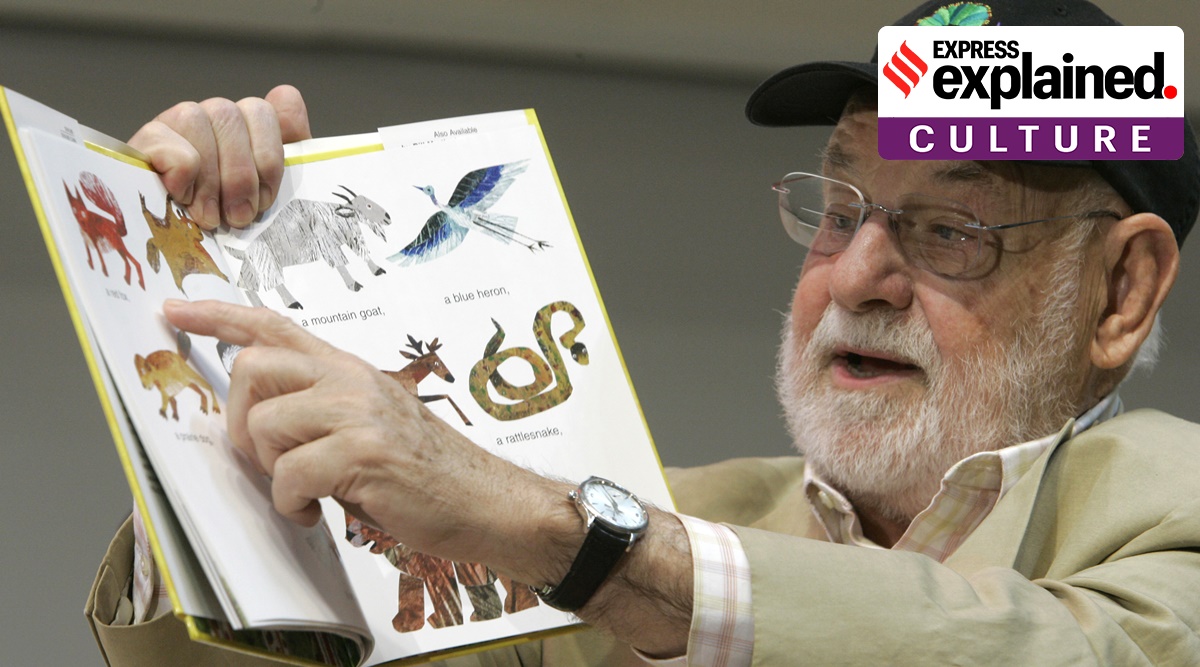
Eric Carle reads from "Baby Bear, Baby Bear, What Do You See?" on Oct. 1, 2007 in New York. (Photo: AP)
A grouchy ladybug, itching for a fight, meets a host of bugs and animals, each progressively bigger than the previous one, and realises over the course of a long, discomfiting day how disadvantageous its unnecessary belligerence is. The ladybug’s journey in the picture book ‘The Grouchy Ladybug’ (1977) taught generations of young readers not just the hierarchy in the food chain, or how day slowly progresses into night, but also the importance of exploring one’s emotions to understand the consequences of our actions.
The author of the book, American writer and artist Eric Carle, died on May 23 in Northampton, Massachusetts. He was 91. His death was announced on May 27.
Most well-known for his 1969 classic, ‘The Very Hungry Caterpillar’, that has sold over 55 million copies around the world and that celebrated its 50th birthday in 2019, Carle was also the author of over 70 books for children that have sold more than 152 million copies worldwide.
These include ‘The Tiny Seed’ (1970), ‘Do You Want to Be My Friend?'(1971), ‘The Mixed-Up Chameleon’ (1975), among others. His books sparkled with hope and friendship and the possibility of a better, brighter future.
Carle was born in New York in 1929 but grew up in Nazi Germany, which had a deep impact on his family, and, later, on his art. In his website eric-carle.com, in response to a frequently asked question, Carle explained his love for the natural world and wrote, “When I was a small boy, my father would take me on walks across meadows and through woods. He would lift a stone or peel back the bark of a tree and show me the living things that scurried about. He’d tell me about the life cycles of this or that small creature and then he would carefully put the little creature back into its home. I think in my books I honour my father by writing about small living things. And in a way I recapture those happy times.”
Carle returned to America in 1952, two years after graduating from Stuttgart’s Akademie Der Bildenden Künste. He worked as a graphic designer with The New York Times before joining an advertising agency as its art director.
Story continues below this ad
His career as a writer took off when American author and educator Bill Martin Junior invited him to illustrate one of his stories. The result was another celebrated children’s book — ‘Brown Bear, Brown Bear, What Do You See?’ (1967).
From then on, Carle never looked back, publishing his own picture book ‘1, 2, 3, To the Zoo’ in 1968. The next year, he published the story of a ravenous caterpillar who eats its way through a variety of foods and emerges metamorphosed from its cocoon into a butterfly.
“When I illustrated a historical cookbook, the editor heard about my box of ideas and asked to see them. I submitted ‘1,2,3 to the Zoo’. Then I showed her a story about a worm who ate holes through the pages. Ann Beneduce, my editor, wasn’t so sure about the appeal of a worm. ‘Maybe another creature would be better. How about a caterpillar?’ Ann asked. ‘Butterfly!’ I exclaimed. That is how ‘The Very Hungry Caterpillar’ was born. Almost without trying, I had become an author and illustrator of books for children,” wrote Carle in his website.
Carle was the recipient of the prestigious Children’s Literature Legacy Award (formerly known as the Laura Ingalls Wilder Award) in 2003, the Original Art Lifetime Achievement Award from the Society of Illustrators in 2010, among others. The Eric Carle Museum of Picture Book Art was set up in Amherst in 2002.
Paromita Chakrabarti is Senior Associate Editor at the The Indian Express. She is a key member of the National Editorial and Opinion desk and writes on books and literature, gender discourse, workplace policies and contemporary socio-cultural trends.
Professional Profile
With a career spanning over 20 years, her work is characterized by a "deep culture" approach—examining how literature, gender, and social policy intersect with contemporary life.
Specialization: Books and publishing, gender discourse (specifically workplace dynamics), and modern socio-cultural trends.
Editorial Role: She curates the literary coverage for the paper, overseeing reviews, author profiles, and long-form features on global literary awards.
Recent Notable Articles (Late 2025)
Her recent writing highlights a blend of literary expertise and sharp social commentary:
1. Literary Coverage & Nobel/Booker Awards
"2025 Nobel Prize in Literature | Hungarian master of apocalypse" (Oct 10, 2025): An in-depth analysis of László Krasznahorkai’s win, exploring his themes of despair and grace.
"Everything you need to know about the Booker Prize 2025" (Nov 10, 2025): A comprehensive guide to the history and top contenders of the year.
"Katie Kitamura's Audition turns life into a stage" (Nov 8, 2025): A review of the novel’s exploration of self-recognition and performance.
2. Gender & Workplace Policy
"Karnataka’s menstrual leave policy: The problem isn’t periods. It’s that workplaces are built for men" (Oct 13, 2025): A viral opinion piece arguing that modern workplace patterns are calibrated to male biology, making women's rights feel like "concessions."
"Best of Both Sides: For women’s cricket, it’s 1978, not 1983" (Nov 7, 2025): A piece on how the yardstick of men's cricket cannot accurately measure the revolution in the women's game.
3. Social Trends & Childhood Crisis
"The kids are not alright: An unprecedented crisis is brewing in schools and homes" (Nov 23, 2025): Writing as the Opinions Editor, she analyzed how rising competition and digital overload are overwhelming children.
4. Author Interviews & Profiles
"Fame is another kind of loneliness: Kiran Desai on her Booker-shortlisted novel" (Sept 23, 2025): An interview regarding The Loneliness of Sonia and Sunny.
"Once you’ve had a rocky and unsafe childhood, you can’t trust safety: Arundhati Roy" (Aug 30, 2025): A profile on Roy’s recent reflections on personal and political violence.
Signature Beats
Gender Lens: She frequently critiques the "borrowed terms" on which women navigate pregnancy, menstruation, and caregiving in the corporate world.
Book Reviews: Her reviews often draw parallels between literature and other media, such as comparing Richard Osman’s The Impossible Fortune to the series Only Murders in the Building (Oct 25, 2025). ... Read More


 4 min read