Premium

A sword returns, a legacy revived: Why Raghuji Bhonsle’s weapon matters?

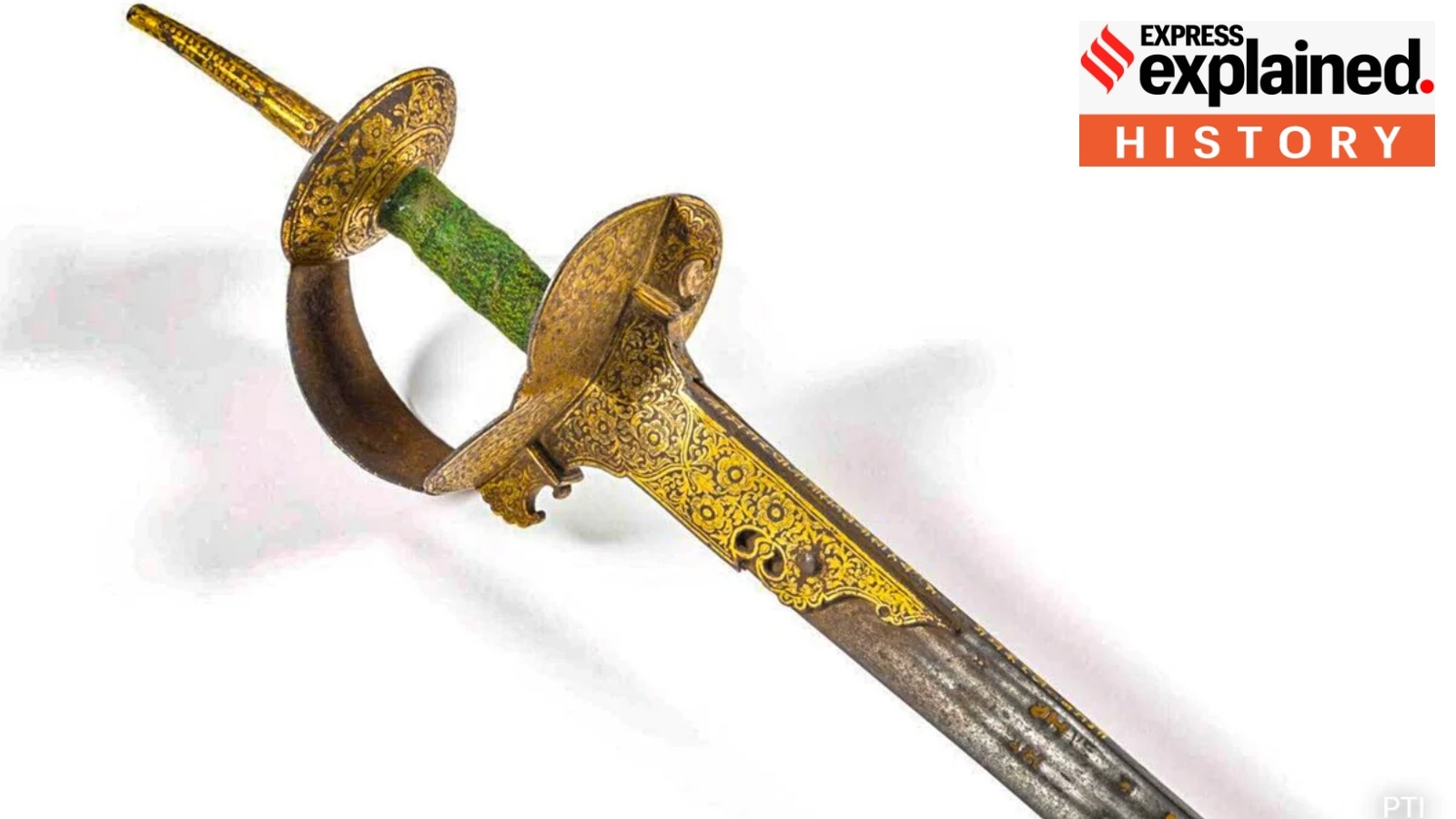
The basket-hilt sword has a European-style single-edged blade, which is slightly curved, and two fullers — grooves or channels that run the length of the sword

swordThe spine of the sword has an inlaid in gold with an inscription in Devanagari script. The inscription reads Shrimant Raghuji Bhosale Sena Saheb Subah Firang, suggesting that the sword could be ceremonial. (Photo: Sotheby's)

The Maharashtra government on Tuesday (April 29) reclaimed the iconic sword of Maratha warrior Raje Raghuji Bhonsle I at an auction in London for Rs 47.15 lakh.

In a post on X, Chief Minister Devendra Fadnavis said, “I am happy to announce that the state government has purchased the historic sword of Raje Raghuji Bhonsle, the founder of the Bhonsle family of Nagpur, which was auctioned in London. Thus, a valuable and historical treasure from our Maratha Empire will now come to Maharashtra.”

What are the features of the sword?

The basket-hilt sword has a European-style single-edged blade, which is slightly curved, and two fullers — grooves or channels that run the length of the sword. The spine of the sword is inlaid in gold with an inscription in Devanagari script. The inscription reads Shrimant Raghuji Bhosale Sena Saheb Subah Firang, suggesting that the sword could be ceremonial.

Sena Saheb Subah was a title of high military rank that was associated with the Maratha Empire, and would be usually conferred by the Chhatrapatis of Satara. The person receiving the title would also get a sword and robe.

This particular sword is likely a gift from Chhatrapati Shahu Maharaj to Raghuji Raje Bhonsle who was conferred with the title of Sena Saheb Subah.

Who were Nagpur Bhonsles?

Like the Peshwe, Holkar, Gaikwad, and Scindia families, the Nagpur Bhonsle family also played a significant role in expanding the Maratha Empire. The family was one of the royal or Kshatriya clans of the Marathas, and considered itself as the descendant of Udaipur’s Sisodia Rajputs.

The Bhonsles of Nagpur were known as Hinganikar as one of their ancestors — who was probably a contemporary of Maloji, the grandfather of Chhatrapati Shivaji Maharaj — rehabilitated the village Beradi near Hingani in the present district of Pune.

Story continues below this ad

Notably, after the death of Shivaji Maharaj, his obsequies were performed by Sabaji Bhosle, as Sambhaji, the eldest son, was in confinement on the fort of Panhala, according to Malhar Ram Rao Chitnis’s biography of Shivaji Maharaj, called Chitnis Bakhar.

Who was Raghuji Raje Bhonsle I?

Raghuji Bhonsle I was an important figure in 18th-century Maratha history, whose power was shaped by both family conflict and strategic alliances. Backed by Chhatrapati Shahu in 1728, Raghuji Bhonsle set out not just to confront his uncle Kanhoji but to carve out a legacy of power, earning new titles, lands, and the right to collect taxes across Berar and Gondawana. His decisive victory in 1730 after the siege of Bham marked a turning point, securing his leadership and laying the foundation for the Bhonsle dynasty’s rise in Nagpur.

In the second half of the eighteenth century, as Mughal authority crumbled and Maratha power expanded, Raghuji Bhonsle I emerged as the key figure in bringing Odisha under Maratha rule following the 1751 treaty with Nawab Alivardi Khan, marking the start of Maratha administration over the region and the Jagannath temple in Puri. Raghuji Bhonsle I, after taking control of Odisha in 1751, played a pivotal role in reviving the Shree Jagannath Temple’s activities, which had languished under Mughal rule. He appointed priests, restarted daily offerings, ensured temple upkeep, and made generous endowments—including the Mohun Bhog established by his mother—and assigned land revenue worth Rs 27,000 (Satais Hazari Mahal) for its support. To aid pilgrims, Raghuji Bhonsle built over 22 Dharamshala, spent Rs 20,000 annually to conduct the yatra in full grandeur, introduced the Annachhatra charity scheme, and developed roads connecting Puri to the rest of the country—restoring the temple’s sanctity and making it a vibrant hub for Hindu worship again.

Raghuji Bhonsle I expanded the Maratha empire to Orissa, Bihar, West Bengal, Uttar Pradesh, Madhya Pradesh and Chhattisgarh. He led pivotal military campaigns in Bengal from 1745 and 1755. The approximate area under the rule of Nagpurkar Bhonsles was 2.17 lakh sq km. It was initially Raghuji Bhonsle I who raided Odisha and Bengal and reclaimed the temples.

Story continues below this ad

How did the sword leave India?

Following the 1817 battle of Sitabuldi, where the East India Company defeated the Nagpur Bhonsles, the British looted the Bhonsle treasury, seizing priceless treasures, ornaments, and weapons. Experts believe that this sword may have been a part of that war loot or a gift presented to the British in the aftermath of the battle. During the Battle of Sitabuldi in 1817, the British East India Company, under the leadership of General Sir Alexander Campbell, set fire to the Bhonsle Palace in Nagpur – said to be bigger than Shaniwar Wada of the Peshwas of Pune – and it remained ablaze for six months. It was the same time when the Holkars were defeated in the battle of Mahidpur.


Ankita Deshkar is a Deputy Copy Editor and a dedicated fact-checker at The Indian Express. Based in Maharashtra, she specializes in bridging the gap between technical complexity and public understanding. With a deep focus on Cyber Law, Information Technology, and Public Safety, she leads "The Safe Side" series, where she deconstructs emerging digital threats and financial scams. Ankita is also a certified trainer for the Google News Initiative (GNI) India Training Network, specializing in online verification and the fight against misinformation. She is also an AI trainer with ADiRA (AI for Digital Readiness and Advancement) Professional Background & Expertise Role: Fact-checker & Deputy Copy Editor, The Indian Express Experience: Started working in 2016 Ankita brings a unique multidisciplinary background to her journalism, combining engineering logic with mass communication expertise. Her work often intersects regional governance, wildlife conservation, and digital rights, making her a leading voice on issues affecting Central India, particularly the Vidarbha region. Key focus areas include: Fact-Checking & Verification: As a GNI-certified trainer, she conducts workshops on debunking deepfakes, verifying viral claims, and using OSINT (Open Source Intelligence) tools. Cyber Law & IT: With postgraduate specialization in Cyber Law, she decodes the legalities of data privacy, digital fraud, and the evolving landscape of intellectual property rights. Public Safety & Health: Through her "The Safe Side" column, she provides actionable intelligence on avoiding "juice jacking," "e-SIM scams," and digital extortion. Regional Reporting: She provides on-ground coverage of high-stakes issues in Maharashtra, from Maoist surrenders in Gadchiroli to critical healthcare updates and wildlife-human conflict in Nagpur. Education & Credentials Ankita is currently pursuing her PhD in Mass Communication and Journalism, focusing on the non-verbal communication through Indian classical dance forms. Her academic foundation includes: MA in Mass Communication (RTM Nagpur University) Bachelors in Electrical Engineering (RTM Nagpur University) Post Graduate Diploma (PGTD) in Cyber Law and Information Technology Specialization in Intellectual Property Rights Recent Notable Coverage Ankita’s reportage is recognized for its investigative depth and emphasis on accountability: Cyber Security: "Lost money to a scam? Act within the 'golden hour' or risk losing it all" — A deep dive into the critical window for freezing fraudulent transactions. Public Health: "From deep coma to recovery: First fully recovered Coldrif patient discharged" — Investigating the aftermath of pharmaceutical toxins and the healthcare response. Governance & Conflict: "Gadchiroli now looks like any normal city: SP Neelotpal" — An analysis of the socio-political shift in Maoist-affected regions. Signature Beat Ankita is best known for her ability to translate "technical jargon into human stories." Whether she is explaining how AI tools like MahaCrimeOS assist the police or exposing the dire conditions of wildlife transit centres, her writing serves as a bridge between specialized knowledge and everyday safety. Contact & Follow X (Twitter): @ankita_deshkar Email: ankita.deshkar@indianexpress.com   ... Read More


Latest Comment
Post Comment
Read Comments
Advertisement
Loading Taboola...
Advertisement
Advertisement
Advertisement