7 min read
© The Indian Express Pvt Ltd



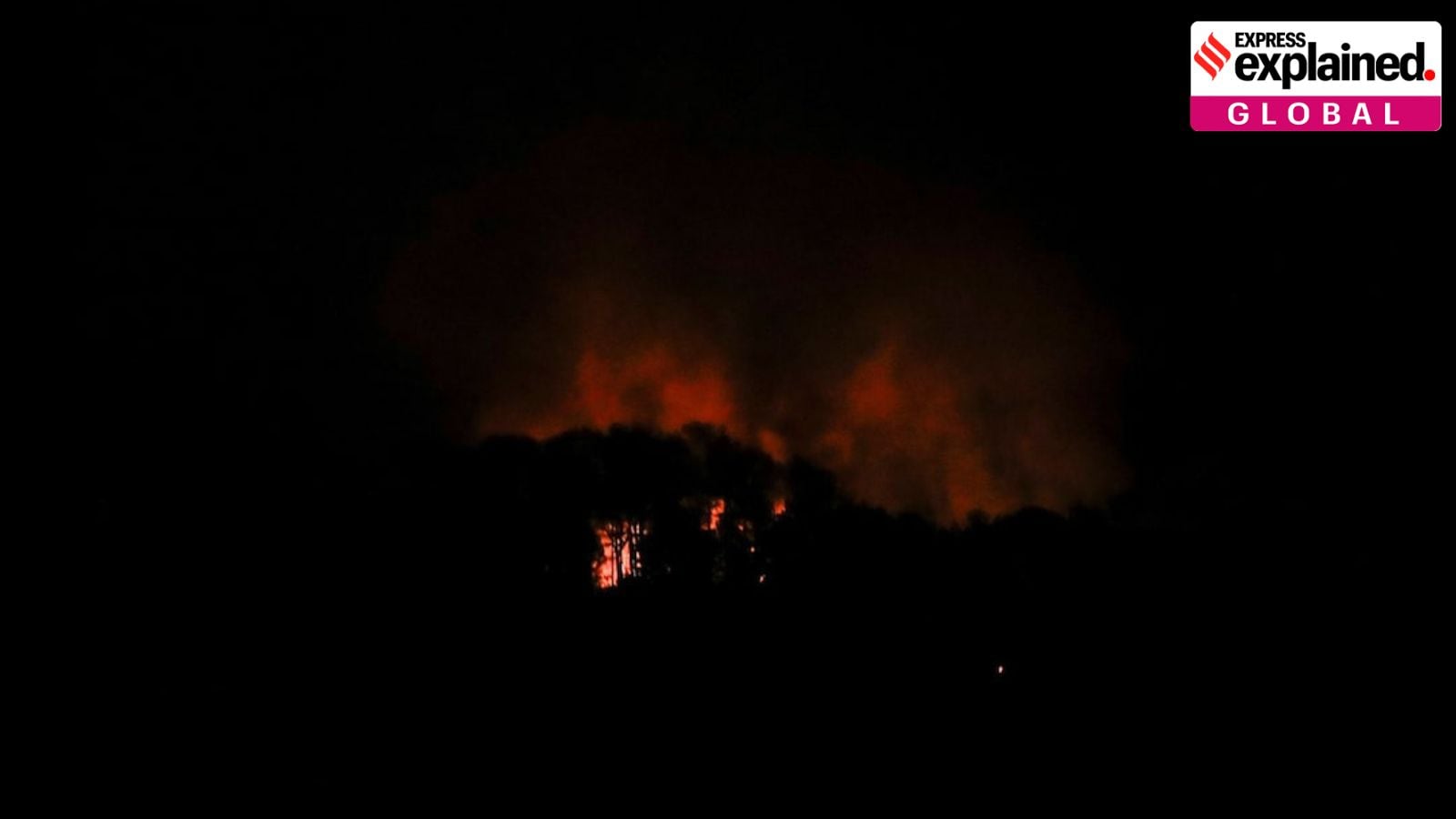 Smoke rises near Fort Tiuna, a military zone, during a full blackout, following explosions and loud noises in Caracas, Venezuela, on Saturday. (Photo: Reuters)
US Strikes Venezuela News: US President Donald Trump Saturday claimed that Nicolas Maduro and his wife had been “captured and flown out of the country” after the US carried out widespread strikes on Venezuela. At least seven explosions were heard in the country’s capital, Caracas.
Trump said in a post on Truth Social: “The United States of America has successfully carried out a large scale strike against Venezuela and its leader, President Nicolas Maduro, who has been, along with his wife, captured and flown out of the Country. This operation was done in conjunction with U.S. Law Enforcement. Details to follow…”
The US attack marks a significant escalation after months of strikes on Venezuelan “drug boats” and a massive military build-up in the Carribean with the deployment of troops, aircraft and warships. The US has accused Maduro of drug trafficking and working with gangs designated as terrorist organisations. Maduro has denied these allegations.
But this is hardly the first time the US has intervened in a South American country. And there may be more to its strategic interests than just drugs.
A chequered history
The US has a long history of meddling in the affairs of Latin American countries (and elsewhere), one which has seen Washington rig elections, facilitate coups, and undermine democratic processes, all to install acquiescent regimes in strategically important countries.
“Throughout the twentieth century and into the beginning of the twenty-first, the United States repeatedly used its military power, and that of its clandestine services, to overthrow governments that refused to protect American interests,” wrote author Stephen Kinzer in his book Overthrow: America’s Century of Regime Change from Hawaii to Iraq (2006).
“Each time, it cloaked its intervention in the rhetoric of national security and liberation. In most cases, however, it acted mainly for economic reasons — specifically, to establish, promote, and defend the right of Americans to do business around the world without interference,” Kinzer wrote.
Interventions in Latin America have been borne out of the Monroe Doctrine, a foreign policy position first articulated by President James Monroe in 1823, which holds the New World as the United States’ zone of influence. Post-1945, these were also in line with the Truman Doctrine of containment: the Cold War-era US foreign policy geared at arresting the spread of communism.
Over the years, the US has installed (or tried to) friendly regimes in a dozen Latin American countries, including Bolivia, Brazil, Chile, Cuba, Dominican Republic, Guatemala, Haiti, Mexico, Nicaragua, Panama, and Venezuela.
Trump’s actions against Maduro
Even if history alone was not enough to justify Caracas’ fears of regime change, Trump’s actions, in this term and his previous one, have not left much to imagination.
In January 2019, Trump had officially declared pro-Washington opposition leader Juan Guaidó as Venezuela President, and handed over the control of Venezuela’s bank accounts and property in the US to him. This came after Washington imposed sanctions on the sale of oil to the US, a major source of income for Venezuela.
Maduro’s personal assets were also frozen, and he was effectively barred from leaving his country. Notably, in 2017-18, ahead of the 2018 presidential polls in Venezuela, the Trump administration had held secret meetings with rebellious military officers from Venezuela to discuss plans for a coup to overthrow Maduro.
The NYT, in 2019, had described Trump’s actions as “one of Washington’s most overt attempts in decades to carry out regime change in Latin America”.
Soon after returning to power in January 2025, Trump resumed his attacks on Venezuela, this time under the guise of going after drug cartels. Notably, the White House has repeatedly called Maduro a cartel leader and a “fugitive of American justice”.
Draft legislation is circulating at the White House and on Capitol Hill that would give Trump broad powers to wage war against drug cartels he deems to be “terrorists,” as well as against any country he says has harboured or helped them, The NYT reported.
All about the oil
Unlike previous American interventions, Trump has not used esoteric ideas such as “exporting democracy” or “liberating the country” to justify his actions.
For Trump, “It is a national security initiative meant to eliminate a source of tons of cocaine from entering the United States,” José Cárdenas, a former National Security Council and US State Department official who has dealt extensively with Latin America policy, told Newsweek. “Main Street, USA, can identify with that,” he added.
That said, there is more to it.
Venezuela has the largest oil reserves in the world. Since 1999, when anti-Washington socialist Hugo Chávez was voted to power in Venezuela, the US has long struggled to exert greater control over the country’s oil reserves. This is what prompted the US to back an eventually unsuccessful coup against Chávez in 2002, and continues to be the bedrock of American interests in Venezuela today.
Tom Shannon, a career diplomat who served as undersecretary for political affairs during the first Trump administration, told Newsweek: “Venezuela is sitting on the largest reserves of oil and gas in the world, and OFAC (Office of Foreign Assets Control), through its licensing process, gets to control who works in the oil and gas sector”.
The belief in the US establishment is that if US companies were given licenses to operate in Venezuela, foreign competitors from nations viewed as hostile to US interests — such as China or Russia — would be expelled.
This is why international support for Maduro, a protege of Chávez, has largely been on geopolitical lines. After the US sanctions in 2019, China has emerged as the largest importer of Venezuela’s oil.
After taking office in January, Trump sent special envoy Richard Grenell to strike a deal in Caracas to secure a license for oil giant Chevron to resume operations in the country, among other things.
Hope & skepticism
Maduro was not a popular leader. Decades of economic mismanagement, corruption, and allegations of human rights violations took a toll on his and his party’s image. Many independent watchdogs agree that Maduro lost the 2024 elections, but held onto power with the help of massive rigging.
Many in Venezuela wanted Maduro gone. Others, including those who disagree with Maduro’s politics, were skeptical of what such an ouster would mean for the country.
For one, given the history of US misadventures in Latin America and the violence it has often unleashed, many were staunchly opposed to any American intervention. But such an intervention has indeed come to pass. And it has plunged an already struggling country into further uncertainty.
As one opposition politician told The NYT, “And the cost for us Venezuelans, what will it be? What guarantee do we have that this (removal of Maduro) will translate into a recovery of our democracy?”