5 min read
© The Indian Express Pvt Ltd



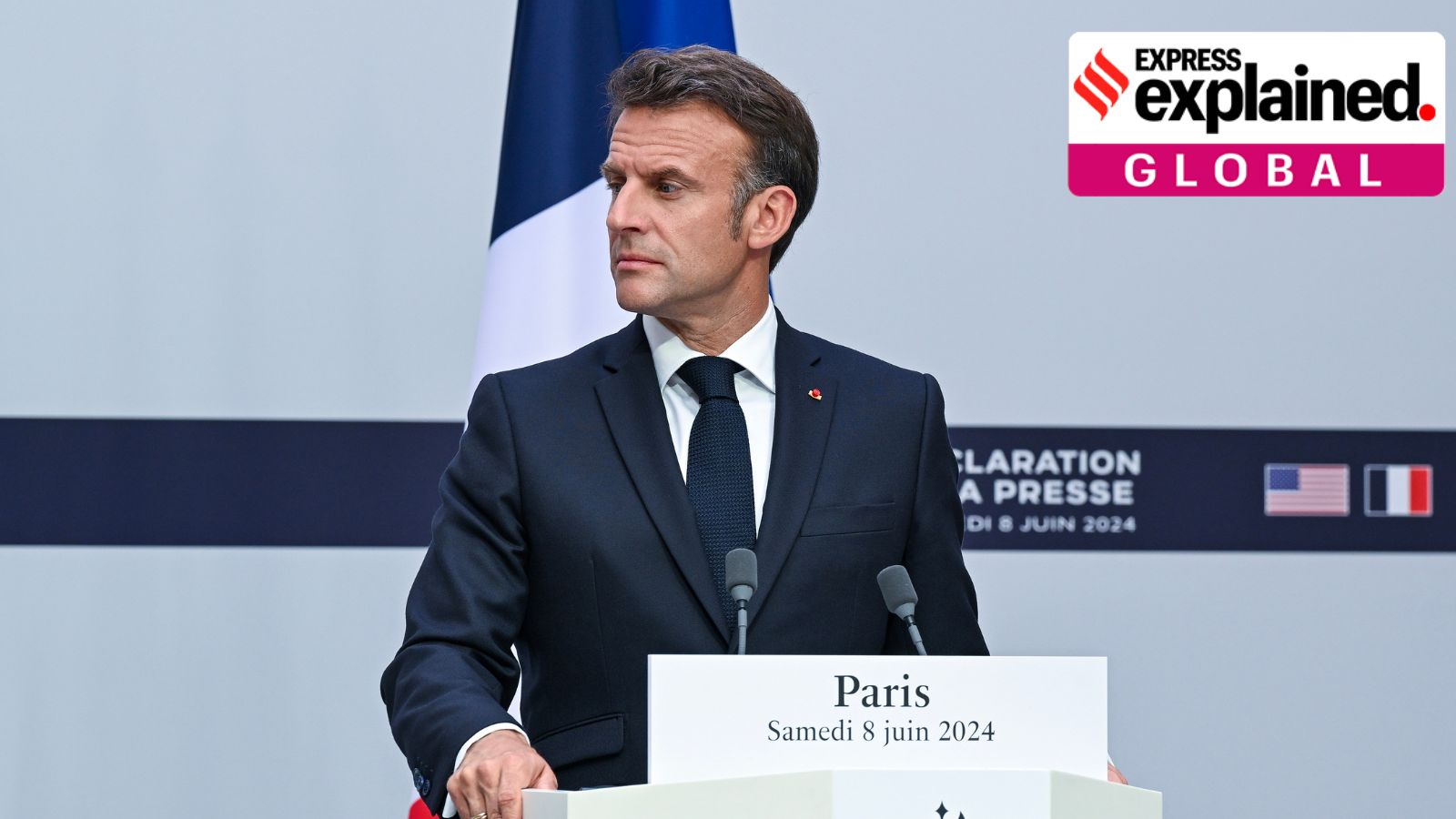 President Emmanuel Macron speaking to reporters. (File Photo - New York Times/Kenny Holston)
Nearly two months after France’s parliamentary elections concluded, President Emmanuel Macron is yet to announce a new prime minister.
The far-left party France Unbowed, part of the coalition which won the most seats in the polls, has now called for Macron to be impeached for “serious failings” in his constitutional duties, according to the French newspaper Le Monde.
France Unbowed (known in French as La France Insoumise or LFI) also called for public demonstrations on September 7. Here is what is happening.
Macron declared snap elections to the legislature on June 9, following his party’s crushing defeat to the right-wing National Rally (RN) party in the European Parliament elections. He gambled on the elections to prove that the RN had limited popularity within French politics.
France thus went to polls in two phases to elect legislators for the 577 seats of the National Assembly. At the outset, Macron’s centre-right Renaissance party had slim prospects of winning.
This trend was confirmed when the first round of results was declared on June 30, when RN took an expected lead. Macron’s Ensemble coalition finished last in these polls, after leftist parties.
The results prompted protests from supporters of leftist and centrist parties, as Macron called for anti-right-wing forces to come together to defeat RN. Jean-Luc Mélenchon of LFI, and the de facto head of the leftist New Popular Front (NFP) coalition, made a similar call.
Tactical withdrawals thus ensued from the centrist and leftist coalitions, with 218 candidates dropping out to consolidate the vote against the RN. This effort successfully thwarted the RN’s march to power: after the second round of polls — the RN finished last with 142 seats. The NFP won 188 seats and the Ensemble 161 seats.
France now has a hung parliament since no coalition secured a parliamentary majority of 289 seats. Macron then called for “republican forces” – seemingly implying centrist parties – to unite.
“…I ask all political forces that recognise themselves in republican institutions, the rule of law, parliamentarianism, a European orientation and the defence of French independence, to engage in a sincere and loyal dialogue to build a solid, necessarily plural, majority for the country,” he said in a July 10 letter published in some French newspapers.
It became clear that Macron did not wish to align himself with the far-left LFI, and leftist parties viewed his letter as an effort to prevent them from power.
“The best he can do for the country at this stage is to allow the group that won the most seats, the New Popular Front, to govern. Any other machinations would be truly problematic and dangerous for democracy,” said Eric Coquerel, an LFI parliamentarian.
Macron also said that until the next prime minister was elected, the current government would continue as a caretaker. According to Le Monde, the power to appoint the prime minister rests solely with the president under the French system. However, while there is pressure to appoint someone from the largest party in parliament, the president is “under no legal obligation” to do so.
On July 23, Macron announced no transfer of power would happen until the Olympics in the interest of political stability. The NFP also concluded their discussions on the same day and virtually nominated Lucie Castets, a 37-year-old economist and civil servant, as their prime ministerial candidate.
After the Olympics ended on August 12, Macron resumed talks with parties. The different coalitions have stuck to their guns — the NFP has asserted its right to form the government with Castets as PM, while conservative parties and Ensemble allies have vowed to vote no-confidence if a leftist government ascends.
With mounting pressure, Macron met with RN’s Marine Le Pen in hopes of finding a way forward on August 26. He reiterated later that a left-wing government “would be immediately censored by all the other groups represented in the National Assembly.”
Cohabitation governments, where the President belongs to a party not in power in the French legislature, are not new to France. But the transition period between two prime ministers has never exceeded nine days — until now.
Cohabitation governments in the past have been marred with administrative friction. In 1986, President François Mitterrand, who was from a leftist party, refused to sign ordinances on denationalisation that centre-right Prime Minister Jacques Chirac’s government had proposed. The move would have ensured the privatisation of over 60 industrial groups.
While this would eventually be passed as a Bill in Parliament, it allowed Mitterand to reiterate his status as a Leftist leader.