Premium
This is an archive article published on August 31, 2021

Explained: Is Covid-19 now endemic in India? Should we worry about rising cases?

WHO chief scientist Dr Soumya Swaminathan has said India seems to be entering some stage of endemicity. If the virus is present all the time, what are the implications for immunity, future waves, and vaccination?

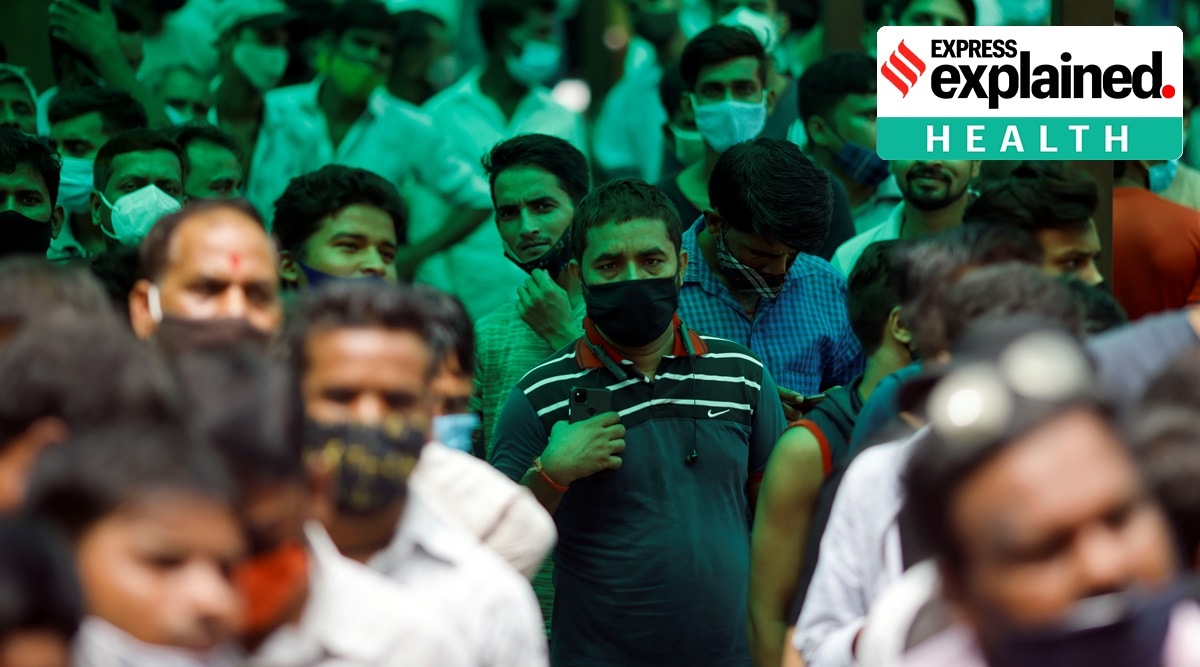
People wait for a Covid-19 vaccine dose at a hospital in Noida on Monday. Scientists believe a large section of the population has developed antibodies against the virus, either due to vaccination or natural infection. (Reuters Photo)People wait for a Covid-19 vaccine dose at a hospital in Noida on Monday. Scientists believe a large section of the population has developed antibodies against the virus, either due to vaccination or natural infection. (Reuters Photo)

As India gets ready to face a possible third wave of SARS-CoV-2, World Health Organization (WHO) chief scientist Dr Soumya Swaminathan has said that “India seems to be entering some stage of Covid-19 endemicity where there is low- to moderate-level transmission”. Earlier this year, scientists had indicated in a survey carried out by the journal Nature that the SARS-CoV-2 virus is set to become endemic and would continue to circulate in pockets of the global population.

What is endemicity?

Endemic means something that is present all the time. For example, said leading virologist Dr Shahid Jameel, influenza is endemic, unlike smallpox which has been eradicated.

“Only those pathogens can be eradicated that don’t have animals (another species) as a reservoir. Smallpox and polio are human virus examples, rinderpest is a cattle virus. This means if there is a virus/pathogen that is present in some animal reservoir like bats, camels or civet cats, then it can transmit again once the level of immunity wanes in the population against the disease caused by it,” Dr Jameel said.

“In the case of coronavirus disease, it will continue to circulate as it is present in the animal reservoir. This also means that it will cause disease to the extent that people have had no vaccination against or exposure. If, however, enough people are vaccinated or have been exposed to the infection, then the virus will cause symptomatic infection but not disease. So, that is what is considered becoming endemic – it is there but not causing disease,” Dr Jameel said.

When is SARS-CoV-2 likely to become endemic?

That will depend on how fast it spreads and mutates. There are many variables that have to be considered, Dr Jameel said, and there is no clear answer regarding when the virus is likely to be endemic. “Instead of getting bogged down on whether the virus has become endemic or not, the need is to focus on vaccination and limit transmission. It is not possible to predict when the virus is going to be endemic,” Prof Jameel said.

The last serological survey by the Indian Council of Medical Research (ICMR) had shown from a representative sample of the population — 70 districts out of 718 — that roughly two-thirds of the population have antibodies. Again, out of those two-thirds, some would have had the antibodies because they have now been fully vaccinated. However, since vaccination rates are still fairly low, the general assumption is that most people who have antibodies have been infected but not all have had disease. This means a majority will be protected from symptomatic disease later on, Dr Jameel explained; they may get infected but are protected.

“Again, that is assuming the virus is not going to change to a form that transmits easily and evades immunity. One cannot predict if and when the virus mutates into something where vaccines start failing,” Prof Jameel said.

Story continues below this ad

How long can the antibodies be expected to last?

It is an open question, said Professor Partha Majumder, National Science Chair, Government of India. “Most everybody now has antibodies that likely reduces the chance of infection and even if infected may not develop severe disease. This virus is going to stay with us. We may already have developed herd immunity, which indicates that most of us have antibodies — either due to infection or vaccination — and hence if infected we may not develop severe disease,” he said.

“From its rate of spread and its rate of mutation, many of us indeed expect that this coronavirus will never be eradicated – not just in India, but globally – and will become endemic to stay with you without causing major health problems, since the vast majority would have developed protective antibodies,” he said.

Clinical epidemiologist Colonel (retired) Dr Amitav Banerjee, too, referred to countrywide serosurveys that indicate almost 67 % Indians, including a large proportion of children, have IgG antibodies. “As the antibody levels wane over time, the immunity persists due to memory and T cells. We can assume that a much larger proportion beyond this 67 % have encountered the virus and would have had immunity due to natural infection. There is a need for more serosurveys for IgG levels to be carried out,” Col Banerjee said.

Can an additional vaccine dose help?

Whether or not a booster dose of a vaccine is required, Professor Majumder said, depends on how quickly the antibody level comes down in the average individual. “There are wide variations in the trend of waning of antibody level among persons; sufficient data have not yet accumulated to definitively determine the need for a booster dose,” Professor Majumder said.

Story continues below this ad

“While vaccine effectiveness does appear to decline over time, there is still expected to be substantial protection. It is likely that a third shot or booster might be necessary in the future and in fact, a regular booster shot, just like for influenza, might be indicated,” said Professor Gautam Menon, Professor of Physics and Biology at Ashoka University.

Should we worry about numbers rising again?

According to Professor Menon, one can expect a more or less constant level of infection within the population, with the likelihood of severe illness, hospitalisation or death becoming increasingly small as people are vaccinated.

The Delta variant now dominates new infections around the country. Viruses mutate constantly, but the question, Professor Menon said, is whether a new variant will come along that is much more transmissible than Delta and can evade a immune response from either a prior infection or vaccination.

“As long as it does not, we might expect that a small background of reinfections and vaccine breakthroughs will help maintain numbers of infected at a low, constant level. It is more likely that there will be a steady level of cases, with some regions, especially of low prior seroprevalence and low vaccination rates, seeing spikes. It is completely unlikely that we will see case numbers comparable to the second wave,” Prof Menon said.

Story continues below this ad

Newsletter | Click to get the day’s best explainers in your inbox

Anuradha Mascarenhas is a Senior Editor at The Indian Express, based in Pune. With a career spanning three decades, she is one of the most respected voices in Indian journalism regarding healthcare, science and environment and research developments. She also takes a keen interest in covering women's issues . Professional Background Education: A gold medalist in Communication and Journalism from Savitribai Phule Pune University and a Master’s degree in Literature. Author: She authored the biography At The Wheel Of Research, which chronicles the life and work of Dr. Soumya Swaminathan, the former Chief Scientist at the WHO. Key Focus: She combines scientific accuracy with storytelling, translating complex medical research into compelling public and human-interest narratives. Awards and Recognition Anuradha has won several awards including the Press Council of India's national award for excellence in journalism under the gender based reporting category in 2019 and the Laadli Media award (gender sensitivity -2024). A recipient of the Lokmat journalism award (gender category-2022), she was also shortlisted for the RedInk awards for excellence in journalism-2021. Her debut book At The Wheel Of Research, an exclusive biography of Dr Soumya Swaminathan the inaugural chief scientist of World Health Organisation was also nominated in the Popular Choice Category of JK Paper AUTHER awards. She has also secured competitive fellowships including the Laadli Media Fellowship (2022), the Survivors Against TB – New Research in TB Media Fellowship (2023) and is part of the prestigious 2025 India Cohort of the WomenLift Health Leadership Journey.” Recent Notable Articles (Late 2025) 1. Cancer & Specialized Medical Care "Tata Memorial finds way to kill drug-resistant cancer cells" (Nov 26, 2025): Reporting on a breakthrough for triple-negative breast cancer, one of the most aggressive forms of the disease. Discipline, diet and purpose; How a 97-year-old professor defies ageing'' (Nov 15, 2025) Report about Prof Gururaj Mutalik, the first Head of Department at Pune's B J Government Medical College who at 97 credits his longevity to healthy habits and a strong sense of purpose. 2. Environmental Health (The "Breathless Pune" Series) Long-term exposure even to 'moderate' air leads to chronic heart, lung, kidney issues" (Nov 26, 2025): Part of an investigative series highlighting that even "safe" pollution levels are damaging to vital organs. "For every 10 µg/m3 increase in PM2.5 level, there was 6-8% jump in medicine sales" (Nov 23, 2025): Using commercial data to prove the direct link between air quality and respiratory illnesses in Pune. 3. Lifestyle & Wellness News "They didn't let cancer, diabetes and heart disease stop them from travelling" (Dec 22, 2025): A collaborative piece featuring survivors who share practical tips for traveling with chronic conditions. At 17, his BP shot up to 200/120 mmHG; Lancet study flags why child and teen hypertension doubled between 2000 and 2020'' (Nov 12,2025)--A report that focusses on 17-year-old-boy's hypertensive crisis and reflects the rising global trend of high blood pressure among children and adolescents. 4. Scientific Recognition & Infrastructure For promoting sci-comm, gender diversity: IUCAA woman prof highlighted in Nature" (Nov 25, 2025): Covering the global recognition of Indian women scientists in gender studies and physics. Pune researchers find a spiral galaxy like the Milky Way from early universe'' (December 3, 2025)- A report on how Indian researchers discovered a massive galaxy that existed when the universe was just 1.5 billion years old , one of the earliest to have been observed so far. Signature Beat: Health, Science & Women in Leadership Anuradha is known for her COVID-19 reportage, where she was one of the first journalists to provide detailed insights into the Covishield and Covaxin trials. She has a dedicated interest in gender diversity in health and science, often profiling women researchers who are breaking the "leaky pipeline" in STEM fields. Her writing style is scrupulous, often featuring interviews with top-tier scientists and health experts from various institutions.   ... Read More


Latest Comment
Post Comment
Read Comments
Advertisement
Loading Taboola...
Advertisement
Advertisement
Advertisement