3 min read
© IE Online Media Services Pvt Ltd



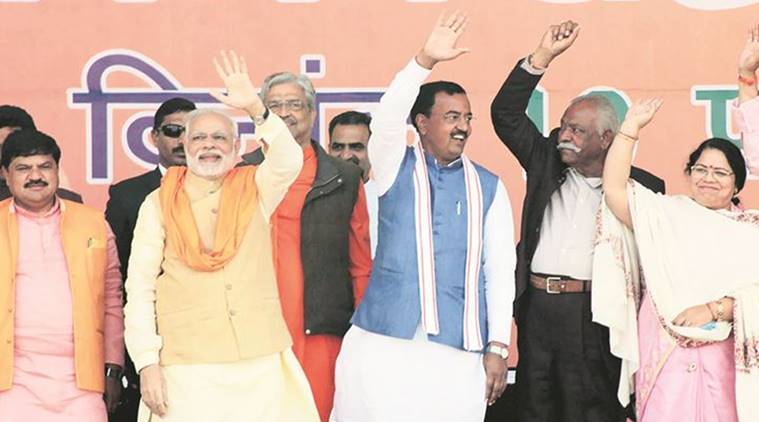 Prime Minister Narendra Modi and Uttar Pradesh BJP chief Keshav Prasad Maurya in Bijnor on Friday. PTI
Call it Moditva if you like. The signals from the poll outcome in Uttar Pradesh and Uttarakhand are clear” the BJP has buried its 2015 devastating debacle in the Bihar polls and has come out with flying colours in the Hindi heartland. It has returned to power in India’s most populous state after a gap of over 15 years, ending the spell of the BSP and the SP while it routed the Harish Rawat-led Congress in Uttarakhand. Coming as it does almost three years after Modi government swept to power at the Centre in 2014 and two years before the next general elections, the results are in a shot in the arm for the BJP and a disappointment for the Congress, which performed so poorly even after an alliance with Samajwadi Party.
UP in particular was a test case for the BJP where even though it got a massive 42 percent of the total votes in the 2014 Lok Sabha elections, doubts remained about whether it would be able to repeat its performance in the 2017 assembly polls, owing to its poor show in last few state polls.
The trends suggest that BJP has managed to retain a fair percentage of votes it polled in 2014 in the state.
A range of factors seem to have worked in favour of the BJP but the most important is obviously the personality of Narendra Modi who has retained his popularity and his government’s recent decision on demonetisation has gone well down with the poor who believe that it has harmed the rich.
The BJP’s outreach among Extremely Backward Castes or Most Backward Castes, basically a grouping of all non-Yadav OBCs, seem to have worked well. The trends also indicate that it has once again managed to rupture the Dalit vote base of the BSP.
OBCs make up roughly 44 per cent of UP’s electorate, Dalits 21 per cent, Muslims 19 per cent, and upper castes 16 per cent. Yadavs, the core of the SP’s base, are numerically and socially dominant among OBCs. However, the 200-odd non-Yadav OBCs more than double the Yadav population. They include Kurmis , Koeris, Lodhs, Jats, Sunars. Among the Dalits, Pasis, Khatik and Valmikis are the large non-Jatav communities.
It seems BJP has got a large chunk of the non Jatav and non Yadav vote. Besides the caste arithmetic, the aspirational youth vote seems to have gone for the party under Modi.
In 2014, BJP has got 42.3 per cent of the votes, almost double the SP’s 22.2 per cent and BSP’s 20 per cent. It remains to be seen whether the party has managed to retain its peak.
Even a 5 to 8 percent shift in votes can lead to a difference in a substantial number of seats. In the 2007 assembly polls, the BSP got 30.40 per cent of the votes — five percent more than SP — and formed the government. In 2012, the SP hadt the largest share (29.15 per cent), followed by the BSP (25.91 per cent and formed the government.