11 min read
© IE Online Media Services Pvt Ltd



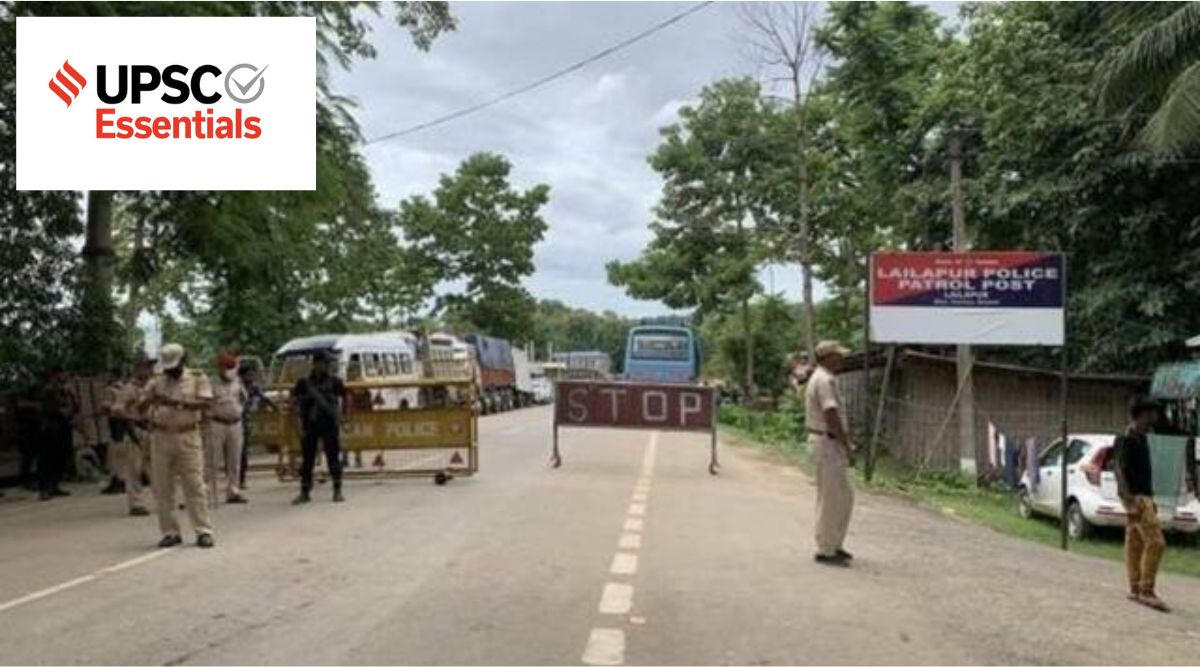 Attempt questions on Inter-state dispute and India-Nepal relations. Here is a representational image of border between two states. (Source: File)
 🚨 This story is part of our special initiative for UPSC and other competitive exams. Look out for UPSC KEY on weekdays and UPSC Essentials everyday, Weekly news express with MCQs, Key Terms of the past week, Quizzes as well as The Indian Express 360° Upsc Debate, Society & Social Justice, UPSC Mains Practice, Art and Culture with Devdutt Pattanaik, UPSC Ethics Simplified, Experts Talk, and more. 🚨
UPSC Essentials brings to you its new initiative for the practice of Mains answer writing. Mains Answer Writing will cover essential topics of static and dynamic parts of the UPSC Civil Services syllabus covered under various GS papers. This answer-writing practice is designed to help you as a value addition to your UPSC CSE Mains.
Each day, we will cover one new subject. Attempt today’s answer writing on questions related to topics of GS-2 to check your progress.
There is much more between India and Nepal than the sum of their treaties and agreements. Discuss how the current progress has enhanced India-Nepal bilateral relations.
How inter-state border disputes are resolved? Discuss in the context of recent border disputes that took place in India.
Introduction
— The introduction of the answer is essential and should be restricted to 3-5 lines. Remember, a one-liner is not a standard introduction.
— It may consist of basic information by giving some definitions from the trusted source and authentic facts.
Body
— It is the central part of the answer and one should understand the demand of the question to provide rich content.
— The answer must be preferably written as a mix of points and short paragraphs rather than using long paragraphs or just points.
— Using facts from authentic government sources makes your answer more comprehensive. Analysis is important based on the demand of the question but do not over analyse.
— Underlining keywords give you an edge over the other candidates and helps in the better presentation of the answer.
— Using flowcharts/tree-diagram in the answers saves much time and boosts your score. However, it should be use logically and only where it is required.
Way forward/ Conclusion
— The ending of the answer should be on a positive note and it should have a forward-looking approach. However, if you feel that an important problem must be highlighted, you may add it in your conclusion. Try not to repeat any point from body or introduction.
— You may use the findings of reports or surveys conducted at national and international levels, quotes etc. in your answers.
Self Evaluation
— It is the most important part of our Mains answer writing practice. UPSC Essentials will provide some guiding points or ideas as a thought process that will help you to evaluate your answers.
QUESTION 1: There is much more between India and Nepal than the sum of their treaties and agreements. Discuss how the current progress has enhanced India-Nepal bilateral relations.
Introduction:
A simple introduction to this answer can revolve around a general statement about India-Nepal relations.
— Nepal and India have strong bilateral ties that are based on a shared history, culture, tradition and religion.
— These ties are close, comprehensive, and multifaceted, with a focus on political, social, cultural, religious, and economic engagements.
Body:
You may incorporate some of the following points in the body of your answer:
Source: (http://www.mea.gov.in)
Development Partnership
— India is providing financial and technical assistance for the construction of two broad gauge cross-border railway links viz., Jaynagar-Bardibas and Jogbani-Biratnagar.
— A MoU was signed between India and Nepal for the construction of a motorable bridge across the Mahakali River connecting Dharchula (India) with Darchula (Nepal), under Indian grant assistance.
Cooperation in Water Resource
— There are three-tier bilateral mechanism (with Ministerial meeting at the apex) has been established in 2008 to discuss issues relating to cooperation in water resources, flood management, and inundation. These specialized committees are:
(i) Joint Team of Experts (JTE) on Saptkosi and Sunkosi projects;
(ii) Joint Committee on Inundation and Flood Management (JCIFM) and
(iii) Joint Committee on Kosi and Gandak Projects (JCKGP).
Trade and Economic Ties
— India remains Nepal’s largest trade partner, with bilateral trade crossing US$ 7 billion in FY 2019-20.
— India provides transit for almost the entire third country trade of Nepal. India’s export to Nepal has grown over 8 times in the past 10 years while exports from Nepal have almost doubled.
— In FY 2021-22, it constituted 2.34% of India’s exports. The exports from India constitute almost 22% of Nepal’s GDP.
Power Cooperation
— A total of about 600 MW of power is currently being supplied by India to Nepal through different transmission lines, assisting Nepal to overcome power shortage in the country.
— Cross-border transmission lines that were completed with Government of India assistance:
400 kV Muzaffarpur-Dhalkebar line (2016).
132 kV Kataiya-Kusaha and Raxaul-Parwanipur lines (2017).
— There was also an MoU between Sutlej Jala Vidyut Nigam, a Himachal government subsidiary, and Nepal Electricity Authority for a 695 MW Arun-4 power project under which Nepal will receive 152 MW of free electricity under a sharing arrangement.
Defence and Security Cooperation
— Historically, both armies have shared excellent and harmonious relationship, and since 1950, India and Nepal have been awarding honorary rank of General to each other’s Army Chief.
— The security agencies of both sides also share close cooperation including exchange of information.
— Law enforcement agencies hold regular bilateral meetings at various levels to discuss security issues of mutual concern including border management in institutionalized bilateral mechanisms.
— India-Nepal Joint Military Training, Exercise Surya Kiran between Indian Army and Nepali Army is conducted annually.
Educational and people-to-people exchanges
— Visa-free entry
— India-Nepal Ramayana Circuit: Sister city agreements signed (Kathmandu-Varanasi, Lumbini-Bodhgaya, Janakpur-Ayodhya) to strengthen people to people exchanges and India-Nepal Ramayana Circuit.
Cultural Exchange
— The assistance provided to several India-Nepal Friendship Organizations : to promote Indian culture and India-Nepal bilateral relations
— MoUs/Agreements have been signed between:
(i) Sahitya Kala Akademi (India) and Nepal Academy
(ii) Doordarshan (India) and Nepal TV
(iii) Government of India and Government of Nepal for cooperation on youth affairs,
— Foundation stone India International Centre for Buddhist Culture and Heritage: It is the first centre to be established by India in Lumbini, where several of the world’s major countries, including the US and China, have centres dedicated to Buddhism
— Dr Ambedkar Chair for Buddhist Studies in Lumbini Buddhist University;
— ICCR Chairs of Indian Studies in Tribhuvan University and Kathmandu University
— A joint master’s degree programme between IIT-Madras and Kathmandu University.
Conclusion:
You may add the following lines in your conclusion:
— The intention of Nepal to build and foster warm and friendly relations with its surrounding countries is evident in its long-standing policy of not allowing its territory to be utilized by elements hostile to India. The open border between the two countries is a unique feature in maintaining good relations.
Sources: (India-Nepal ties are as stable as the Himalayas, says PM Modi in Lumbini by Yubaraj Ghimire, http://www.mea.gov.in)
Points to Ponder
— Kalpani Territory, Limpiyadhura, Lipulekh Trijunction
QUESTION 2: How inter-state border disputes are resolved? Discuss in the context of recent border disputes that took place in India.
Introduction:
A simple introduction to this answer can revolve around a general statement about the inter-state council which provides for resolution of disputes between states.
— Article 263 of the Constitution of India gives powers to the President to set up an Inter-state Council for the resolution of disputes between states. The Council is envisaged as a forum for discussion between the states and the Centre.
— In 1988, the Sarkaria Commission suggested that the Council should exist as a permanent body, and in 1990 it came into existence through a Presidential Order.
— The Inter-state council was set up to:
(a) Inquiring into and advising upon disputes which may have arisen between States;
(b) Investigating and discussing subjects in which some or all of the States, or the Union and one or more of the States, have a common interest; or
(c) Making recommendations upon any such subject and, in particular, recommendations for the better coordination of policy and action with respect to that subject, it shall be lawful for the President by order to establish such a Council and to define the nature of the duties to be performed by it and its organisation and procedure.
— The Supreme Court in its original jurisdiction decides imputes between states. Article 131 of the Constitution of India provides for original jurisdiction in any dispute
(a)between the Government of India and one or more States; or
(b)between the Government of India and any State or States on one side and one or more other States on the other; or
(c) between two or more States.
(Source: How are disputes among states resolved in India? by Apurva Vishwanath)
Body:
You may incorporate some of the following points in the body of your answer:
Recent Border Disputes in India
Maharashtra-Karnataka border dispute
— The border dispute over Belagavi, Karwar and Nipani in North Karnataka is long-standing, when state boundaries were redrawn on linguistic lines as per the States Reorganisation Act of 1956.
— Belagavi became part of the erstwhile Mysore state while Maharashtra claims that parts of Belagavi, where Marathi is the dominant language, should remain in Maharashtra.
— In October 1966, the Centre set up the Mahajan Commission, led by former Chief Justice of India Mehr Chand Mahajan, to resolve the border dispute in Maharashtra, Karnataka and Kerala. The Commission recommended that Belgaum and 247 villages remain with Karnataka. Maharashtra rejected the report, and in 2004, moved the Supreme Court.
Assam-Arunachal Pradesh border dispute
— The two states share a roughly 800-kilometre-long border and the disputed areas the MoU signed by these two states deals with are 123 border villages, which span 12 districts of Arunachal Pradesh and 8 districts of Assam.
— When Arunachal was made a Union Territory in 1972, it contended that several forested tracts in the plains that had traditionally belonged to hill tribal chiefs and communities were unilaterally transferred to Assam.
Assam- Mizoram border disputes
— Assam and Mizoram issued a joint statement expressing a resolve to end the boundary dispute between the two states and maintain peace.
— The two northeastern states had agreed to promote, maintain and uphold peace, and prevent any untoward incident along the inter-state boundaries.
You may also add other border disputes such as:
Assam-Meghalaya
Odisha-West Bengal
Himachal Pradesh-Uttarakhand
Conclusion:
Your concluding remark should be short.
— There are several attempts made to resolve inter-state disputes with the cooperation of both sides, with the Centre working as a facilitator or a neutral mediator.
— If issues are resolved amicably, Parliament can bring a law to alter state boundaries, such as the Bihar-Uttar Pradesh (Alteration of Boundaries) Act of 1968 and the Haryana-Uttar Pradesh (Alteration of Boundaries) Act of 1979.
(Sources: How are disputes among states resolved in India? by Apurva Vishwanath, What is the Assam-Arunachal Pradesh border dispute, over which the states’ Chief Ministers signed an MoU? by Sukrita Baruah , Tora Agarwala, Assam, Mizoram hold high-level meet for ending interstate boundary dispute by Debraj Deb)
Related Previous Year Questions
Constitutional mechanisms to resolve the inter-state water disputes have failed to address and solve the problems. Is the failure due to structural or process inadequacy or both? Discuss. (2013)
(The UPSC Essentials Indian Express is now on Telegram- Indian Express UPSC Hub. Click here to join our YouTube channel and stay updated with the latest updates.
Note: Catch the UPSC Weekly Quiz every Saturday evening and brush up on your current affairs knowledge.)

Read UPSC Magazine